Kart Boats in Indonesia: Operator Guide to the 7-GT Line
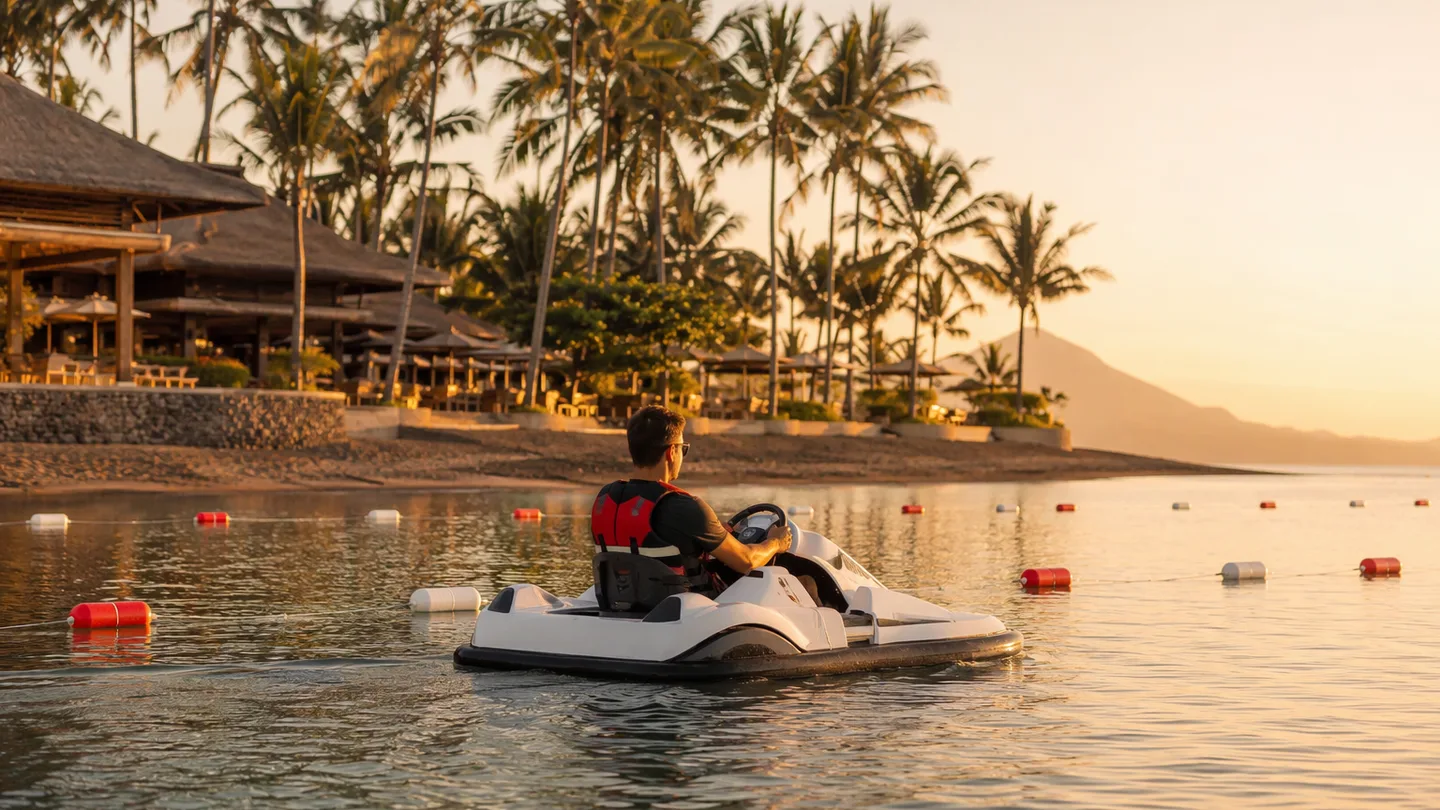
TL;DR: Indonesia closed 2025 with 15.39 million international visitors (+10.8%), Bali alone at 6,948,754 arrivals (+9.72%) — and Batam, the ferry island next to Singapore, at 1.61 million, which makes Indonesia a two-engine market, not a single-Bali story. The regulatory line that matters is refreshingly simple: Ships Law UU 17/2008, Article 15(1) sets a single 7-GT registration threshold — below it, small craft run on a Surat Pas Kecil (small-ship certificate) track without entering the national registry. A four-passenger electric kart boat sits far under that line by weight, and Indonesia has no amusement-ride decree at all — the lightest regulatory track this series has mapped. Import economics: ACFTA Form E takes the HS 8903 duty from 5% to zero, VAT (PPN) runs 11% with no expiry date, and tourism-business imports are exempt from the 20-75% luxury-goods surcharge (PPnBM) — a stability story rather than Vietnam's deadline story. And Bali adds a layer no other market in this series has: beaches owned by traditional villages (Desa Adat), whose consent is the real waterfront gatekeeper.
Where this guide sits in the series
Every market in our operator series has asked the investor to accept a premise. Greece asked you to read visitor-flow management as an equipment-upgrade signal; Portugal, to trust a mature market's composition; Croatia, to accept a statute that sorts the equipment itself; Turkey, to hold licence reform and a punishing currency in one spreadsheet; Kuwait, Qatar and Oman, to price the Gulf's zero-VAT tiers; Thailand, to work within gross-tonnage licensing; and Vietnam — our most recent guide — to move inside a five-passenger rule and a VAT window that expires 31 December 2026. Indonesia completes the pattern with the simplest axis of all: one 7-gross-tonnage line, no multi-tier licensing, no amusement-ride decree — and a waterfront permission system that runs on village consensus. This is the fifteenth guide, the third in Southeast Asia after the Thailand Phuket operator guide and the Vietnam operator guide, sitting alongside the Mediterranean cluster — the Greece, Portugal and Croatia guides, the Turkey guide and the Mediterranean fleet-planning pillar. Indonesia is not an EU market and not a decree market: the paperwork is thinner than Vietnam's, the tax math is steadier, and the binding constraint is cultural rather than regulatory — which is exactly why it deserves its own guide.
Why does the 7-GT line matter for kart boats?
One article does most of the regulatory work: Law No. 17/2008 on Shipping (UU Pelayaran), Article 15(1) — vessels of 7 gross tonnage (GT) or more must be registered in the national ship registry (registri kapal, valid four years and renewable); vessels below 7 GT stay outside the national registry entirely and run on the Surat Pas Kecil, a small-ship certificate issued under the implementing decrees (PP 18/2012 jo. PP 52/2018, and the transport-minister regulations behind them). We read the threshold against the statute text as cross-checked in Indonesian maritime-law literature from 2025, and the practical reading is straightforward: a four-passenger electric kart boat is far below the 7-GT line. It is a small craft by any measure the law uses.
Put the four Southeast Asian and Mediterranean readings side by side and the series' pattern completes:
| Thailand | Vietnam | Turkey | Indonesia |
|---|---|---|---|---|
Regulatory axis | Gross tonnage, multi-tier licensing | Passenger count (≤5) | Length (ADB 10/ADB 24) | 7 GT single line |
Where a 4-passenger kart boat lands | GRT entertainment-vessel track | Provincial registration, 3 working days | Inside ADB 10 | Surat Pas Kecil small-craft track |
Amusement-ride decree | Entertainment-vessel tax position | Decree 48/2019 exists | No dedicated decree | No dedicated decree at all |
That last row is the Indonesian difference, and we state it as the finding it is: we found no Indonesian equivalent of Vietnam's Decree 48/2019 — no amusement-ride decree, no mandatory national safety standard for water park equipment (the SNI 9042:2021 CHSE standard for tourism premises is voluntary), no dedicated inspectorate for recreational craft. Indonesia regulates ships, not rides. For a fleet buyer that cuts both ways, and we will say so honestly: the entry paperwork is the lightest in this series, and the safety architecture is whatever you build into your own operation — there is no national template doing the engineering review for you. Our electric-versus-gas comparison makes the design-for-supervision argument in every protected-water jurisdiction; in a no-decree market it is the whole safety case.
What is the market signal actually saying?
Indonesia is not a single-Bali story, and the demand data says so three times. Nationally, 2025 closed at 15.39 million international visitors (+10.8% over 2024's 13.89 million). Bali — the engine everyone knows — took 6,948,754 direct international arrivals (+9.72%), a figure our audit traced to BPS data via Antara, Indonesia's national news agency, and 2026 is holding that level: July alone logged 697,809, with roughly 4.7 million through Ngurah Rai airport in the first eight months. The second engine is the one the resort industry under-reads: Batam, the free-trade island forty minutes by ferry from Singapore, logged 1,613,202 international arrivals in 2025 — and in May 2026 Batam and Tanjung Uban together accounted for 88.37% of all sea-route arrivals into Indonesia. A kart-boat circuit serves two very different formats across those engines: a supervised lagoon session next to a Bali beach club, and a short, high-turnover shore-side attraction for ferry-day-trippers who never check into a hotel. The Kuwait operator guide makes the shore-excursion argument for cruise ports; Batam is the ferry equivalent at ten times the volume.
The source mix matters too. Malaysia led all sources in 2025 at ~2.64 million; China reached 1.34 million — a six-year high, up roughly 48% from 905,002 in 2024, now the fourth-largest source; Bali's own mix is Australian-led (over one million in the first eight months of 2026). A Chinese source market growing at that rate is the demand side of the Mandarin-crew argument we made in Vietnam — and Indonesia pairs it with the region's most developed family-entertainment pricing ladder: jet-ski sessions at Tanjung Benoa run Rp 250,000-300,000 for 15 minutes (about US$16-19), parasailing Rp 225,000-300,000, flyboard Rp 550,000-700,000 — while the island's flagship water park, Tripadvisor's 2025 global No.1 Waterbom Bali, prices a full day at IDR 495,000 (~US$33) for foreign visitors. Between a $17 quarter-hour and a $33 day sits exactly the gap a supervised, multi-passenger, twenty-minute kart-boat session is built to fill: mid-price, longer duration, family-per-head math.
Now the supply side, and it is the most consequential signal in the guide: from 2026, six Bali regencies have banned new hotel and restaurant construction, with industry forecasts (Colliers, via secondary reporting) pointing to only ~1,700 new rooms nationwide through 2029 and investment attention shifting to North Bali — which received a Rp 250 billion (~US$15 million) tourism investment package tied to the planned international airport there. The moratorium does not ban attractions; it bans accommodation supply in the south while pushing development north and offshore. An operator who holds an existing venue — a beach club, a water park, a hotel pond — can add a water attraction without touching the moratorium; an operator waiting for new southern supply will wait. That, plus the honest part: bumper boats exist in Indonesia as scattered single installations (Bintan Treasure Bay, Dusun Bambu in Bandung, venues in Depok and Jakarta) — social-tier [T3] evidence of a category with no documented scaled kart boat operation anywhere in the country, on the public-data basis this series uses. Nobody has built here yet, in a market where the paperwork is the lightest we have mapped.
One honest note, consistent with the whole series: no Indonesian inquiry has reached our inbox yet. Everything here is public-data inference, and we label it as such.
The licensing chain, end to end
For the boats: import on your own HS 8903 declaration (duty math below), then the small-craft certificate. Below 7 GT the Surat Pas Kecil track applies — documentation filed under the PP 18/2012 jo. PP 52/2018 implementing framework rather than the national registry. Indonesia's CR-equivalent conformity regime (SNI) does not include complete recreational craft in its mandatory list, so the technical file is your import and certification paperwork — CE documentation has no statutory route here either, and serves as supporting evidence in practice. We keep the "in practice" honesty we owe you: confirm the certificate path with a local agent before shipping.
For the business: licensing runs on Indonesia's OSS-RBA risk-based system — a Business Identification Number (NIB) plus activity licences keyed to KBLI codes. Water tourism sits under KBLI 93246/93297 and theme parks under 93210; large-scale water recreation is classified high-risk in the OSS matrix, and the 2025 tourism law update (UU 18/2025 with its implementing PP 28/2025) keeps tourism business at medium risk. We describe the framework at system level — we have not read each implementing circular, so we do not restate terms.
For the water itself — and this is Indonesia's genuinely different layer: in Bali, the beach is not state land in the way operators assume. Perda Bali No. 4/2019 (Padruwen Desa Adat) recognizes traditional villages' ownership of coastal assets: operating on a Bali beach means an agreement with the Desa Adat, compliance with village rules (pararem), and village fees — and in October 2025 the Badung regency was re-examining permit boundaries and coastal setbacks around Tanjung Benoa, the island's water-sports hub. Read that as friction, and read it as moat: the village consultation is a real cost on day one, and it is also the barrier that keeps the casual entrant out. An operator who arrives with a documented fleet, a safety plan and respect for the pararem process converts that layer into a defensible site. Outside Bali — Batam, Jakarta's bay, the lake districts — the jurisdiction is conventional provincial and municipal permitting.
For the riders: life jackets are operator practice across Bali's established water-sports zones, driver competence is operator-verified rather than licence-gated at kart-boat scale, and tourist accident insurance is industry practice rather than a statutory mandate — we present it as what good operators buy, not as a legal requirement, and flag the details for confirmation at contract time. The 5-horsepower licence line from Vietnam has no Indonesian equivalent we could find at this craft scale; the constraint that matters is the water-zoning layer above, not the engine below.
The import tax stack: zero duty, stable VAT, and a luxury-tax exemption
Vietnam's tax argument was a window with an expiry date. Indonesia's is the opposite — a stack with no clock in it, and one genuinely surprising exemption.
The layers, from the top: HS 8903 recreational craft carry a 5% MFN import duty under Indonesia's 2022 tariff schedule (BTKI; the customs office's own examples list 8903.20.90 at 5%). With a China Form E certificate of origin under ACFTA, that duty goes to zero — confirmed for headings 8903.20 and 8903.90 in the agreement's tariff finds; the 8903.30 heading's preferential rate we flag for confirmation against the live schedule at contract time, since heading classification between the motorboat and "other" lines is a classification call, not a given. VAT (PPN) runs at the standard effective 11% — Indonesia's statutory rate moved to 12% in 2025 under PMK 131/2024, but only for the luxury-goods band; the effective standard rate for ordinary goods remains 11%, and a small recreational craft is, on the luxury-goods list as published, not on it — that is a confirm-with item for your tax advisor, not a settled point. Import income tax (PPh 22) adds 2.5% for importers holding an API licence (7.5% without one), per the customs office's own calculator examples.
Stack the standard case: 0% duty + 11% PPN + 2.5% PPh 22 ≈ 13.5% over CIF with Form E, versus ~18.5% without it. And the layer that makes Indonesia unlike every other market in this series: the luxury-goods sales-tax regime (PPnBM, PMK 96/2021 jo. PMK 15/2023) lists yachts and cruise vessels at rates up to 75% — and imports or deliveries for tourism-business use (usaha pariwisata) are exempt, via an SKB exemption certificate. The headline number scares people; the exemption is the actual position for a park operator. We state it at system level: the exemption's application to fixed-site amusement equipment (versus the yachts the text names) is a confirmation item for the SKB process, not something we hard-claim. Against the series: Thailand prices the category at a 0% entertainment-vessel position, Vietnam offered 0% + 8% until 31 December 2026, the EU members carry 21-25% VAT — Indonesia is the market where the rate you sign this year is the rate you live with, and the yacht-class surcharge that looks terrifying on the tariff sheet does not apply to tourism operators. See our HS-code and duty guide for the layer-by-layer method and our price guide for how a landed-cost stack is built; run your own numbers before signing.
Foreign ownership: 100% allowed — and what it actually costs
Here Indonesia inverts the Vietnam comparison. Vietnam's travel-service licence regime caps foreign ownership and requires a JV partner; Indonesia's positive investment list (Perpres 10/2021 as amended by Perpres 49/2025, effective June 2025 — tourism and the creative economy sit in the priority fields) allows 100% foreign ownership in water tourism (KBLI 93246/93297) and theme parks (KBLI 93210). The cost is a PT PMA (foreign investment company) with an investment plan of at least IDR 10 billion (about US$650,000-700,000) — a committed plan value, not paid-in capital — plus the OSS licensing stack above. And the localization question every Indonesian equipment buyer asks: TKDN (local content) requirements do not bind private venue procurement — the mandatory scenarios are government procurement and sector-specific lists (telecoms, electronics), and the 2025 ministry regulation moved to loosen them further. For a private park importing a fleet, local content is a procurement consideration, not a gate. The structural advice mirrors our series: entity and licences are a day-one decision; the Indonesian version is lighter on ownership, heavier on capital-commitment paperwork.
Where the demand sits: Bali, Batam, and the season math
The season is the classic tropical split — dry April-October, wet November-March — with peaks in July-August and the Christmas-New Year window, and May, June and September as the sweet-spot months where weather and crowds both behave. Pair it across the series and Indonesia sits opposite the Gulf (the Kuwait guide's November-March season) as a natural two-venue year.
Siting-wise, we would rather enter through an existing venue partner than a greenfield beach: the 2026 moratorium makes south-Bali accommodation a constrained-asset market, Waterbom Bali's Tripadvisor reign has trained the island's visitors to pay for premium water experiences, and the Tanjung Benoa corridor already has the operator density, the safety practice and the Desa Adat relationships a new entrant can build on. That is a judgment call — Batam's ferry-daytripper volume (1.61 million arrivals, 88% of sea-route traffic) is the contrarian pick with almost no incumbent water-attraction competition and a Singapore price-payer base, and North Bali is the policy-favored frontier if the airport timeline holds. What the data does not support is treating Indonesia as one market: the 7-GT line is national, the Desa Adat layer is Balinese, and the demand is two engines. Cost-side anchors for the model: Bali's 2026 minimum wage is Rp 3,207,459/month (+7.04%, about US$190) — with Jakarta at Rp 5,729,876 — and our startup-cost guide plus the running-cost lines in the maintenance guide slot Indonesian wage levels straight into the stack.
Safety backdrop: maritime tightening, not amusement rules
Two 2025-2026 threads shape the safety conversation, and we place both precisely. First, a fatal jet-ski incident in January 2026 involving a foreign tourist happened in Sukabumi, West Java — not Bali — and put tourism safety back in the national press; the coverage is about operator responsibility across water sports, not about any amusement-ride enforcement wave. Second, Indonesia's recurring ferry and crossing accidents (Komodo route, the Bali crossing) are passenger-transport incidents — we cite them as the background to maritime-authority tightening on commercial vessels, not as amusement-ride precedent, and we would be overstating the enforcement climate to blur that line. The practical consequence for a kart-boat buyer: Indonesia's safety conversation is operator-side and reputational — the SNI voluntary standard, CHSE certification and village-level pararem rules are the visible frameworks — and a fleet that arrives with documented engineering, supervised session formats and visible life-jacket practice is positioned exactly where the conversation is heading. The electric fleet's quietness and low wake are the same argument our Croatia guide made in Natura 2000 waters, applied here to shared village beaches.
The honest gaps
Three gaps, stated as found. Charging infrastructure: zero pilots found — no marina or venue fast-charging programme surfaced for 2025-26 in Indonesia in multiple search rounds; plan charging as private infrastructure, the model our 15-boat venue ROI case is built on. The no-decree finding cuts both ways: the lightest entry paperwork in this series means the safety architecture is yours to build — no national template reviews your engineering, so the documentation discipline you would get from a Vietnamese inspectorate is a discipline you impose on yourself. The zero-scaled-operations finding is [T3]-floor evidence — scattered bumper-boat installations prove the category exists and nothing more; treat it as absence of documentation, not proof of absence. And one more, already stated: no Indonesian inquiry has reached our inbox yet.
FAQ
Do kart boat operators need a licence in Indonesia?
The vessel question turns on the 7-GT line in Law 17/2008, Article 15(1): below 7 gross tonnage a craft stays outside the national ship registry and runs on the Surat Pas Kecil small-ship certificate under the PP 18/2012 jo. PP 52/2018 framework — a four-passenger electric kart boat is far below the line. The business needs an NIB plus KBLI-keyed licences (93246/93297 water tourism, 93210 theme parks) through the OSS-RBA system, and in Bali, an agreement with the local Desa Adat whose customary rules (pararem) govern the beach. There is no national amusement-ride decree; confirm the certificate path and village terms locally before contracting.
What does importing a kart boat to Indonesia actually cost in duty and tax?
With a China Form E certificate of origin under ACFTA, the HS 8903 duty is 0% (from a 5% MFN base). VAT (PPN) adds the standard effective 11% — Indonesia's 12% statutory rate applies only to the luxury-goods band — and import income tax (PPh 22) adds 2.5% with an API import licence: roughly 13.5% over CIF in the standard case, versus ~18.5% without Form E. Tourism-business imports are exempt from the 20-75% yacht-class PPnBM surcharge via an SKB certificate; confirm the 8903 heading classification and the luxury-list position with your customs broker before contracting.
Can a foreign investor own a water park or boat rental business outright in Indonesia?
Yes — water tourism (KBLI 93246/93297) and theme parks (KBLI 93210) are open to 100% foreign ownership under the positive investment list (Perpres 10/2021 as amended by Perpres 49/2025). The requirement is a PT PMA with an investment plan of at least IDR 10 billion (~US$650,000-700,000) — a committed plan value rather than paid-in capital — plus the OSS-RBA licence stack. TKDN local-content rules do not bind private venue procurement.
How does Bali's Desa Adat system affect a beachfront water attraction?
Bali's beaches are recognized as traditional-village assets under Perda Bali No. 4/2019: operating means a written agreement with the Desa Adat, compliance with village rules (pararem), and village fees — and Badung regency was re-examining permit boundaries and setbacks around Tanjung Benoa in late 2025. Treat it as a real first-cost and a moat: the consultation layer deters casual entrants, and an operator who arrives with a documented fleet and a safety plan converts it into a defensible site. Outside Bali, conventional provincial and municipal permitting applies.
How does Indonesia's regulatory track compare with Thailand, Vietnam and Turkey?
By axis, as the series maps it: Thailand licenses entertainment vessels in gross-tonnage tiers; Turkey's 2026 reform sorts private vessels by length (ADB 10/24); Vietnam sorts water-based amusement rides by passenger count with a three-working-day provincial registration; Indonesia runs a single 7-GT registration line with no amusement-ride decree at all. A four-passenger kart boat clears all four by tonnage, length and seat count — Indonesia is simply the lightest of the four, with the trade-off that safety architecture is the operator's to build rather than the regulator's to impose.
How long does delivery to Indonesia take?
Six to nine weeks of production plus roughly three to four weeks of ocean transit to an Indonesian port (Belawan for Sumatra, Tanjung Priok/Jakarta for the west, Tanjung Perak/Surabaya for the east, with Bali typically fed via Surabaya transshipment), then customs clearance and the small-craft paperwork. Working back from a dry-season opening in April, order by late autumn; the ACFTA Form E certificate must be issued at the Chinese factory gate — get it right before the goods sail, not at Indonesian customs.
Data caveats
Tourism figures (15.39M national visitors in 2025, +10.8%; Bali 6,948,754 direct arrivals, +9.72%, traced to BPS via Antara and independently confirmed against Antara's published text; July 2026 single-month 697,809; ~4.7M through Ngurah Rai January-August 2026; Malaysia ~2.64M, China 1.34M/+48% from 905,002, fourth-largest source; Bali Australia-led with 1M+ in eight months) come from BPS-basis reporting via Kompas, Antara and Xinhua [T1/T2]; the BPS official pages were inaccessible at research time, so national-level figures rest on major-outlet transcription of BPS releases and are labeled accordingly. Batam's 1,613,202 (2025) and the May 2026 88.37% sea-route share come from BPS-basis trade and HR-industry reporting [T2]; the original BPS release was not retrieved, and the figure is presented at the precision the secondary source supports. Pricing anchors (Tanjung Benoa jet-ski Rp 250,000-300,000/15 min tandem basis, parasailing Rp 225,000-300,000, flyboard Rp 550,000-700,000) are operator-published rates [T3]; Waterbom Bali IDR 495,000 foreign-visitor day ticket and its 2025 Tripadvisor Best-of-the-Best No.1 ranking come from the operator's own pages [T2]. The regulatory spine — UU 17/2008 Article 15(1) 7-GT threshold and the Surat Pas Kecil track (PP 18/2012 jo. PP 52/2018), BTKI 2022 HS 8903 MFN 5%, ACFTA Form E zero duty for 8903.20/.90 (8903.30 flagged), PMK 131/2024 PPN 12%-luxury-only with effective 11% standard, PPh 22 at 2.5% with API, PMK 96/2021 jo. 15/2023 PPnBM exemption for usaha pariwisata, Perpres 10/2021 jo. 49/2025 100% foreign ownership in KBLI 93246/93297/93210 with the IDR 10 billion PT PMA plan threshold, Perda Bali 4/2019 Desa Adat padruwen, Badung's 2025 permit re-examination, SNI 9042:2021 voluntary status, TKDN non-application to private procurement — comes from the statute texts, the finance-ministry document server, customs-office examples, JETRO's tariff database and Indonesian law-firm commentary [T1/T2]; items flagged confirm-with in the text are stated there, not silently assumed. Wage figures (Bali Rp 3,207,459/+7.04%, Jakarta Rp 5,729,876) are 2026 UMP reporting via Databoks and legal publishers [T2]. The supply-side signals (2026 six-regency Bali construction moratorium, ~1,700-room Colliers forecast cited as industry projection, Rp 250 billion North Bali package) come from Jakarta Globe and Colliers-basis secondary reporting [T2]. The bumper-boat landscape (Bintan Treasure Bay, Dusun Bambu, Depok, Splash Waterpark Bali, Kids World Jakarta) is platform and venue-listing evidence [T3], stated as absence of documentation rather than proof of absence. The January 2026 Sukabumi jet-ski death (West Java, not Bali) and the ferry-incident background come from Jakarta Post and national press [T2], cited as maritime-operator context, not amusement-ride precedent. PEVS 2026 electric-water-equipment presence is social-tier evidence and is stated as exhibition-context only. We explicitly did not use: the unverified "Uluwatu Arena" project, the World Bank Bali infrastructure figure with unclear provenance, China-origin import-dominance claims without trade statistics, the Komodo and Bali-crossing death tolls as amusement-ride material, and any PPnBM headline rate without its tourism-use exemption. Nothing in this guide is legal, tax or investment advice; confirm licences, tax classifications, SKB applications and Desa Adat terms with Indonesian counsel before contracting.
Sources
- Kompas (retrieved 2026-11-06) — BPS-basis 2025: 15.39M international visitors (+10.8%); Malaysia ~2.64M leading
- Antara (retrieved 2026-11-06) — Bali 2025 direct arrivals 6,948,754 (+9.72%), BPS Bali basis; text independently verified
- BPS Bali press release (official page inaccessible at research time; figures via search transcription) — July 2026: 697,809; Ngurah Rai ~4.7M Jan-Aug 2026; Feb -1.97%, Mar +0.26%
- Antara / Xinhua (retrieved 2026-11-06) — China 1.34M in 2025, six-year high, +~48% from 905,002, fourth-largest source
- Bali Discovery (2026-09-24, retrieved 2026-11-06) — Indian arrivals to Bali -8.14% in first seven months of 2026 [T3]
- Databoks / pajakku / hukumonline (retrieved 2026-11-06) — UMP 2026: Jakarta Rp 5,729,876; Bali Rp 3,207,459 (+7.04%); Bali tourism-catering UMK Rp 3,267,693; Kepulauan Riau Rp 3,879,520
- Operator pages: blanjabali.com / balibestadventure.com / baliwatersport.net (retrieved 2026-11-06) — Tanjung Benoa jet-ski Rp 250,000-300,000/15 min (tandem basis); parasailing Rp 225,000-300,000; flyboard Rp 550,000-700,000
- Waterbom Bali / No.1 announcement (retrieved 2026-11-06) — IDR 495,000 foreign day ticket; Tripadvisor 2025 Best of the Best global No.1 water park
- Klook / Parkful / Famz Guide listings (retrieved 2026-11-06) — bumper boats at Bintan Treasure Bay, Dusun Bambu (Bandung), Depok venue, Splash Waterpark Bali, Kids World Jakarta [T3]
- Jakarta Globe (2025-12-30, retrieved 2026-11-06) — North Bali Rp 250bn (~US$15M) tourism investment package; Bali six-regency construction moratorium from 2026; Colliers ~1,700-room 2026-29 forecast (industry projection)
- BPS-basis reporting via humanresourcesonline.net (retrieved 2026-11-06) — Batam 1,613,202 international arrivals 2025; Batam+Tanjung Uban 88.37% of sea-route arrivals May 2026
- ILO NATLEX text of UU 17/2008 + Jurnal Selat 2(1) Unjani 2025 — Article 15(1) 7-GT registry threshold; Surat Pas Kecil small-craft track; PP 18/2012 jo. PP 52/2018 implementing framework
- Bea Cukai official examples (retrieved 2026-11-06) — BTKI 2022 HS 8903 MFN 5% (8903.20.90 example); PPh 22 2.5% with API / 7.5% without, per official calculator
- JETRO tariff database (retrieved 2026-11-06) — ACFTA Form E preferential 0% for HS 8903.20.00 and 8903.90.00
- pajak.go.id + PwC TaxFlash 02/2025 (retrieved 2026-11-06) — PMK 131/2024: PPN 12% from 2025-01-01, luxury band only from 2025-02-01; effective standard 11%
- PMK 96/PMK.03/2021 jo. PMK 15/PMK.03/2023 (retrieved 2026-11-06) — PPnBM luxury list (yachts/kapal pesiar 20-75%); usaha pariwisata exemption via SKB
- Indonesian law-firm commentary (jhlegal / mapagama / schinderlawfirm, retrieved 2026-11-06) — Perpres 10/2021 jo. Perpres 49/2025 (effective 2025-06-05): 100% foreign ownership KBLI 93246/93297/93210; PT PMA plan ≥IDR 10 billion; OSS-RBA risk framework; UU 18/2025 + PP 28/2025 tourism medium-risk; TKDN non-binding for private procurement, MOI 35/2025 loosening
- Badung BPKAD + Perda Bali No. 4/2019 (retrieved 2026-11-06) — Desa Adat coastal padruwen; pararem and village fees; Tanjung Benoa permit-boundary re-examination October 2025
- mastan.or.id + BSN (retrieved 2026-11-06) — SNI 9042:2021 CHSE voluntary certification; no mandatory amusement-ride decree found
- Jakarta Post (2026-01-07, retrieved 2026-11-06) — Sukabumi (West Java) jet-ski tourist death; tourism safety coverage
- bali.com / Intrepid (retrieved 2026-11-06) — dry season April-October; peaks July-August and Christmas-New Year; sweet-spot months May/June/September
Похожие статьи
Get a Quote for Your Kart Boat Business
Tell us what you need — OEM/ODM specs, quantity, target market. Our team replies within 24 hours.
Prefer a quick chat?
Chat on WhatsAppFree B2B resources
Buyer guides, ROI calculators, customs checklists, and case studies — built on direct factory manufacturing experience.