Kart Boats in Portugal: Operator Guide to Licensing & Costs
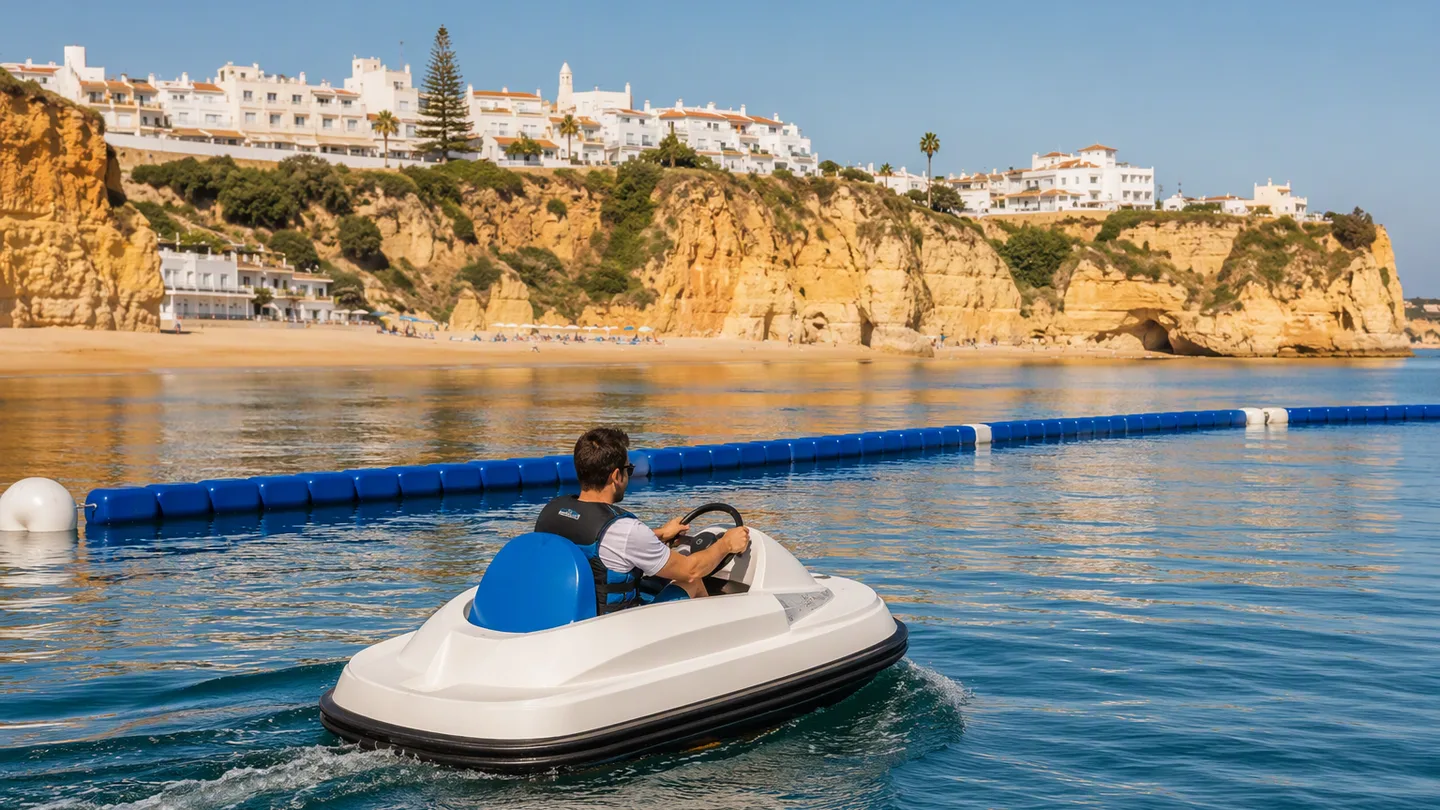
TL;DR: Portugal closed 2025 with a record tourism year approaching €30 billion in revenue, and the Algarve posted a record 5.3 million guests — with British travelers alone accounting for 57% of all UK overnight stays in Portugal. Licensing runs through Decreto-Lei 93/2018 and DGRM; the license-free operating band is narrower than Greece's (~15 hp industry threshold versus 30 hp), which raises the compliance bar slightly and thins the field of professional operators. Standard VAT is 23%, recoverable by a registered operator. In the Ria Formosa lagoon, electric tour boats are already a commercial category, not a concept.
Every frontier market in our operator series so far has required some act of imagination: NEOM's waterfront does not exist yet, Kuwait's maritime law is months old, Oman's Khareef season is a weather anomaly turned into an economy. Portugal requires none. It is the most thoroughly proven mass leisure market on our list — Western Europe's principal affordable-sun destination, drawing 5.3 million guests to the Algarve alone in 2025 — and the country closed 2025 with record tourism revenues of almost €30 billion, described as a historic year on Banco de Portugal travel-item data, against €28 billion in 2024 (the EU's fifth-largest foreign-tourist take). What makes Portugal strategically interesting for a kart boat operator is not the headline growth but the composition of the demand: an extraordinarily concentrated, repeat, high-frequency visitor base. The Algarve alone captures 57% of all British tourist overnight stays in Portugal, ahead of Madeira (18.8%) and Lisbon (12.7%), per Turismo de Portugal's TravelBI portal. British holidaymakers do not come for a once-in-a-lifetime excursion; they come every year, for one to two weeks, to the same resort strip — and a family that visits the same beach town annually is exactly the customer profile that books a self-driven boat session with the kids, then books it again next summer.
This guide covers the demand structure, the licensing chain under Decreto-Lei n.º 93/2018 and DGRM administration, landed cost inside EU customs territory with recoverable 23% VAT, and where a kart boat circuit fits — including one lagoon where electric commercial operation is already proven, not promised.
Why does Portugal suit electric kart boats?
Three structural facts, in ascending order of importance.
First, scale. Portugal's tourism economy closed 2025 with record revenues of almost €30 billion — a historic year on Banco de Portugal travel-item data as reported by Portugal Resident — against €28 billion in 2024, with the hotel sector recording 82 million overnight stays (+3%) and 33 million guests (+2%), per INE figures. The Algarve closed its own record year with 5.3 million guests, 21 million overnight stays and €1.8 billion in revenue, an all-time high per the region's March 2026 reporting. This is not a frontier market being built; it is a mature machine running at full utilization.
Second, the visitor mix. The Algarve's foreign demand is dominated by the United Kingdom — not as a growth vector but as a base load. British travelers made roughly 2.46 million trips and 10.2 million overnight stays in Portugal (2024, the latest TravelBI market breakdown), and 57% of those nights were spent in the Algarve. The 2025 season added a fast-growing American segment on top, with higher spend and longer stays. Base-load demand is the single most underrated variable in attraction economics: jet ski operators can price per adrenaline-minute into a one-time crowd, but a repeat family audience rewards operators who build session products — timed laps, family pricing per boat, a reason to come back next August. A kart boat circuit is a session product.
Third — and this is the fact most guides miss — Portugal is already running a commercial electric boat market in its most protected waters. In the Ria Formosa natural park, the 18,000-hectare barrier-island lagoon behind Faro and Olhão that holds dual Natura 2000 and Ramsar designation, electric "eco boat tours" are an established retail category: operators run silent electric launches into the lagoon daily, with sunset tours advertised from around €15 per person. Nobody subsidized this into existence. Operators chose electric because it is quiet, emission-free, shallow-water friendly and sells — in a protected lagoon, to a nature-tourism audience. For a kart boat supplier, that is commercial proof, not advocacy: the lowest-impact propulsion available has already been validated as a product in Portugal's most environmentally sensitive venue, and an electric kart boat fleet is a defensible extension of a proven category.
The regulatory direction adds a tailwind rather than a mandate. Lisbon now charges the country's highest municipal tourist tax at €4 per night, plus a €2 per-cruise-passenger disembarkation fee, and Portuguese authorities have announced restrictions on peak-season cruise arrivals — reported in late 2025, with mechanics still being defined. Roughly forty municipalities nationwide now levy tourist taxes. None of this rations visitors the way Santorini's 8,000-per-day cruise cap does — yet. The direction of travel, though, is the same one we documented in Greece: tax headcount, manage arrivals, and reward per-visitor yield. Operators who install higher-value, lower-impact session products ahead of that curve buy their position at today's prices.
What is the market signal actually saying?
Portugal's signal is quieter than Greece's cap-and-tax headlines, and in one respect more useful.
The volume signal is a mature-market compounding story: record revenue, record Algarve guests, best-ever shoulder-season months. The management signal is early-stage — tourist taxes spreading across forty municipalities, a cruise disembarkation fee in Lisbon, reported peak-season cruise restrictions under definition. And the demand-quality signal is the one we weight highest: a 57% national concentration of the UK's most reliable sun-seeking cohort, now plus a rising American segment. Volume tells you a market exists; composition tells you what it will pay for. Portugal's composition favors family session products over adrenaline minutes — which is precisely the product line a kart boat fleet occupies.
One honest note on demand evidence, consistent with how we opened the Greece guide: no Portuguese inquiry has reached our inbox yet. The Kuwait buyer journey remains our only first-hand case in this series. Everything here is built from public data and platform pricing, and the inference — strong as we think it is — should be read as inference.
How does licensing work?
Portugal's recreational boating framework is Decreto-Lei n.º 93/2018 of 13 November, the Regime Jurídico da Náutica de Recreio, administered by DGRM (Direção-Geral de Recursos Naturais, Segurança e Serviços Marítimos), with the Autoridade Marítima Nacional and the local Capitanias enforcing on the water. The law classifies recreational craft by navigation area — ocean, offshore, coastal, sheltered — and sets the license ladder on top: the full Carta de Navegador de Recreio (after examination, from age 18) covers boats up to 12 meters; the Patrão Local and limited-license tiers cover shorter craft operating near the coast and in sheltered waters. Operating without a required license carries fines in the €250–2,500 range.
Here is the commercially decisive nuance, and it is the mirror image of our Greece operator guide. Greek practice treats motorboats up to 30 hp as license-free — our 15 kW (~20 hp) kart boats slide inside that band, and the customer base becomes "everyone." Portuguese rental-platform practice draws the license-free line much lower — around 15 hp for small motorboats — and the major Algarve hire fleets state plainly that self-drive ("bareboat") requires a license, with every boat also available with a skipper. We state this as an industry threshold, not a statute citation: we have not read the exemption instrument in the Diário da República, so treat "confirm with DGRM and your local Capitania" as a real task. But the practical consequence is clear: a kart boat venue in Portugal should be planned as a licensed-operator business — either the fleet runs with skippers, or the operating principal holds a Portuguese license tier appropriate to the craft and area. That is a cost line Greece does not have.
We would argue it is also a moat. A market where any tourist can take the wheel has many casual operators; a market that requires a licensed hand on the helm has fewer, more professional ones, and pricing discipline holds better. In Portugal, the compliance chain — company formation, DGRM vessel registration, licensed skippers or principal, Capitania alignment on the operating zone — filters out the improvised competition before the season starts. The §€250–2,500 fines are the least of it; the real filter is that running a compliant fleet takes preparation your weekend competitor will not do.
For the guests themselves, the experience is unchanged: the family boards, the session runs, no customer license is needed because the operation carries the license — the same customer-side simplicity as every market in this series.
What does landed cost look like?
Portugal is EU customs territory, so the import math matches our Greece guide's structure. Recreational craft clear under the EU Common Customs Tariff with no national import-permit layer; the HS classification question we cover in our duty and HS-code guide (8903.99 versus 9508.29) sets the duty line — low single digits either way. The significant number is VAT: the Portuguese standard rate is 23%, applied at import, and a VAT-registered operating business generally recovers it as input tax — cash-flow, not permanent cost. (Some tourism services sit in the 13% reduced band; whether any part of a water-sports operation touches reduced rates is a question for your accountant, and we do not assert it either way.)
The compliance cost is front-loaded on our side of the container: CE marking under the Recreational Craft Directive 2013/53/EU is the legal entry ticket to the EU market, and our production line ships the CE documentation chain — declaration of conformity, builder's plate, owner's manual — as standard, exactly as for Greece. Lithium consignments travel with UN38.3 documentation; radio-equipped options carry the additional radio-equipment certification.
Portugal-specific logistics are, frankly, the easiest in this series. Leixões and Lisbon serve the north and center; for the Algarve, Portimão and the Spanish border port of Huelva-Vilareal handle feeder traffic, but the honest planning answer is that most Algarve operators truck from Lisbon or Spanish entry ports — a two-to-four-hour highway leg on EU-internal roads, no transshipment, no island congestion, no August berth lottery. The island-logistics surcharge we flagged for Greece simply does not exist here. Set-up friction is bureaucratic rather than physical: DGRM registration and licensing lead times belong in your project plan, and they are measured in weeks, not days.
Where should you operate?
The Algarve is the market; the question is which water. Our view, having now priced this series across nine markets: the central Algarve's headline beaches — Vilamoura, Albufeira — have the traffic but also the jet ski clusters, and jet ski pricing there runs €75–80 per 30 minutes from Vilamoura marina with a cheaper €32–37 closed-circuit tier in Albufeira. That is a functioning adrenaline price ladder, not a vacuum. The fit we see is in two adjacent waters.
The first is the Ria Formosa lagoon itself — the Faro–Olhão water behind the barrier islands. The operator base there already runs electric tours commercially; what the lagoon lacks is a session product: timed family circuits in a flat, sheltered, no-swell environment, sold from the same jetties the eco tours depart from. Sheltered water is operationally cheaper — no sea-state cancellations, longer effective seasons on any given day's schedule, lower maintenance on hulls and drives — and an electric fleet is the only propulsion profile that matches the venue's Natura 2000/Ramsar identity rather than fighting it. This is the same reserve-adjoining logic we built the Oman guide on, except that in Ria Formosa the electric-boat business model is already on the price list, which shortens the operator's proof burden to zero.
The second is the western and mid-Algarve family beaches — Lagos, Portimão's opposite shore, the Tavira fringe — where the audience is the repeat British family base load rather than marina adrenaline traffic, session pricing can anchor against the €32–80 jet ski ladder rather than compete with it, and municipal beach-concession processes are the main gate to clear. One operational note we would underline after watching this series' markets: Portuguese beach concessions (are as de areia) are municipal and seasonal, and the concession calendar runs on the municipality's rhythm, not yours — start that conversation before you order hardware, not after.
Session economics | Jet ski rental (Vilamoura/Albufeira) | Kart boat circuit (proposed) |
|---|---|---|
Pricing unit | Per rider, per 20–30 minutes | Per boat (2–4 riders), per 20–30 minutes |
2025 observed pricing | €75–80 / 30 min Vilamoura; €32–37 Albufeira entry tier | Set by operator against family budgets, anchored below jet ski-per-minute rates |
Customer license | None (operator-led sessions) | None — operation carries the license, not the customer |
Audience | Solo riders, thrill-seekers | Repeat family base load, resort guests |
Session length | 20–30 minutes | 20–30 minutes, repeatable within a day pass |
Lisbon deserves one sentence: it is a day-trip urban market with the country's highest tourist tax and a cruise fee, and its water is ocean-exposed — a candidate for a second venue, not the first.
How do season and delivery timing work?
The Algarve season runs broadly April through October — longer than the Greek islands' May–October, thanks to the southern latitude and the golf-and-city shoulder trade — peaking July–August. Payback planning on a 140–160 operating-day season is realistic, against the 120–140 days we budget for Aegean venues; the framework is the one in our 15-boat ROI case study. Production runs six to nine weeks and ocean transit to Iberian ports roughly three to four, so the working order deadline for an April soft opening is late autumn to mid-winter — earlier than the Greek deadline, bought back by an easier logistics leg.
And the two-venue arithmetic still applies: an Algarve summer (April–October) pairs with a GCC winter (November–March) exactly as the Greek season does, with the bonus that Portugal's shoulder months (April, May, October) are genuinely revenue-producing rather than marginal — the fleet earns in more months of the year here than on most Aegean islands.
What should you check before ordering?
Our standing sourcing checklist applies unchanged: verify the specification sheet against the quote, inspect before shipment (our pre-shipment inspection guide covers the third-party workflow), confirm spares and documentation in the contract (MOQ and lead-time guide). For Portugal add three: confirm the license treatment for your specific craft and operating area with DGRM and the local Capitania in writing — the ~15 hp industry threshold is platform practice, and your venue's answer is whatever your Capitania says it is; confirm your beach or lagoon concession with the municipality before ordering, because the concession calendar does not follow your procurement schedule; and if you are positioning into Ria Formosa, talk to the park authority (ICNF) and the established eco-tour operators early — in a protected lagoon, the incumbent electric operators are potential partners and the surest source of what the venue will actually permit.
FAQ
Do I need a license to run kart boat rentals in Portugal?
The business needs one even though the customers do not. Under Decreto-Lei 93/2018 and the license-free band as practiced by Portuguese rental platforms (around 15 hp for small motorboats), a 15 kW (~20 hp) kart boat is planned as a licensed operation — skippers on board or a licensed operating principal, registered with DGRM, aligned with the local Capitania. Guests need no personal license because the operation carries it. This is the main structural difference from our Greece guide, where the 30 hp industry threshold puts the same craft in the license-free band.
How much tourist tax and VAT does a Portugal operation carry?
Indirect taxes first: the standard VAT rate is 23%, applied on the imported fleet and generally recoverable as input tax by a registered operator. Municipal tourist taxes (€1–4 per night, Lisbon at €4 plus a €2 cruise fee) are paid by overnight visitors, not by operators, but they are a demand-side cost to watch as the forty-municipality network spreads. None of it is a fleet-level tax like Greece's island surcharges — Portugal's tourist taxes stay modest compared with the per-head cruise taxes reshaping Greek island economics.
Is Ria Formosa open to commercial kart boat circuits?
The lagoon already hosts commercial electric tour operators, which proves the venue accepts motorized eco-tourism; whether a timed kart boat circuit is permitted in a specific zone is a question for the park authority (ICNF) and the Capitania de Faro, and we have not read a zone map that answers it. We flag this as the venue's single biggest open question — and the reason the incumbent eco-operators should be your first phone call.
Is electric propulsion required or subsidized in Portugal?
Neither, currently. No Portuguese subsidy program for electric recreational craft surfaced in our research. The alignment is market-led: Ria Formosa's operators chose electric because the product sells in a protected lagoon. Buy electric there because the venue rewards it; elsewhere in the Algarve, buy it for the operating economics and the regulatory direction the whole EU is drifting in.
How long does delivery to Portugal take?
Six to nine weeks of production plus roughly three to four weeks of ocean transit to Iberian ports, then a short EU-internal truck leg to the Algarve — no transshipment risk, no August berth congestion. Working back from an April soft opening, order by late autumn or mid-winter.
Can one fleet serve both Portugal and a Gulf venue?
Yes, and Portugal strengthens the case: an April–October Algarve season plus a November–March Gulf season leaves fewer dark months than almost any other pairing in this series, and the EU logistics leg is the simplest we have covered. The fleet is one asset base with two long seasons and a short, road-served repositioning.
Data caveats
Tourism revenue ("almost €30 billion" for 2025, a historic year) is Banco de Portugal travel-item data as reported by Portugal Resident; the 2024 comparison (€28 billion, EU fifth) comes from The Portugal News citing official balances. Overnight stays (82 million) and guest counts (33 million) are INE figures as reported in sector press in early 2026; we have not pulled the primary INE series. Algarve figures (5.3 million guests, 21 million overnight stays, €1.8 billion revenue) come from Portugal Resident's March 2026 regional reporting. The 57% UK overnight-share, the Madeira/Lisbon comparison (18.8%/12.7%) and the 2024 UK volumes (2.46 million guests, 10.2 million overnight stays) come from Turismo de Portugal's TravelBI "Markets: United Kingdom" portal. The ~15 hp license-free threshold is rental-platform practice, not a statute we have read; Decreto-Lei 93/2018 is described from legal summaries and the Diário da República listing, without article-level citations. Jet ski prices are operator-listing and booking-platform data from the 2025 season and move with demand. The reported peak-season cruise restrictions are announced policy direction with mechanics still undefined — no numbers asserted. Ria Formosa's Natura 2000 and Ramsar status is public designation; per-zone motor rules were not verified against an official zoning instrument. Nothing in this guide is legal or tax advice; confirm licensing, concessions and tax treatment for your specific venue with Portuguese counsel and the competent authorities.
Sources
- Portugal Resident (Dec 31, 2025) — 2025 closes with record tourism revenues of almost €30 billion, a "historic year" (Banco de Portugal travel-item basis) (retrieved 2026-10-04)
- Portugal Resident (Mar 4, 2026) — Algarve 2025: 5.3 million guests, 21 million overnight stays, €1.8 billion revenue, all-time high (retrieved 2026-10-04)
- The Portugal News — Portugal fifth-largest EU country in foreign-tourist revenue at €28 billion in 2024 (Jan 19, 2026; site blocks automated fetch — figure verified via search index) (retrieved 2026-10-04)
- TravelBI, Turismo de Portugal — Markets: United Kingdom — Algarve 57.0% of UK overnight stays, Madeira 18.8%, Lisboa 12.7%; UK 2024: 2.46M guests, 10.2M overnight stays (retrieved 2026-10-04)
- Travel and Tour World — Portugal peak-season cruise arrival restrictions reported December 2025 (retrieved 2026-10-04)
- Diário da República — Decreto-Lei n.º 93/2018 — Regime Jurídico da Náutica de Recreio, 13 November 2018 (retrieved 2026-10-04)
- DGRM — náutica de recreio licensing and exemptions — license tiers, exemption/equivalence procedure (retrieved 2026-10-04)
- SeaRadar / Click&Boat / GetMyboat / Algarve Boat Rental — ~15 hp license-free practice, bareboat license requirement, skipper option, €250–2,500 fines (retrieved 2026-10-04)
- SeaBookings / GetYourTicket / Viator — Vilamoura jet ski €75–80 per 30 min, €150 per hour; Albufeira €32–37 entry tier, 2025 season (retrieved 2026-10-04)
- Tours in Algarve / CheckYeti — Ria Formosa electric eco boat tours, sunset tours from ~€15 (retrieved 2026-10-04)
- PwC Worldwide Tax Summaries — Portugal VAT 23% standard, 13%/6% reduced bands (retrieved 2026-10-04)
Get a Quote for Your Kart Boat Business
Tell us what you need — OEM/ODM specs, quantity, target market. Our team replies within 24 hours.
Prefer a quick chat?
Chat on WhatsAppFree B2B resources
Buyer guides, ROI calculators, customs checklists, and case studies — built on direct factory manufacturing experience.