How Much Does a Kart Boat Business Cost? 2026 Costs & Timeline
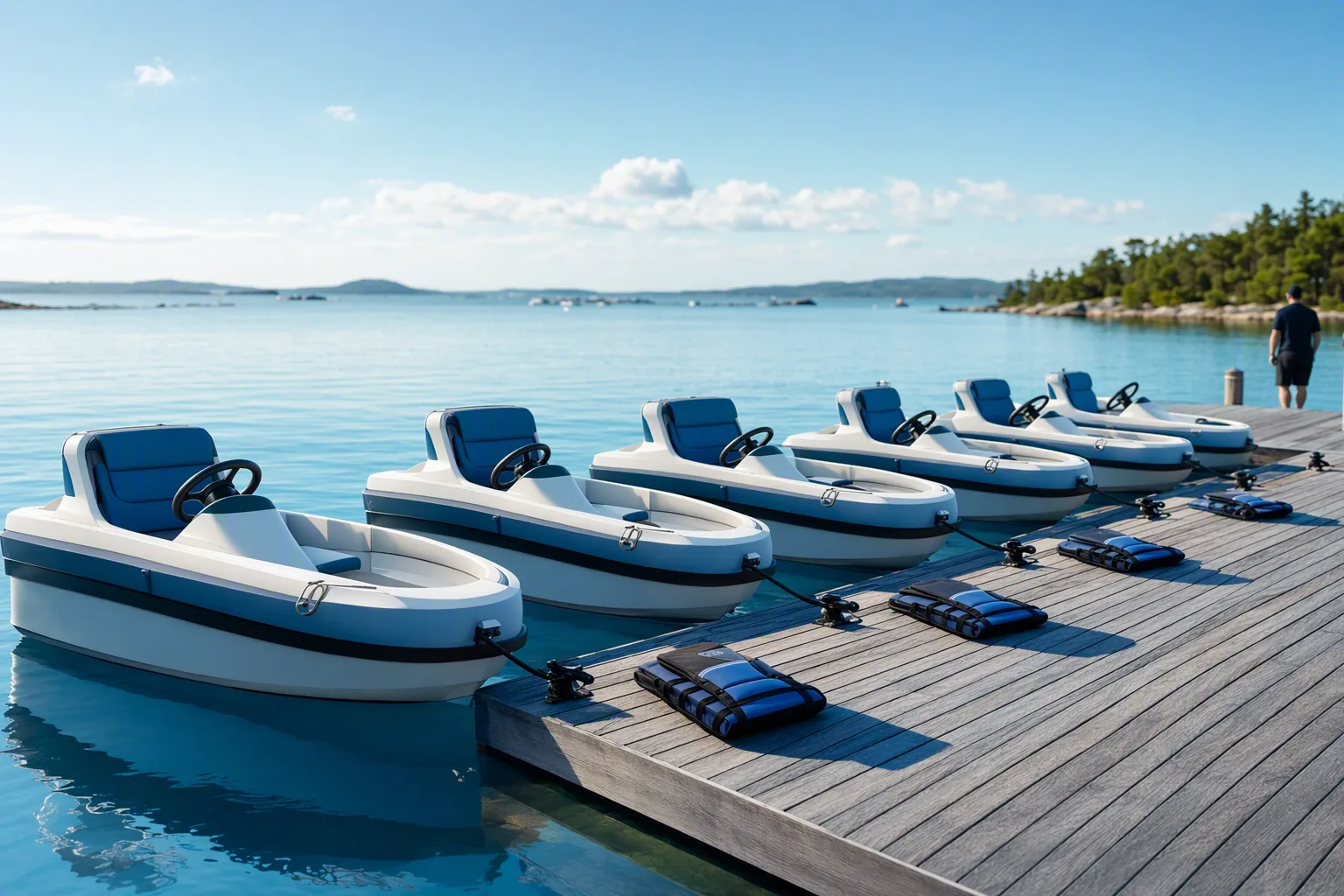
A small kart boat fleet on existing water can open in roughly three months for a five-figure budget; a built-from-scratch pool venue is a six-figure, one-to-two-season project. The equipment is rarely what decides either number — the pool, the permits, and the calendar are.
This guide gives you both halves of the startup decision: how much (a five-line cost stack you can take to a bank or a business partner) and how long (a week-by-week timeline from deposit to first paying rider, which most guides skip entirely). It complements our bumper boat rental business guide, which covers business models and day-to-day operations in depth — that article answers "should I do this"; this one answers "what will it cost me and when can I open."
TL;DR — 5 Quick Answers
- What's the equipment budget? A 5–6 boat starter fleet lands between roughly $16,000 and $62,000 delivered — 2026 B2B factory prices of $2,400–$6,900 per unit plus 30–50% in freight, duties, and compliance.- What's the critical path? The pool, not the boats, for a built venue: budget 3–4 weeks for permitting and 6–10 weeks of construction even before commercial-grade requirements stretch the number.- How fast can I open? 8–13 weeks on existing water, 4–9 months for a constructed pool — and longer in Indonesia or Brazil, where battery certification alone takes 8–16 weeks.- What's the cheapest line item? Staff training: an American Red Cross lifeguarding course is about 27–28 hours, typically completed in 3–5 days.- What delays openings most? UN38.3 battery transport documentation — mandatory for every shipment, and a missing certificate is the single most common self-inflicted delay we see.
How Much Do You Need? Three Startup Tiers
Most operators fit one of three profiles: a five-boat trial on water you already control, a purpose-built pool venue, or a resort partnership. The table below is the whole answer in one view. The ranges are planning-stage orders of magnitude, not bids — your site, your country's duty schedule, and your fleet size move every line.
Tier | Fleet | Typical venue | Equipment delivered (est.) | Dominant soft cost | Total budget shape | Fastest opening |
|---|---|---|---|---|---|---|
Trial | 5–6 boats | Existing pool, FEC, or leased waterfront | ~$16,000–$62,000 | Marketing + staffing (low five figures) | Low-to-mid five figures | ~8–13 weeks |
Standard pool | 15–20 boats | Constructed pool or large leased site | ~$47,000–$207,000 | Pool construction (six figures) | Mid-to-high six figures (when building) | 4–9 months |
Resort integration | 8–15 boats + battery-swap | Resort or scenic-area partnership | Fleet + charging/swapping system | Environmental review + integration | Often partner-funded / revenue-share | Case-specific, 6–12 months |
Data caveat: The equipment cells are arithmetic on the 2026 B2B price band ($2,400–$6,900 per unit factory-direct, single-seat electric kart boats) plus the 30–50% landed-cost adder from our 2026 kart boat price guide. Soft-cost shapes come from family-entertainment-center industry planning ranges, not kart-boat-specific quotes. Treat the "total budget" column as a shape, not a number — get three DDP quotes before you commit to anything.
One honest boundary before the breakdown: if the total is under roughly $40K and you don't already control suitable water, don't force it. Below that line the lease-or-access question, the safety equipment, and the first-season battery reserve can't all fit, and the operation starts its life undercapitalized — which is how attractions end up listed for sale mid-season. The trial tier works because it borrows water and infrastructure that already exist, not because the boats got cheaper.
What Does It Actually Cost? The Five-Line Startup Stack
1. Equipment — the part you can actually price today
Factory-direct single-seat electric kart boats listed between $2,400 and $6,900 USD on B2B platforms in mid-2026, with branded retail models between $3,500 and $6,600. The full breakdown — including why the same physical boat has been observed quoted 5.5× apart across platforms — is in our 2026 price guide.
Landed cost adds freight, duties, and compliance. Budget 30–50% above factory price depending on destination:
Cost item | Typical range | Note |
|---|---|---|
Ocean freight (2–3 CBM per boat) | $700–$1,500 per boat | Container-sharing lowers this at volume |
Destination duties + VAT | Region-dependent | From ~+6% (Malaysia) to +50–86% (Brazil) |
Compliance & clearing fees | Varies | UN38.3 docs, broker, customs bond |
The regional spread is wide. Malaysia adds roughly 6% on top of factory price (0% duty under ACFTA); the UAE around 21%; the US roughly 30–40% including Section 301 tariffs on Chinese-origin goods; Brazil up to 50–86% before certification costs. The full per-country table is in our global procurement guide.
Two purchase rules that protect both your budget and your schedule:
- Get a DDP (delivered, duties paid) quote so you're comparing one number, not five.
- Confirm the battery is included and UN38.3-certified in writing. A headline price that excludes batteries is the oldest gap in this category.
2. Venue and water — the part that decides everything else
Three venue models, in ascending order of cost and calendar:
Venue model | What you pay | What it does to your timeline |
|---|---|---|
FEC add-on | Low five figures of incremental infrastructure (docking, fencing, signage) | Nearly nothing — your critical path becomes the equipment |
Leased waterfront | Lease + dock + minimal buildout, low-to-mid five figures | Short; mainly local permits |
Constructed pool | Mid-to-high six figures (pool, filtration, fencing, dock), region- and site-dependent | Dominates the calendar — see the timeline section |
Sizing, if you build or section off water: compact references put 12 m × 6 m at 50–60 cm depth for 6–7 small boats; manufacturer design guidance runs larger (one bumper-boat specialist specifies 36 in / 0.91 m water depth for its 1.82 m hull; an Italian ride designer's pool guide points to 16 × 18 m and up for 6–8 boats). Scale depth and footprint to your specific hull, and confirm with a contractor — the residential fiberglass-pool timelines below understate commercial projects.
3. Staffing and training — cheap, fast, and commonly over-planned
A lean 6-boat operation runs with 1–2 attendants per 6–8 boats during peak hours; a 15–20 boat facility adds a manager, with monthly payroll in the mid-four-to-low-five-figure range (US hospitality-rate planning guidance — local wages will move this).
The training line is smaller than most new operators assume. The American Red Cross lifeguarding course is 27 hours 25 minutes of instructor-led training (a similar total in blended learning format), typically scheduled over 3–5 days, with a minimum age of 15 and a certification valid 2 years. One certified lifeguard covers the supervision requirement for many jurisdictions; confirm your local rule before hiring, because some states and insurers impose their own ratio requirements for water attractions.
Data caveat: Course length per redcross.org (accessed 2026-09-07). Whether a certified lifeguard is required — versus a trained attendant — is jurisdiction-specific. This article is not legal advice.
4. Permits, certification, and insurance — where the calendar hides
Money-wise, this line is moderate. Time-wise, it's the most underestimated item on the stack.
Item | Typical cost shape | Typical duration |
|---|---|---|
Business license + water operating permit (US) | Hundreds to ~$2,000 | 4–12 weeks |
General liability $1M–$2M with inland-marine rider | Low single-digit $K/year | Quoted in days once site details are fixed |
Indonesia SNI (lithium battery) | Certification fees + local partner | 8–12 weeks, local entity required |
Brazil INMETRO (lithium battery) | Certification fees | 8–16 weeks |
Saudi SASO Saber | PCoC + SCoC per shipment | Per-shipment cycle |
UN38.3 transport cert | Usually held by manufacturer | Must exist before shipping — see the delay list below |
The asymmetry is the point: insurance quotes take days, but battery certification in Indonesia or Brazil runs months and gates your import. If those markets are on your roadmap, start certification conversations at signing, not at vessel booking.
Data caveat: Certification durations from our compliance wiki, cross-checked against manufacturer certification records; permit lead times are US planning guidance. Requirements shift — verify with the destination authority or a broker. Not legal advice.
5. Launch marketing — small but non-zero
$1,000–$5,000 one-time covers LLC/company setup, signage, a landing page, and opening promotions in most markets. On-site attraction marketing is dominated by signage and partnerships rather than digital ads — the full channel breakdown is in our rental business guide.
The line most first budgets are missing: a battery-and-spares reserve. If a startup budget doesn't carry one, I'd send it back for rework — plan a reserve in the low-to-mid teens as a percentage of equipment value for year one, because batteries are the fleet's main consumable and cross-border parts are the category's most common post-purchase pain. A budget that treats the fleet as buy-once is a budget with a hole in season two.
How Long Until Opening Day? From Deposit to First Paying Rider
This is the half most guides skip. Here is what actually happens, week by week, assuming a China-sourced electric fleet. The scenarios differ in one structural way: on existing water, equipment procurement is the critical path; on a constructed pool, the pool is.
Scenario A: Existing water (FEC add-on or leased waterfront) — ~8–13 weeks
Weeks | Track 1: Equipment | Track 2: Site & people |
|---|---|---|
0 | Sign, deposit, freeze spec & battery config | Permit applications filed; insurance quotes start |
1–6 | Production (commonly 30–45 days) | Permits processing (4–12 wks); hire and schedule lifeguard training (3–5 days) |
7–8 | Packing 3–7 days, then vessel loads | Docking, fencing, signage installed |
8–13 | Ocean transit + customs clearance | Staff certified; opening checklist |
12–13 | Delivery, install, commissioning | Soft opening |
Regional transit refills the top of that funnel: about 15–20 days port-to-port to the US West Coast (East Coast and Gulf ports run longer), 25–45 days to the US East Coast or Europe, and 12–18 days on direct China–UAE services — with indirect Gulf routings running closer to a month (forwarder-published schedules: Dimerco, Basenton, SeaRates, 2026). Production and freight together put most fleets at 6–12 weeks door-to-door from deposit — the schedule above adds commissioning on top.
Scenario B: Constructed pool — ~4–9 months
The pool moves to the critical path, and the equipment runs in parallel:
- Weeks 0–4: Design freeze and permitting. Residential fiberglass-pool benchmarks run 1–10 weeks for permitting depending on jurisdiction, and 2–4 weeks of installation once work starts (the shell itself sets in about 3 days under ideal conditions); commercial water-attraction permits and larger footprints stretch both numbers.
- Weeks 2–10: Construction while the fleet is produced and shipped (parallel, no added weeks if ordered at signing).
- Weeks 10–16: Filtration commissioning, safety systems, final inspections.
- Weeks 14–20+: Boat delivery, install, staff certification, soft opening.
That lands a built venue at roughly 4–6 months in a favorable jurisdiction and 6–9 in a slow one — which is why the standard advice is to sign pool contracts one full season before you want revenue. The constructed-pool budget is also the scenario where the six-figure venue line, not the boats, is most of the check.
Scenario C: Resort or scenic-area integration — 6–12 months, review-gated
Resort projects trade construction risk for review risk. In the Maldives, for example, works at existing resorts can require an Environmental Impact Assessment decision statement, and the boundary between "operational change" and "development requiring EIA" is case-specific. Our Maldives resort guide walks the full site-assessment and no-engineer staffing model; the timeline driver there is regulatory, not procurement.
The certification tail: Indonesia and Brazil
Both markets add a two-to-four-month certification tail in front of everything above: SNI for lithium batteries in Indonesia (8–12 weeks, local entity required) and INMETRO in Brazil (8–16 weeks). If either market is on your roadmap, the certification clock starts at signing — it cannot start at vessel booking, because the certificate must exist before the batteries ship.
What Actually Delays Openings
After walking buyers through this sequence, the same four delays account for most slipped openings — and here's the counterintuitive summary: the boats are almost never the delay; the paperwork is. Production runs to a factory calendar you can verify on a video call. Documents run to bureaucracies nobody can.
- Missing UN38.3 battery transport documentation. It is mandatory for every lithium-battery shipment (Class 9 dangerous goods), some freight forwarders refuse the cargo without it, and re-papering mid-shipment costs weeks. Our UN38.3 and CE/FCC compliance guide lists the full document set.
- HS classification drift at customs. Electric kart boats sit between HS 8903 (recreational craft) and 9508 (amusement equipment), and the classification changes both duty and, in some markets, whether a consumption tax applies. File for a binding ruling before the first shipment — our questions-to-ask-manufacturer checklist includes the documentation items to demand up front.
- Ordering boats for "opening season" instead of backwards from it. Production plus freight is 6–12 weeks; add commissioning and any certification tail. If you want boats in water by June in a northern market, the deposit is due in February at the latest.
- Treating the pool as a line item instead of the critical path. A 15-boat fleet on a pool that isn't ready is capital sitting in crates. Sequence pool permits first, boats second, in every built-venue project.
FAQ: Kart Boat Startup Costs and Timelines
How much does it cost to start a small kart boat business?
For a 5–6 boat trial fleet on water you already control: roughly $16,000–$62,000 in delivered equipment plus low five figures of soft costs (permits, insurance, staffing, marketing) — a low-to-mid five-figure total. The equipment math: 5 units at the band floor with a 30% adder gives ~$15,600 at the low end; 6 units at the band top with a 50% adder gives ~$62,000 at the high end.
How long until a kart boat business opens?
8–13 weeks on existing water (production 4–8 weeks + freight 2–6 weeks + commissioning), 4–9 months with a constructed pool, and longer in Indonesia or Brazil where lithium-battery certification adds 8–16 weeks in front of shipping.
Can I start with just a few boats?
Yes — 3–5 boats can sustain a part-time operation, and the break-even threshold is low: at typical family-attraction pricing, a boat needs only single-digit rides per day to cover its share of operating costs. The full utilization math is in our rental business guide.
What's the cheapest way to test the business?
Lease or section off existing water and start with a 5-boat fleet. That converts the largest cost line (pool construction) and the longest calendar item (pool permitting) into a small monthly lease, and your opening timeline collapses from months to about a quarter.
Do I need a license to operate kart boats?
Almost always a business license plus some form of water-attraction operating permit, and in the US, boat registration and hull identification requirements can apply even to small electric craft. Operator-side licensing (as opposed to business-side) depends on speed class and jurisdiction — higher-speed craft can trigger boat-license requirements. Verify locally; not legal advice.
How profitable is a kart boat business?
Season length and utilization decide it, and the honest modeling rule is to discount any projection that assumes year-round full occupancy. Anchored to a verified US operator ($12 per 5-minute ride), a 20%-utilization season covers most equipment capital within one season under favorable assumptions; realistic net margins run materially higher for pure rental than for multi-attraction venues. The full three-scenario model is in the rental guide, and the return-on-investment framework belongs to our upcoming ROI guide.
What should I budget for spare parts?
Plan a spare-parts reserve on day one — propellers, controllers, and a spare battery strategy sized to fleet value. Cross-border parts are the most common post-purchase pain point in this category, and a written spare-parts availability commitment belongs in every purchase contract.
Data Caveats (read before quoting this guide)
- ✅ Anchored in real data: 2026 B2B price bands and landed-cost adders from our published price guide; certification durations from our compliance wiki (SNI, INMETRO, Saber); Red Cross course length from redcross.org; ocean transit times from freight-forwarder published schedules (Dimerco, SeaRates, accessed 2026-09-07); pool timelines from fiberglass-pool industry sources (residential benchmarks, explicitly flagged).
- ✅ The ROI-first inquiry signal (an opening request for a payback model ahead of any spec question) comes from a 2026 inbound inquiry, anonymized.
- ⚠️ Directional only: Total budget tiers (planning shapes, not quotes); staffing pay ranges (general US hospitality guidance); permit durations (jurisdiction-specific); commercial pool timelines (extrapolated from residential benchmarks + commercial permitting reality); the ~$40K undercapitalization threshold (our planning judgment, not a measured dataset); the battery-and-spares reserve sizing (low-to-mid teens of equipment value, planning rule of thumb).
- ❌ Deliberately omitted: Per-manufacturer prices (quote-based — request a DDP quote); a promised ROI percentage (belongs to the ROI framework, not this article); jurisdiction-specific legal requirements (verify locally).
Sources & Verification
- Kart boat factory prices, landed-cost formula, and 5.5× quote-spread evidence: SinoKartboat 2026 price guide (published from our buyer-guide wiki, data collected 2026-07)
- American Red Cross lifeguarding course duration and format: redcross.org (accessed 2026-09-07; 27 h 25 min instructor-led confirmed against the official course listing and the Lifeguarding r.24 fact sheet)
- China–US ocean transit times: Dimerco shipping-time breakdown — 15–20 days to US West Coast, East/Gulf longer (accessed 2026-09-07); East Coast and EU ranges from aggregate freight-forwarder schedules
- China–UAE transit times: Basenton shipping-from-China-to-Dubai guide (~30 days typical sea freight) and SeaRates Shanghai–Jebel Ali route (12–18 days on direct services; page blocks automated access but is publicly browsable, accessed 2026-09-07)
- Fiberglass pool construction and permitting timelines: American Fiberglass Pools (1–10 weeks permitting, 2–4 weeks installation, ~3 weeks standard), Latham Pool (shell set in ~3 days) (accessed 2026-09-07; residential benchmarks, flagged as such)
- Pool sizing references: J&J Amusements Blaster Boat specifications; Eurogames bumper-boat pool design guide (accessed 2026-09-02, as cited in our rental business guide)
- Compliance durations (SNI 8–12 wks, INMETRO 8–16 wks, US permits 4–12 wks, UN38.3 requirement): SinoKartboat compliance wiki, cross-checked with manufacturer certification records
- Venue cost tiers, staffing ranges, and insurance shapes: FEC-industry planning guidance as compiled in our bumper boat rental business guide
Last updated: September 2026. All figures USD unless stated. Equipment pricing is quote-based at fleet level — send your venue and target market for a current DDP quote sized to your site. This guide is planning information, not legal or investment advice.
Get a Quote for Your Kart Boat Business
Tell us what you need — OEM/ODM specs, quantity, target market. Our team replies within 24 hours.
Prefer a quick chat?
Chat on WhatsAppFree B2B resources
Buyer guides, ROI calculators, customs checklists, and case studies — built on direct factory manufacturing experience.