Kart Boats in Croatia: Operator Guide to the 5 kW Line
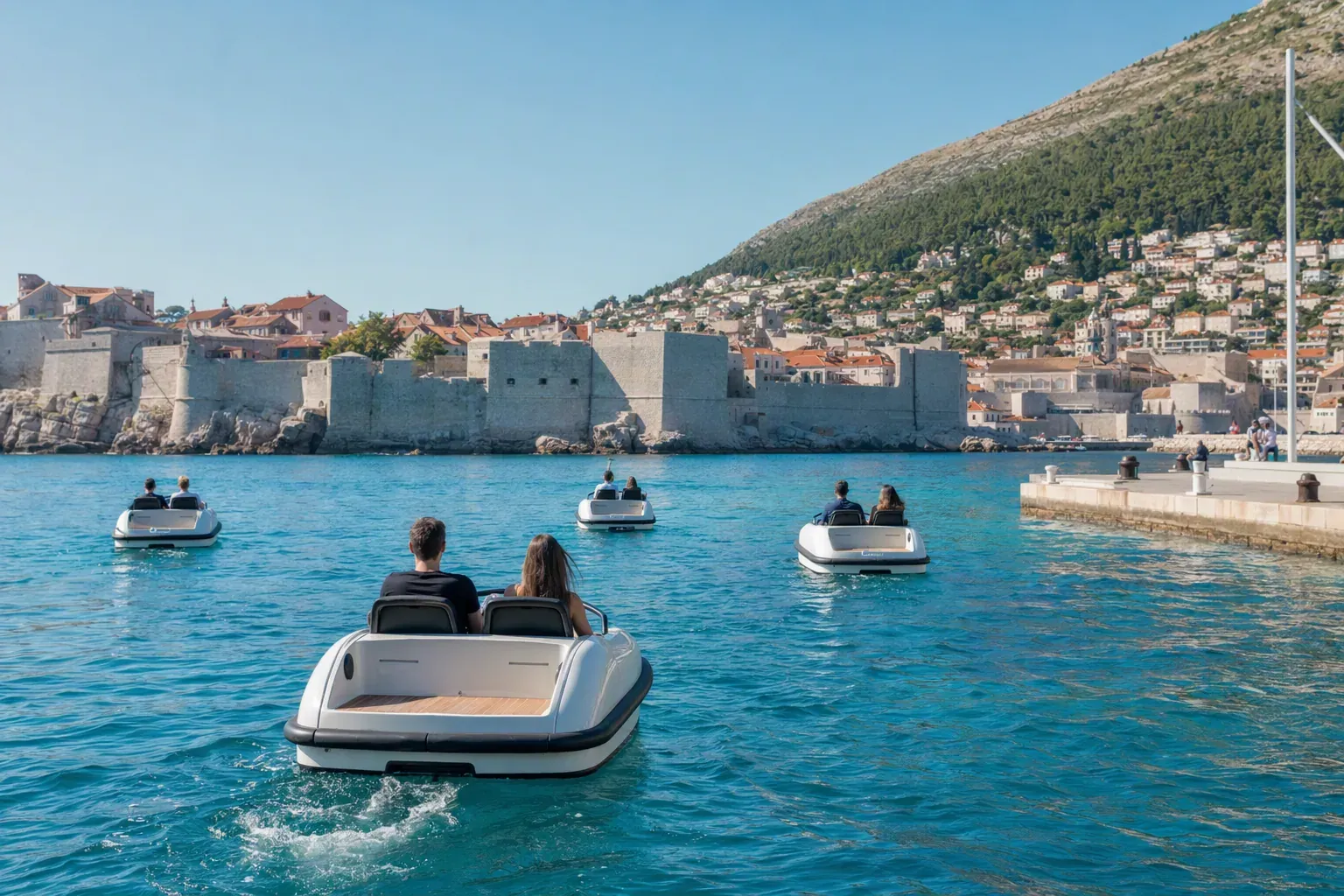
TL;DR: Croatia closed 2025 with 21.8 million tourist arrivals and 110.1 million overnight stays (eVisitor system) and €15.3 billion in foreign tourism revenue (Croatian National Bank). Its license-free operating line for boats is 5 kW (~6.7 hp) — the narrowest power band we have covered in this series, after Greece's ~30 hp and Portugal's ~15 hp — and combustion rental craft sit almost entirely outside it, while electric kart boats in the small-craft class fall inside. Croatia also carries the EU's largest terrestrial Natura 2000 coverage (37.85%) with roughly 30% of its marine waters protected, and a 2024 charter-licence reform has reshaped who may legally rent boats at all. Regulation is not the obstacle here; it is the filter.
Every market in our operator series has asked the investor to accept a premise: Greece asked you to read visitor-flow management as an equipment-upgrade signal, Portugal asked you to trust a mature market's composition. Croatia asks something different — and in our reading, something better. It is the first market in the series where the law itself sorts the equipment. Boats up to 5 kW of power can be operated by anyone over 16 without a boat-leader licence under the Croatian Maritime Code (Pomorski zakonik); almost nothing with a combustion engine clears that bar usefully, and a great deal of small electric craft does. Layer on the EU's densest protected-area structure and a 2024 reform that removed an estimated 500–1,000 boats from the legal rental fleet, and you get a market where the compliance perimeter and the electric product line overlap almost exactly.
This is the third stop in our Mediterranean cluster, alongside the Greece operator guide, the Portugal operator guide and the Mediterranean fleet-planning pillar. The three countries form a staircase of license-free thresholds — roughly 30 hp, then 15 hp, then 5 kW — and Croatia is the narrowest step. This guide covers the demand engine behind 110 million overnight stays, the licensing chain after the October 2024 charter reform, the tax treatment (25% standard VAT, 13% on boat rental), the protected-waters structure, and where a kart boat circuit realistically fits.
Why does Croatia suit electric kart boats?
One number does most of the work: 5 kW.
Under the Croatian Maritime Code, a vessel with power up to 5 kilowatts — about 6.7 horsepower — does not require a licensed boat leader, and anyone aged 16 or older can operate it. Above that line, licensing steps up in tiers: a boat-leader licence (voditelj brodice) category A for higher power, category B above 15 kW, and category C for commercial operation of vessels up to 30 GT. The tiering comes from the Rulebook on boats and yachts (Pravilnik o brodicama i jahtama); the 5 kW figure is in the Maritime Code text as published on zakon.hr.
A caution from our own research process: several rental-industry pages repeat "5 hp" as the license-free line. That is inconsistent with the statutory text we checked, which states 5 kW — roughly triple the power. We write 5 kW with the conversion shown because the difference is not cosmetic: 5 kW is the band where a small electric kart boat with real payload lives, and 5 hp is not. If you take one number from this guide, verify it against the current code text before you sign anything; statutes get amended, and our reading is dated to October 2026.
There is a second rule that matters even more for electric buyers. Since 2005, industry practice in Croatia has treated a vessel by its design maximum power — what it is equipped to exceed, not what it currently produces — when deciding whether the licence requirement applies. We flag this as an industry interpretation rather than a clause we have read in the original rulebook, but its logic is unforgiving and it favors electric: a combustion hull rated for 20 hp stays licensed even if you detune it, while an electric kart boat whose motor is definitively a sub-5 kW unit sits inside the license-free band with nothing to detune. Power certainty is a compliance feature, and electric drivetrains are the only ones that offer it cleanly.
Then there is the protected-waters structure. Croatia hosts 872 Natura 2000 sites, covering 37.85% of its land territory — the highest share in the European Union — plus roughly 11,300 km² of marine protected areas, about 30% of its waters, per the European Commission's country fact sheet. Within that structure: Mljet National Park caps speed at 5 knots within 150 m of shore and reserves its enclosed Small Lake (Malo Jezero) for rowboats only; Kornati National Park runs a 12-knot park-wide limit (6 knots in swimming coves) with mandatory park mooring buoys in designated bays; and coastal cruising rules reported for 2025 set an 8-knot limit within roughly 300 m of shore, with jet skis and planing craft pushed outside that band. Read those rules as a fleet planner, not a tourist: the venues with the strongest demand are also the venues where noise, wake and emissions are regulated hardest — and the propulsion class that clears every one of those gates is the quiet, zero-emission, low-wake class that electric kart boats occupy.
What is the market signal actually saying?
Croatia's tourism engine is the largest in this series by raw volume. The eVisitor system recorded 21.8 million arrivals and 110.1 million overnight stays in 2025 (up about 2% year-on-year), with the Adriatic coast carrying 104.6 million of those nights and August alone crossing 5 million arrivals for the first time. The Croatian National Bank's balance-of-payments data put 2025 foreign tourism revenue at €15.298 billion. Early 2026 continues the pattern: 7.6 million arrivals and 29.5 million overnight stays in the first half.
Volume this large produces a specific management response, and Croatia's is getting stricter in ways an operator should track. Dubrovnik's "Respect the City" programme caps cruise ships at two berthed simultaneously (about six calls per day are scheduled around it), and separately limits the Old Town to 4,000 cruise visitors present at once during peak hours — these are two different caps with two different scopes, and much of the coverage online blends them incorrectly; the 8,000 figure that circulates refers to total passengers across ships in port, not the Old Town cap. The city's 2027 berthing policy keeps the 4,000 limit, and the University of Dubrovnik has published research putting the Old Town's comfortable daily capacity around 11,300 total visitors — a level peak days have already exceeded. Hvar turned against its party-tourism image in 2025 with amplified-music bans on regulated beaches (fines reported up to €36,000) and alcohol restrictions in public zones.
The direction is the one we documented in Greece and watched begin in Portugal: cap the crowd, tax the head, and reward per-visitor yield. An operator selling ten short jet-ski adrenaline sessions a day is exposed to that squeeze; an operator selling a family kart-boat session at a higher ticket with lower footprint is aligned with it. That is not a prediction that Croatia will ban anything — it is an observation that the country's tourism policy has spent five years moving from "more arrivals" to "better arrivals," and equipment choices made now are bets on which side of that line a venue will land.
One honest note, consistent with the whole series: no Croatian inquiry has reached our inbox yet. The Kuwait buyer journey remains our only first-hand case. Everything here is public-data inference, and we label it as such.
The licensing chain, end to end
If your fleet stays at or below 5 kW: no boat-leader licence is required for renters over 16. That single fact changes the funnel math — every customer who can drive a car can legally take the helm, with no certificate check, no briefing-certificate logistics, no excluded walk-ups.
If you go above 5 kW: the licence tiers apply (category A, then B above 15 kW), and your renter base narrows to licence-holders — foreign licences are recognized on an official list (a German Sportbootführerschein See or a US OUPV qualify), but renters need the original on board, and operating without required credentials draws fines reported at €500–4,000.
For the rental business itself: October 2024 brought a reform that industry media describe as requiring a charter licence (plovidbeno dozvoljenje) for commercial boat rental — issued by the harbour authority under the Ministry of Sea, Transport and Infrastructure, valid five years, one licence per boat attached to the company rather than the person, with fees around €100 plus harbour dues of roughly €1–7 per metre per day. The same coverage reports that rental must run through a licensed operator holding an operational-technical-conditions licence, and estimates 500–1,000 boats left the legal rental fleet in the shakeout. We describe this law through industry reporting because we have not read the Narodne novine text ourselves; treat the specifics as directionally solid and confirm against the current regulation with local counsel.
Two more gates complete the chain. Commercial water-tourism use of the maritime domain requires a special concession, revocable on violation. And foreign renters on chartered boats need a Charter Confirmation issued by the harbour office — a small administrative step, but one your booking flow should anticipate.
The 2024 reform is why we think the timing argument in Croatia is real rather than rhetorical. When a licensing regime tightens, marginal operators exit, and the operators who remain hold their positions with newer, cleaner, more defensible fleets. Entering during a shakeout with a product category the old incumbents never carried — electric, sub-5 kW, family-session — is a fundamentally different entry than competing against an entrenched fleet in a stable regime. Imports still face the full EU conformity stack (more below), so the bar is real; it is just a bar the electric category clears by design.
Landed costs and tax treatment
Import duties for an EU member are settled by the HS-code and duty guide we published earlier: Croatia applies the EU common external tariff, and since 2013 the country applies Directive 2013/53/EU (the Recreational Craft Directive) directly — CE marking, Declaration of Conformity, owner's manual, builder's plate and Hull Identification Number are all entry requirements, with no national deviation to track.
Tax, however, is where Croatia parts ways with its Mediterranean neighbours. The standard VAT rate is 25% — the EU's joint-highest — applied to the imported fleet and generally recoverable as input tax by a registered operator. The rate that matters more for your P&L is the 13% reduced band, which covers boat charter rental services, per the Croatian Tax Administration's VAT schedule (the tax office site blocks access from outside Croatia; we cross-checked the rates against PwC and Avalara summaries and 2026 charter-industry pricing pages, which uniformly apply 13% to charter fees — bareboat rentals can be treated differently from crewed charters, so confirm your exact configuration): your revenue side carries 13%, your capex input is 25% recoverable, and that spread is worth an hour with an accountant before you structure the entity. Unlike Greece — where island VAT rates move with special economic measures — Croatia has no comparable island discount, and a 2026 tax reform has been notified to the EU's TRIS process with contents not yet fully public; we explicitly do not predict which way it breaks. A sojourn tax of €1.50–2.65 per guest-night in 2026 (municipally tiered, collected via eVisitor) is paid by overnight guests, not by your operation.
For pricing context, the rental market you would enter clears these marks on booking platforms: jet-ski sessions run roughly €50–90 per 30 minutes across Dalmatia (CheckYeti lists from about €70), with Dubrovnik's premium end at €146–173 per 30-minute session for a two-person craft, and Hvar listings spanning €40–130 by format. Without a licence, customers are limited to guided tours or sub-5 kW craft — which is precisely the corner a license-free kart boat fleet occupies. Those are platform list prices, seasonal and negotiable; treat them as anchors, not promises.
The infrastructure gap is the position
Here is the blunt finding from our research: Croatia has no dedicated subsidy programme for electric boats or marina charging, and we found no marina fast-charging infrastructure — ACI Marinas berths offer standard water and electricity pedestals, and the country's road-EV network (roughly 780 chargers) already trails the EU average. Fondek's €21.2 million zero-emission vehicle programme for companies, and its €20 million citizen scheme expected to open in late 2026, are road-vehicle programmes; boats are not included.
We read that gap the opposite way from most market entries. The EU Directive 2014/94/EU obliges TEN-T core ports — and Croatia's Adriatic ports qualify — to build shore-power and alternative-fuel infrastructure, and EU AFIF funding is the designated channel for financing it. The money and the obligation exist; the local build-out has not happened yet. Whoever equips berths with charging before the wave arrives locks a combination no competitor can quickly copy: licensed operation, protected-waters access, and the only chargers on the dock. Our 15-boat venue ROI case models infrastructure-led differentiation in detail; Croatia is close to the ideal profile for that play — and the counter-position is written in our electric versus gas comparison: in a Natura 2000-dense jurisdiction, combustion propulsion is not the cheaper option with a regulatory cost, it is the option whose regulatory cost is still accruing.
Where a kart boat circuit fits
The season runs May–October with a July–August peak (August 2025 was the first 5-million-arrival month), and the national tourist board actively promotes a "golden shoulder" into September–October — September 2025 alone logged 2.5 million arrivals. The Gulf-complementarity argument (a November–March season pairing with venues like the one in our Kuwait operator guide) holds here as it does across the Mediterranean cluster; it is a secondary benefit, not the reason to enter.
What Croatia adds that its neighbours do not is the sub-5 kW product fit. In Greece, a kart boat fleet lives comfortably in the license-free band and rents to anyone; in Portugal, the ~15 hp rental-practice threshold already requires licence vetting for the strongest craft. In Croatia the sub-5 kW band is not a compromise — it is the entire rental funnel: every walk-up over 16 is a legal helm. Specify the fleet so that no unit in it exceeds 5 kW designed power, keep the charter licence and concession paperwork ahead of the season, and the Croatian regulatory stack stops being overhead and becomes the moat the 2024 reform handed you.
FAQ
Do renters need a licence to operate a kart boat in Croatia?
If the boat's power does not exceed 5 kW, no — anyone over 16 may operate it. Above 5 kW, the boat-leader licence tiers apply and renters must hold a recognized licence (original on board) or the operation needs a licensed skipper. The 5 kW figure is from the Maritime Code text on zakon.hr; verify against the current text at contract time.
Is Mljet's Small Lake open to motorized boats?
No. Malo Jezero is reserved for rowboats — that is the park's rule, and we state it plainly because it is a boundary, not an opportunity: a kart boat circuit does not belong there. Mljet's other waters allow motorized craft with a 5-knot limit within 150 m of shore. Kornati's rules (12 knots general, buoys in designated bays) are reported by charter operators rather than read from the park's own price list, so confirm on site.
Are there subsidies for electric boats in Croatia?
None that we could find as of October 2026 — no dedicated electric-boat or marina-charging subsidy surfaced in official or industry sources. Road-vehicle programmes (Fondek) exist and explicitly exclude boats. EU port-electrification obligations and AFIF funding are the channels to watch instead.
How long does delivery to Croatia take?
Six to nine weeks of production plus roughly three to four weeks of ocean transit to an Adriatic port, then a short EU-internal truck leg — customs territory entry happens at the EU's outer border, so after that it is a member-state move. Working back from a May opening on the Adriatic, order by late winter.
Data caveats
The 5 kW license-free threshold and the A/B/C licence tiers come from the Croatian Maritime Code text on zakon.hr and the FAOLEX copy of the Rulebook on boats and yachts; neither is a gazette-original read, and industry pages sometimes print "5 hp" — we side with the statutory text. The design-power rule (since 2005) is an industry interpretation, not a clause we have read in the original. The 2024 charter-licence reform (effective 16 October 2024), the €100 fee, €1–7/metre/day harbour dues, the 500–1,000-boat shakeout estimate and the €500–4,000 fines are industry-media coverage (Croatia Week, crobiz, NauticEd, sailing guides) rather than statute text. Tourism figures (21.8M arrivals, 110.1M nights, August 5M, September 2.5M) come from the eVisitor system via HrTurizam and sector press; the €15.298 billion revenue figure is Croatian National Bank balance-of-payments data as reported by Nacional and travel trade press — we have not pulled the HNB series directly. Dubrovnik's two-ship berthing cap and 4,000 Old Town cap are Port Authority policy; the 8,000 in-port figure is Euronews reporting and is a different measure (do not merge them); the 11,297 daily-capacity figure is a University of Dubrovnik study cited by Express. Kornati speeds and fees are charter-operator reports. Jet-ski prices are 2025-season platform listings. The 2026 VAT reform is a TRIS notification without public detail; nothing here predicts its content. Nothing in this guide is legal or tax advice; confirm licences, concessions and VAT positions with Croatian counsel and the harbour authority before contracting.
Sources
- zakon.hr — Pomorski zakonik (Croatian Maritime Code), consolidated text — 5 kW license-free power line (retrieved 2026-10-04)
- FAOLEX — Pravilnik o brodicama i jahtama (Rulebook on boats and yachts), cro119629.pdf — licence categories A/B/C (retrieved 2026-10-04)
- HrTurizam / portal.hr — eVisitor 2025: 21.8M arrivals, 110.1M overnight stays, August first 5M month; 2026 H1: 7.6M / 29.5M (retrieved 2026-10-04)
- Nacional / Travel and Tour World — HNB balance-of-payments: 2025 foreign tourism revenue €15.298 billion; 2025 H1 €4.375B (+5.9%) (retrieved 2026-10-04)
- Dubrovnik Port Authority (portdubrovnik.hr) — Respect the City: max 2 ships berthed simultaneously; 2027 berthing policy keeps 4,000 Old Town cap (retrieved 2026-10-04)
- Euronews — 8,000 total cruise passengers in-port figure; Hvar amplified-music fines up to €36,000 (retrieved 2026-10-04)
- Express (Feb 2026) — University of Dubrovnik capacity study 11,297 daily visitors; 2026 mayor proposals (retrieved 2026-10-04)
- Croatia Week / crobiz — 2024 charter licence reform (from 16 Oct 2024), 5-year validity, ~€100 fee, 500–1,000 boats exit estimate (retrieved 2026-10-04)
- Croatian Tax Administration (porezna-uprava.gov.hr) — VAT Act Art. 38: 25% standard, 13% incl. boat/charter rental, 5%, 0% (site unreachable from our network at retrieval time; rates cross-checked via PwC/Avalara and 2026 charter pricing pages) (retrieved 2026-10-11)
- European Commission — Natura 2000 Country Factsheet Croatia — 872 sites, 37.85% terrestrial (EU highest), ~11,268 km² marine (retrieved 2026-10-04)
- NP Mljet — Information for yachtmen — 5 knots within 150 m; Malo Jezero rowboats only (retrieved 2026-10-04)
- splendid.hr / croatia-yachting.com — Kornati 12-knot limit, buoy mooring, entry fees €40–80 by length (retrieved 2026-10-04)
- sailingincroatia.eu / boataround — 2025 coastal rules: 8 knots within ~300 m, jet ski ban inside, 150 m protected-beach anchoring ban (retrieved 2026-10-04)
- CheckYeti / TripAdvisor / Viator — Dalmatia jet-ski €70+ per session; Dubrovnik €146–173 premium 30-min; Hvar €40–130 (retrieved 2026-10-04)
- adrysa.com / total-croatia-news — 2026 sojourn tax €1.50–2.65 tiers, eVisitor collection (retrieved 2026-10-04)
- EU Alternative Fuels Observatory / FZO-EU — Fondek road-vehicle programmes (€21.2M corporate, €20M citizen), no boat inclusion; ACI marina pedestal status (retrieved 2026-10-04)
Get a Quote for Your Kart Boat Business
Tell us what you need — OEM/ODM specs, quantity, target market. Our team replies within 24 hours.
Prefer a quick chat?
Chat on WhatsAppFree B2B resources
Buyer guides, ROI calculators, customs checklists, and case studies — built on direct factory manufacturing experience.