Kart Boat Fleet Scaling Guide: When to Expand Past 2 Boats
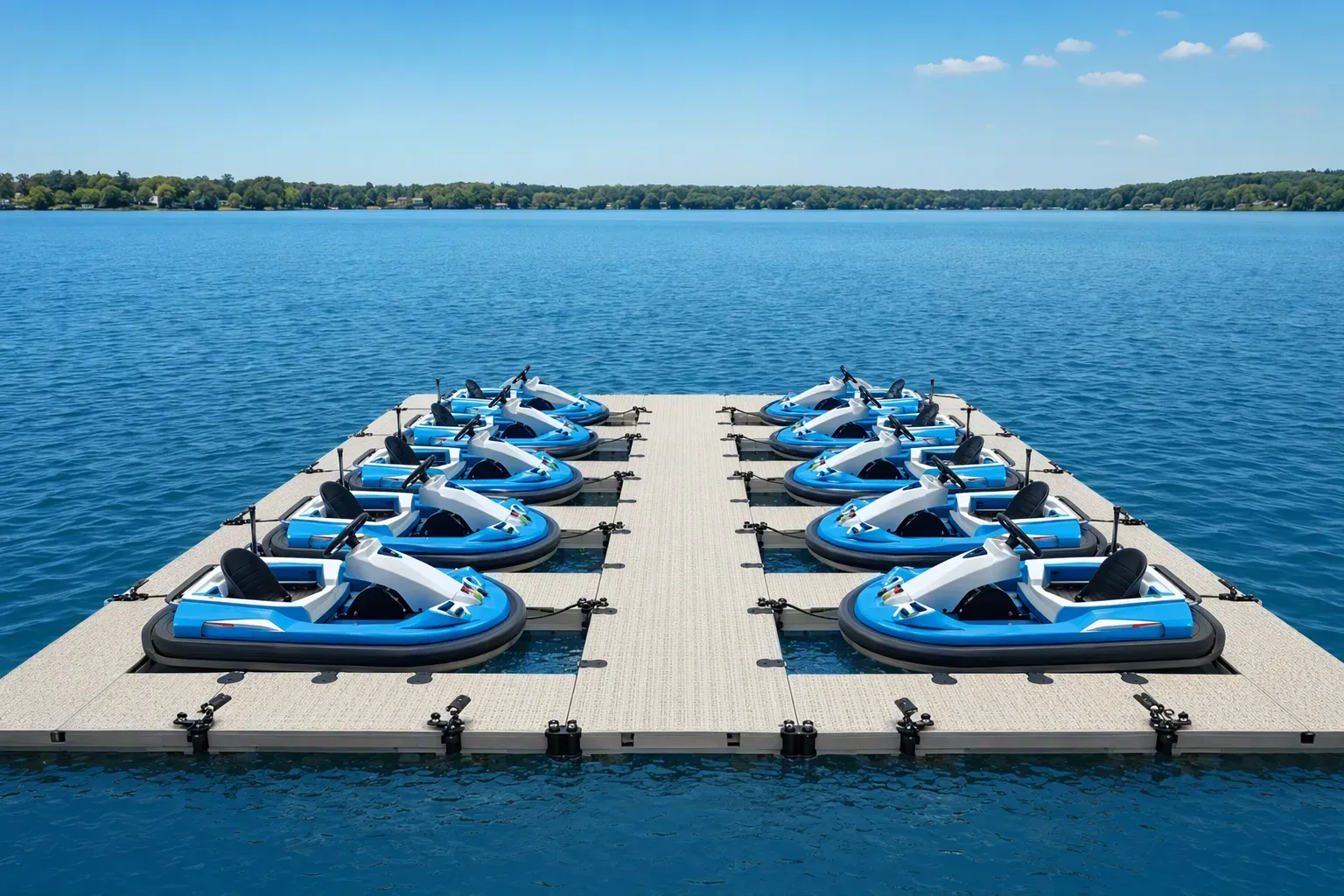
The signal to expand a kart boat fleet is not strong revenue — it is turn-aways: paid customers you had to refuse because every boat was booked. Revenue grows with almost any fleet size; turn-aways only appear when demand exceeds your berths, your staff and your battery rotation. This guide walks what actually changes as the fleet grows from 2 to 12: staffing, berths, batteries, maintenance windows, and the capital plan — including why the numbers that move payback are not the numbers a discount conversation would have you focus on.
In short: Expand on turn-aways, not on good months. Past 2 boats the binding constraint moves from pricing to logistics: a second attendant around 6-8 boats, scheduled battery rotation past 6, berth capacity and maintenance windows past 10. Quoting stays one-to-one — landed cost moves with freight, duties and battery configuration, not with notional bulk discounts.
What actually changes between 2 boats and 12?
Almost nothing about the boat itself. Almost everything about the logistics around it. At 2 boats, one operator does everything: handovers, briefings, charging, cleaning. At 8 boats the same operator becomes the bottleneck — handover lines form at the pontoon, batteries stop cycling on time, and one boat down for maintenance takes 12.5% of capacity offline. At 12 boats the job stops being a job and becomes a schedule: charging rotation, maintenance windows, staffing shifts, berth allocation.
The boat spec sheet stays flat across all three stages. The logistics curve does not. That gap is what this guide is about.
What are the three fleet stages?
Stage | Fleet size | Binding constraint | Published scenario benchmark |
|---|---|---|---|
Pilot | 1-2 | Price discovery | 1.5 sessions/boat/day at $30 |
Steady state | 4-8 | Berths + staffing | 3 sessions/boat/day at $40, 25% operating cost |
Fleet | 10-12+ | Scheduling: charging, maintenance, shifts | 5 sessions/boat/day at $55, 20% operating cost |
Stage 1 — pilot (1-2 boats): the goal is price discovery, not profit. You are validating what your water body accepts: rate, session length, booking rhythm. The published conservative scenario runs 1.5 paid sessions per boat per day at $30 — if you sustain that for a season, the pilot did its job.
Stage 2 — steady state (4-8 boats): the moderate scenario territory — 24 open days, 3 sessions per boat per day, $40 per session, operating cost at 25% of revenue. The binding constraints become berths and staffing: our staffing guide runs 1-2 attendants per 6-8 boats, so a fleet past 8 needs a second pair of hands. This is also where a modular pontoon starts earning its place: one more boarding point removes the handover line.
Stage 3 — fleet (10-12+ boats): the aggressive scenario runs 30 days at 5 sessions per boat per day — that throughput only exists when charging rotation and maintenance windows are scheduled, not improvised. Spare batteries stop being an accessory and become fleet infrastructure: batteries come in 60, 80 and 100 Ah variants (72V), and a spare set cycling through the charger while boats run is what keeps the schedule alive.
What signal says "expand now"?
Turn-aways, measured, not felt. Track them for four consecutive weekends: if you log refusals in more than one weekend out of four, your water body has demand your fleet cannot serve. The second signal is single-boat utilization: when your best boats run 5+ paid sessions a day while your worst run 1, the constraint is berths or briefings, not demand. The third is operational: when handover lines at the pontoon start cutting into session time, adding boats without adding boarding points just moves the queue.
What changes in the logistics at each stage?
Berths and water area. Every added boat needs a berth, a charging point and maneuvering room in the course. A 12-boat fleet on a basin sized for 6 produces congestion, and congestion reads to customers as chaos, not popularity.
Staffing. The 1-2-attendants-per-6-8-boats ratio crosses twice between 2 and 12 boats: once around 6-8 (second attendant), once past 12 (shift structure). Understaffed fleets do not save wages — they lengthen handovers, and longer handovers cut paid sessions per day, which is the single variable that moves payback most.
Batteries and charging. At 2 boats, overnight charging works. At 12, boats run 90-120 minutes per charge (15 kW models with 80-120 Ah packs), and waiting for a charge is a session not sold. The economics are mechanical: spare battery packs (available as a part, in 60/80/100 Ah 72V variants) cycle through chargers while boats run.
Maintenance windows. One boat down at a 2-boat fleet is 50% of capacity; at 12 it is 8%. That asymmetry is why larger fleets schedule maintenance into shoulder hours instead of reacting — and why identical boats (same motor, same battery format) matter more as the fleet grows: one spare-parts kit serves every hull.
What is the capital plan for scaling — and where do discounts fit?
They don't. We publish one price per boat and we do not discount fleet orders into a calculator number. Every quote is one-to-one — freight, duties, battery configuration and payment terms move the landed cost more than any notional bulk percentage, and a payback model built on a discount assumption breaks the day the real quote arrives. The capital question is different: phased purchase vs one-shot.
Phased (2 → 6 → 12): each phase validates demand before the next tranche commits capital, but every phase re-pays freight, documentation and compliance on a new shipment. Our MOQ and lead time guide covers the per-shipment costs in detail.
One-shot (12 at once): one shipment, one compliance cycle, one installation — but capital commits before demand is proven, and the boats arrive before the season may be ready for them.
The published 15-boat venue case ran the six-variable model across three season lengths (200/150/100 days) — and the calendar moved the answer more than the fleet did. Season length is the variable most buyers underestimate when they plan fleet size.
What does the UK scenario actually teach?
A UK operator recently submitted a 12-boat scenario through our ROI calculator: 24 open days a month, 3 sessions per boat per day. The instructive part is not the output — it is that every input behind the submission is editable, from fleet size down to fixed monthly costs. That is what the tool is for: it publishes scenarios so you can argue with them. If you are sizing a fleet past 10, run your own numbers with your fixed costs typed in — venue lease and salaried staff enter through the fixed-cost field, and at 12 boats they are no longer rounding errors.
Which KPI tells you the fleet is healthy?
Sessions per boat per day. It compresses the whole operation into one number: demand strength, berth efficiency, staffing adequacy, battery rotation. The three published scenarios run it at 1.5 / 3 / 5. Track it weekly, by boat, and the fleet will tell you where the constraint is — berths (top boats at 5, bottom at 1), staffing (lines at the pontoon), or batteries (mid-afternoon gaps in the booking sheet).
Revenue per berth is the second useful lens: it prices your water area, which is usually the scarcest input. Payback itself is the wrong fleet KPI — it is an outcome of the first two, computed after the fact.
Questions fréquentes (FAQ)
<!-- FAQ_SCHEMA -->
How many kart boats should a first fleet have?
Two, used as a pricing probe. The conservative published scenario (1.5 sessions per boat per day at $30) is the floor a pilot should clear. Expanding past the pilot makes sense when you log turn-aways on multiple weekends, not when the first good month lands.
When should I add the second attendant?
Around 6-8 boats. The staffing guide runs 1-2 attendants per 6-8 boats; past 8, a single attendant becomes the handover bottleneck and paid sessions per day drop — the variable payback is most sensitive to.
Do I need spare batteries at fleet size?
Past roughly 6 boats, yes — spare packs (60/80/100 Ah, 72V) cycling through chargers while boats run keep the schedule alive. Below that, overnight charging usually covers. Runtime math per model is on the battery runtime calculator.
Is a bulk discount realistic for a 12-boat order?
We quote one-to-one and do not build discounts into fleet math. Landed cost moves with freight, duties, battery configuration and payment terms — those belong in the quote conversation, not in a calculator assumption.
Phased purchase or one-shot for a 12-boat fleet?
Phased validates demand before each tranche commits capital, at the cost of re-paying freight and documentation per shipment. One-shot pays logistics once but commits capital before demand is proven. The 15-boat published case suggests the season length moves the answer more than fleet size — model both against your actual season.
What runtime should fleet boats have?
For rental duty, 90-120 minutes per charge (the 15 kW / 80-120 Ah class) absorbs turnaround and buffer without a mid-day charge stop. Fast tour variants (35 kW, 27.6 kWh) run about 90 minutes at higher speed — a different operational profile, not a better one.
Sources
- Published scenarios and staffing ratio: SinoKartBoat ROI calculator page and rental presets (/en/tools/roi-calculator)
- 15-boat venue case, three season lengths: Kart Boat Venue ROI Case: 15 Boats
- Per-shipment logistics costs: Kart Boat MOQ & Lead Time Guide
- Battery variants and runtime data: SinoKartBoat product specifications (skb-008/009/010/011, skb-acc-battery-pack)
Get a Fleet Quote Built on Your Season
Send us your season length, water body and target fleet size: we return an itemized fleet quote — boats, batteries, pontoon, chargers — with the payback model you can argue with. Inquiry form or WhatsApp, sales@sinokartboat.com.
Fast track: fleet ROI calculator · 15-boat venue case · commercial ROI model · MOQ & lead times
Get a Quote for Your Kart Boat Business
Tell us what you need — OEM/ODM specs, quantity, target market. Our team replies within 24 hours.
Prefer a quick chat?
Chat on WhatsAppFree B2B resources
Buyer guides, ROI calculators, customs checklists, and case studies — built on direct factory manufacturing experience.