Kart Boats in Phuket & Koh Samui: Operator Guide
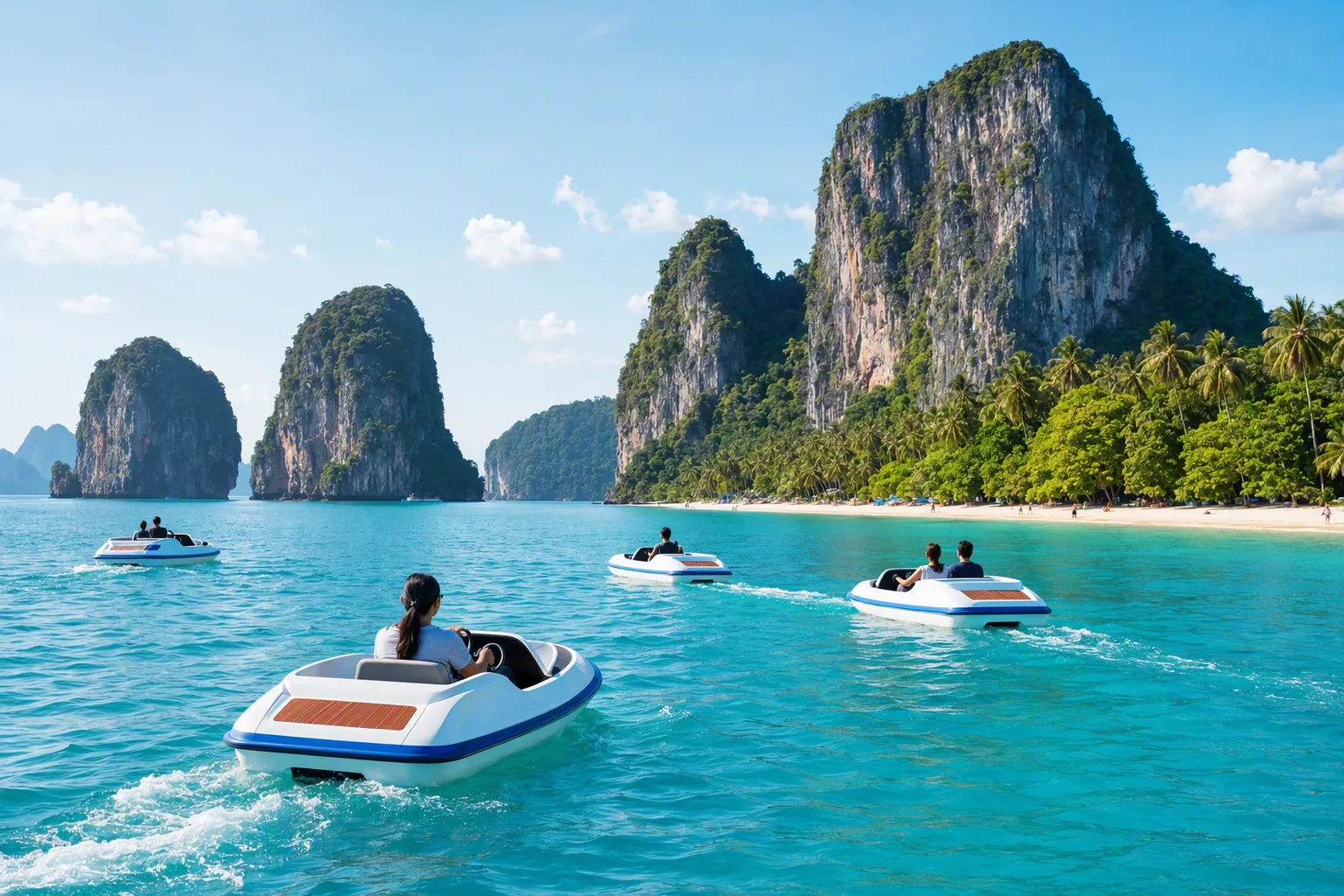
Thailand is the busiest leisure-water market in Southeast Asia, and the guidance written about it is mostly written for tourists. This guide is for the other reader: the resort activities manager in Phuket, the beach-rental operator on Chaweng, the tour company that already runs jet skis and is watching the equipment mix change. It covers what owning and commercially operating a small electric fleet actually requires in Thailand — a vessel-law ownership test that surprises foreign investors, a permit routine that runs on an annual clock — what importing costs now that the old punitive taxes are gone, and how two monsoon phases, not one, shape the operating year across the Andaman coast and the Gulf.
Three boundaries before anything else. Ownership structures for foreign-invested operators sit under more than one Thai law at once, so we state what the statutes say and direct the structuring questions to a Thai lawyer — we do not compress that into a one-line recipe. Tax figures below are the published policy baseline; your customs broker's ruling on the specific tariff line binds, not our summary. And this is an operator guide, not a travel piece.
Key Takeaways- The demand base is the largest in the country: Phuket welcomed 13.1 million visitors in 2024 and generated 497.5 billion baht in tourism revenue — the highest of any Thai province — while Koh Samui logged 3.19 million visitors through November with a 70.0% average room occupancy (TAT Samui).- There is no single "water-sports operator license." What binds is a stack: the vessel-owner qualification rule in the Thai Vessel Act (for a limited company, at least half the directors Thai nationals and at least 70% of shares held by non-aliens), an annual vessel operation permit from the Marine Department, and provincial beach rules that Phuket has been enforcing with 10,000-baht fines.- Import cost is the quiet good news: since 18 February 2004 Thailand levies 0% import duty and 0% excise on pleasure boats — a reform that took the old cumulative burden from as high as 245% down to zero (BOI). 7% VAT still applies.- Enforcement is real and getting stricter: Phuket has required jet-ski registration and insurance since 2016 and ran a crackdown in 2024–2026 against unlicensed operators. A documented, compliant fleet is the direction of travel — and electric fleets arrive with the cleanest paperwork story of any power type.- Two monsoons, not one: the Andaman side (Phuket) rides out the southwest monsoon from mid-May to mid-October, when the Thai Meteorological Department's small-craft warnings bite; the Gulf side (Samui) runs on the opposite phase, with rough seas around November–December. Your two-island operating calendars do not overlap — which is a planning asset, not a problem.
Why do Phuket and Samui suit electric kart boats?
Start with the scale, because it is not close. Phuket's 13.1 million visitors in 2024 made it Thailand's top tourism revenue province at 497.5 billion baht, confirmed by the province governor and by the Tourism Authority of Thailand's own leadership; Samui added another 3,185,880 arrivals in just the first eleven months of 2024 with 70.0% occupancy, led by German, British, Israeli, Chinese, and French guests. Under that demand sits a dense beach-rental economy — OTA directories list some 30 water-sports operators across Patong, Kata, and Chalong, and Samui's Chaweng, Bo Phut, and Lamai beaches run the same rental format at roughly 1,400 baht per jet-ski session. The commercial format kart boats plug into — beach-side, pay-per-ride, fenced operating areas — already exists at scale on both islands.
It also has a history of regulation that works in a documented operator's favor. Since 2016, Phuket has required jet skis to be registered and insured, with annual renewal and a minimum renter age; in 2024–2026 the province backed that up with sweeps that fined unlicensed operators 10,000 baht per violation. For an operator deciding what fleet to buy, read that correctly: the beach-rental business is not a free-for-all that enforcement might suddenly crush — it is a licensed activity where the compliant operators are the ones still standing. Buying a fleet with clear type documentation, CE paperwork, and a straight ownership structure is how you stay on the right side of that line.
The electric direction has already touched Thai water in visible ways. In October 2025, Swedish maker Candela and Thai operator Seudamgo confirmed a 10-ship P-12 electric hydrofoil ferry order for the mainland–Koh Kood route in Trat province — one of Asia's largest electric hydrofoil commitments, running at up to 25 knots with no wake and no exhaust. Bangkok has operated electric river ferries on the Chao Phraya since 2021, with a city plan for more than 200 electric ferries. And the closest analogue to a kart boat program: Amanpuri on Phuket has run electric leisure boats in its private bay since 2020. None of these is a kart boat — they are the signal that Thai regulators, hotel groups, and guests already accept electric hulls on Thai water. We made the same directional argument for the Red Sea's NEOM zone; Thailand's version is less about one flagship project and more about a broad, licensed, tourist-heavy market where the equipment mix is changing.
What does owning and operating a fleet legally require?
This is the section where Thailand most differs from our Mexico guide, so let us correct the most common planning error first: there is no single national "water-sports operator license" to go buy. What exists is a stack of older laws that each bite a little, and one ownership test that surprises foreign investors. Here is the stack:
Layer | Authority | What it governs | Status of detail |
|---|---|---|---|
| Marine Department (under the Thai Vessel Act B.E. 2481) | Who may own a Thai vessel operating commercially in Thai waters | Confirmed in law — Section 7 (read directly) |
| Marine Department regional offices | Permission to operate a specific boat commercially | Confirmed — annual permit for vessels under 10 gross tons |
| Marine Department (Hire Boat and Passenger Boat Safety Act B.E. 2551) | Inspections and equipment for commercially hired/passenger vessels | Framework confirmed; inspection specifics — confirm with the Phuket office |
| Phuket provincial announcements | Jet-ski/similar rental conduct on designated beaches | Confirmed practice since 2016; current rules — confirm locally |
Layer 1 — the ownership test. Section 7 of the Thai Vessel Act, as amended, sets who may hold ownership of a Thai vessel operating marine commerce in territorial waters. For a limited company, the test is arithmetic: not less than half the directors must be Thai nationals, and not less than 70% of the registered capital must be held by non-aliens. The Act also separately restricts commercial operation in Thai territorial waters to Thai vessels (Section 47). For a foreign-invested resort group, this is the structural fact of the whole project: the fleet needs to sit in a qualifying Thai-majority company, and Thai law prohibits using Thai nominees to hold shares for foreigners. Note what this test does not say — it does not prohibit foreign investment in the broader business; it constrains how the vessel-owning entity is structured. The Foreign Business Act's service lists are a separate layer that small electric kart boats largely fall outside of: the boat-leasing restriction there applies to vessels of 300 horsepower or more (or 500 gross tons and over), and a 13–15 kW kart boat sits far below that line. Both frameworks are being adjusted — a 2026 royal decree relaxed several FBA service categories — so before you commit a structure, get a Thai lawyer's opinion against the current lists, not a 2023 blog post.
Layer 2 — the annual operation permit. A kart boat is small enough — roughly 4–5 meters, far below the 10-gross-ton compulsory registration line for commercial craft — that it does not enter the full ship-registration regime. Instead it operates on a vessel operation permit (ใบอนุญาตใช้เรือ) issued by the Marine Department's regional office (for Phuket: the Phuket Regional Marine Office). The published fee schedule is modest — 300 baht for powered vessels up to 5 gross tons — and the operative fact is the clock: for vessels under 10 gross tons, the permit runs no longer than 12 months. Your fleet's legal status renews every year, which means your compliance calendar, your insurance renewals, and your pre-season inspections should be planned on the same annual cycle. Because an electric drivetrain still counts as "machine-propelled" under the Navigation in Thai Waters Act, electric kart boats ride this same track as petrol craft — we found no exemption clause and no extra burden, just the same file.
Layers 3 and 4 — safety and the beach. Commercially hired boats fall under the Hire Boat and Passenger Boat Safety Act (B.E. 2551), which delegates inspection and equipment requirements to the Marine Department; the exact inspection items for a small electric fleet come from the regional office's surveyors, so put that conversation before your delivery date, not after it. At the beach level, Phuket's provincial rules — registration, insurance, designated beaches, renter age — have been the template since 2016 and are actively enforced. And one staffing note that tour operators ask about: jet-ski operation requires a boat driving certificate (ใบขับขี่เรือ) under Section 282 of the Navigation in Thai Waters Act — a five-year certificate at 5,000 baht. Where small, low-speed, circuit-style electric boats sit in that certificate framework has no bright-line clause we could find, so confirm the category in writing with the Phuket Regional Marine Office before you publish your operating plan. On equipment: Thailand's Industrial Standards Institute (TISI) lists no mandatory national standard for recreational vessels as complete units (per TISI's own compulsory list as of this writing), while life jackets follow the Marine Department's own 2017 certification rule — a 10×10 cm permanent label among the requirements.
What does importing a kart boat fleet into Thailand cost?
This is the quiet good news of the whole file, and it is verifiable in public policy, not rumor. Since 18 February 2004, pleasure boats — the categories that cover inflatables, sailboats, and motorized leisure craft — enter Thailand at 0% import duty and 0% excise tax. The Board of Investment's own material describes the reform as taking leisure-vessel import duty from a cumulative burden of up to 245% (import + excise + luxury tax under the old regime) down to zero, a deliberate policy to build Thailand's marine-tourism economy. What remains is 7% VAT on the import value (the reduced rate runs into 2027 per PwC's current summary). So the on-paper tax stack for a kart boat fleet import is about as clean as any market we cover — a striking contrast with Mexico's 15% duty plus 16% VAT, and a structural reason Thailand's beach-rental economics pencil out better than most operators expect.
Two confirmations still belong in your import file. First, the tariff-classification specifics — which line of heading 8903 your exact boat lands on, and whether a newer electric-vessel concession applies — are a ruling your licensed customs broker should confirm against the current customs tariff database; we cite the policy baseline, not a brokered number. Second, the lithium battery file travels with the boats as it does on every lane: UN 3480 / UN 3481 dangerous-goods classification, UN38.3 test summaries per battery design, and dangerous-goods packaging — the paperwork chain that moves delivery schedules more than assembly does is laid out in our MOQ and lead time guide.
Routing. Ocean freight from China to Thailand clears Laem Chabang as the default deep-sea door on the Gulf side, with the island leg to Phuket or Surat Thani quoted separately by your forwarder — plan that final quote before you commit dates. Charging infrastructure is no longer the constraint it was — Thailand counted 11,467 public charging points across 3,720 stations at the end of 2024 (EVAT data), with the mainstream networks (PTT, PEA VOLTA, EGAT's EleX) present on Phuket including the airport corridor. A small fleet's shore charging is a marine electrical installation question, not an infrastructure-availability question. What arrives in the container — staging, commissioning, crew training — is covered in our turnkey delivery guide.
What does the operating year look like?
Thailand runs on two monsoon calendars, and mixing them up is the classic first-year planning error. On the Andaman side, Phuket's southwest monsoon season runs from mid-May to mid-October — the Thai Meteorological Department's official climate definition, with roughly 85% of annual rainfall inside it — and the operational bite comes from TMD's wave advisories: when Andaman swell reaches 2–3 meters, small craft are advised ashore; above 3 meters in thunderstorms, the advisories ground them entirely. September is statistically the wettest month. On the Gulf side, Samui runs the opposite phase — rough seas and the heaviest rain arrive around November into December with the northeast monsoon, when Andaman operators are already back in season. The two calendars barely overlap, and for a two-island group that is an asset: equipment, crews, and maintenance windows can follow the seasons across the peninsula.
The counterintuitive read for first-year operators: the monsoon months are not dead months, they are different months. TMD advisories ground small craft on specific days, not for whole seasons, and the shoulder weeks on either side of the season are where locals and repeat visitors fill weekday slots. What actually breaks first-year fleets is not the monsoon — it is buying peak-season capacity and then discovering that battery charging cycles, dock turnaround, and the daily inspection routine set your real throughput. The six-variable payback model with season length as an explicit input is in our ROI guide, and the fleet-technology side — swap batteries, timing systems, throughput per boat — is in our fleet technology guide.
For pricing orientation, the market anchors are visible: jet-ski beach rentals run ~1,400–1,500 baht per 15 minutes on Samui's beaches, Phuket's Patong stall packages start from 600 baht, and private jet-ski tours and island charters book at 8,000–15,900 baht per group — a market context, not our price recommendation. Where a kart boat circuit fits is a function of your venue and ride format; we keep our own pricing out of articles and in conversations. The budget framework is in our startup cost guide.
FAQ
<!-- FAQ_SCHEMA -->
Can a foreign-owned resort own and operate kart boats in Thailand?
Yes — with a structure. The Vessel Act's Section 7 ownership test requires the vessel-owning company to be Thai-qualified: at least half the directors Thai nationals and at least 70% of shares held by non-aliens, with nominee shareholding prohibited. Foreign investment in the broader resort business is a separate question under the Foreign Business Act, whose boat-leasing restriction keys on 300 hp / 500 gross tons — far above a kart boat. Have a Thai lawyer map the structure against current lists before you commit; both frameworks have active amendments.
Do kart boats need to be registered like ships?
Not under the full ship-registration regime — commercial craft under 10 gross tons sit below the compulsory registration threshold in the Vessel Act. Instead each boat operates on a Marine Department operation permit, issued by the regional office (Phuket's included), with published fees in the hundreds of baht and a validity of no more than 12 months, so renewals are annual. Electric drive does not change the track: it counts as machine-propelled, same as petrol.
How much is the import tax on electric kart boats?
The policy baseline is 0% import duty and 0% excise on pleasure boats since February 2004 — a reform the Board of Investment credits with taking the old cumulative burden of up to 245% to zero — plus 7% VAT on import value. Your broker's ruling on the specific tariff line and any newer electric-vessel concessions binds; get it in writing before you book shipping.
What happens during monsoon season?
On the Andaman side (Phuket), the southwest monsoon runs mid-May to mid-October with the TMD's wave advisories grounding small craft on 2–3-meter days; Samui's rough phase is the opposite, around November–December. Operators plan maintenance, battery-health checks, and staff training into the shoulder weeks, and keep the daily go/no-go routine — the advisories bite on specific days, not whole months.
Do guests or staff need a boat license to drive one?
Jet-ski operation requires a boat driving certificate under Section 282 of the Navigation in Thai Waters Act (five-year validity, 5,000 baht). Where small, low-speed circuit boats sit in that framework has no bright-line rule we could find, so confirm the category in writing with the Phuket Regional Marine Office — most guided-circuit formats run with staff holding certificates and guests under staff supervision.
Is insurance required?
Phuket's provincial rules for beach-rental craft have required insurance since the 2016 framework, alongside registration and annual renewal — and the 2024–2026 enforcement sweeps show the province checks. Treat marine liability cover as a baseline cost of operating, and confirm the current certificate requirements for your beach with the provincial office.
Get the site specifics checked
The statutes frame the project; your beach, your structure, and your utilization model decide it. Send us your parameters — island, venue type, target fleet size, timeline — and we will tell you which of these files bind on your project and in what order. WhatsApp works for a faster back-and-forth.
- Contact the team
- Browse the kart boat catalog
- Also in the regional series: Resort water sports in the Maldives
Sources
- Phuket visitor and revenue figures (13.1 million visitors, 497 billion baht, top province 2024) — Bangkok Post, Sep 2, 2025; The Phuket News, Feb 14, 2025 (governor Sophon Suwannarat); The Thaiger (TAT governor confirmation); retrieved 2026-09-20 at summary level across four consistent sources.
- Phuket tourism revenue 497,523.93 million baht, top-3 provincial ranking (Phuket / Chonburi / Surat Thani) — Ministry of Tourism and Sports 2024 data via Kom Chad Luek / ejan.co, Mar 2025; retrieved 2026-09-20.
- Koh Samui arrivals 3,185,880 (Jan–Nov 2024), revenue 37,074.88 million baht, 70.01% occupancy, top five source markets — TAT Samui office statistics via Daily News (dailynews.co.th/news/4156751, Dec 5, 2024), read directly (figures verified in page text), retrieved 2026-09-20.
- Thai Vessel Act B.E. 2481 (as amended), Sections 7, 7 bis, 8, 9, 47 — official English translation, Office of the Council of State, via FAOLEX (faolex.fao.org/docs/pdf/tha181046.pdf, 31 pp.), read directly, retrieved 2026-09-20; Thai consolidated text at laws.md.go.th.
- Navigation in Thai Waters Act B.E. 2456 — machine-propelled vessel definition and Section 282 (boat driving certificate); Marine Department law library (laws.md.go.th), read directly (definition) and at summary level (Section 282), retrieved 2026-09-20.
- Vessel operation permit fees (300 baht ≤5 GRT powered; 1,100 baht 5–6 GRT) — info.go.th official service fee schedule; retrieved 2026-09-20.
- Marine Department announcement on operation-permit validity for vessels under 10 gross tons (≤12 months) — Royal Gazette, Dec 2019 (ประกาศกรมเจ้าท่า), read directly at section level, retrieved 2026-09-20.
- Marine Department regulations on Thai vessel registry and operation permits B.E. 2563 — Royal Gazette Vol. 137 Special Part 207 ง (2017); cited by reference, full text behind Cloudflare.
- Foreign Business Act B.E. 2542, List 3 (items 17–21) — Siam Legal English translation (consistent with BOI translation); read directly, retrieved 2026-09-20. Royal Decree Prescribing Services of Consequential Character B.E. 2542 (300 hp / 500 GT vessel-leasing entry) — summary level, two independent sources.
- FBA 2026 amendment dynamic (royal decree relaxing eight service categories) — Baker McKenzie / Lexology, 2026, summary level.
- Pleasure-boat import duty and excise at 0% since 18 February 2004; old cumulative burden up to 245% — Thailand BOI ("Thailand Marine Destination of Asia"); Sail-World, "Zero boat tax dream becomes reality in Thailand"; Yachting Monthly (pre-2004 context); retrieved 2026-09-20. Excise item 08.01 (เรือยานพาหนะทางน้ำที่ใช้เพื่อความสำราญ) at rate 0 — Excise Department law library (lawelcs.excise.go.th) current notification text, read at fragment level.
- VAT 7% (reduced rate through Sep 30, 2027) — PwC Tax Summaries, Thailand corporate/other taxes; retrieved 2026-09-20.
- Hire Boat and Passenger Boat Safety Control Act B.E. 2551 — cited by reference; inspection specifics delegated to Marine Department surveyors (confirm with Phuket office).
- Jet-ski driving certificate requirement (Section 282), Aug 2024 enforcement reporting; 5-year/5,000-baht certificate — Thai PBS, Sanook, Spring News, Daily News (Aug 2024); Lexology (2023); summary level.
- Phuket jet-ski framework since 2016 (registration, insurance, annual renewal, renter age) — Bangkok Post, Jan 2016; 2024–2026 enforcement sweeps (10,000 baht per violation) — The Phuket News / The Straits Times, 2026-07; summary level.
- Life-jacket certification rule (Marine Department notification 2017; 10×10 cm label) — Royal Gazette PDF, carried at summary level.
- TISI: no compulsory standard for recreational vessel complete units — TÜV SÜD certification directory, trade.gov Standards for Trade, Thai มอก. searches; retrieved 2026-09-20 (search-level coverage; confirm against TISI official list).
- Candela × Seudamgo 10× P-12 electric hydrofoil ferries, mainland–Koh Kood route (announced Oct 2025) — Candela (mynewsdesk), futuretransport-news, electrive, offshore-energy; retrieved 2026-09-20.
- Amanpuri Ceclo electric leisure boats in resort bay since 2020 — Yacht Style, Dec 18, 2020; read at summary level (price point not verified in source; not cited).
- Bangkok Thai Smile Boat electric ferries (2021–) and BMA 200+ e-ferry plan — plugboats; summary level.
- TMD southwest monsoon season (mid-May to mid-October, ~85% of annual rainfall) — Thai Meteorological Department, "The Climate of Thailand" (climate.tmd.go.th); direct site access-blocked, carried via multiple consistent sources. Wave-advisory practice (2–3 m small-craft advisory; >3 m in thunderstorms) — Nation Thailand reporting on TMD announcements; summary level.
- Koh Samui Gulf-side monsoon phase (rough seas Nov–Dec, northeast monsoon) — multiple travel-climate sources at summary level; season-window planning should follow TMD advisories.
- Thailand public charging infrastructure 11,467 points / 3,720 stations (Dec 2024) — EVAT data via Roland Berger EV Charging Index 2025; summary level. National-context figure only; per-province counts not cited.
- Water-sports pricing anchors (Samui jet-ski beach rental ~1,400–1,500 baht/15 min; Phuket Patong stall packages from 600 baht; private jet-ski tours and island charters 8,000–15,900 baht/group) — Klook, local operator listings, OTA aggregates; market-context level.
- Jet-ski/parasail operator density (≈30 across Patong/Kata/Chalong) — OTA directory summaries (T3); supports order-of-magnitude phrasing only.
- Beach-rental format on Samui (Chaweng/Bo Phut/Lamai) — local operator listings (T3); format enumeration only.
Get a Quote for Your Kart Boat Business
Tell us what you need — OEM/ODM specs, quantity, target market. Our team replies within 24 hours.
Prefer a quick chat?
Chat on WhatsAppFree B2B resources
Buyer guides, ROI calculators, customs checklists, and case studies — built on direct factory manufacturing experience.