Electric Kart Boat Performance Data: Speed, Range & Battery
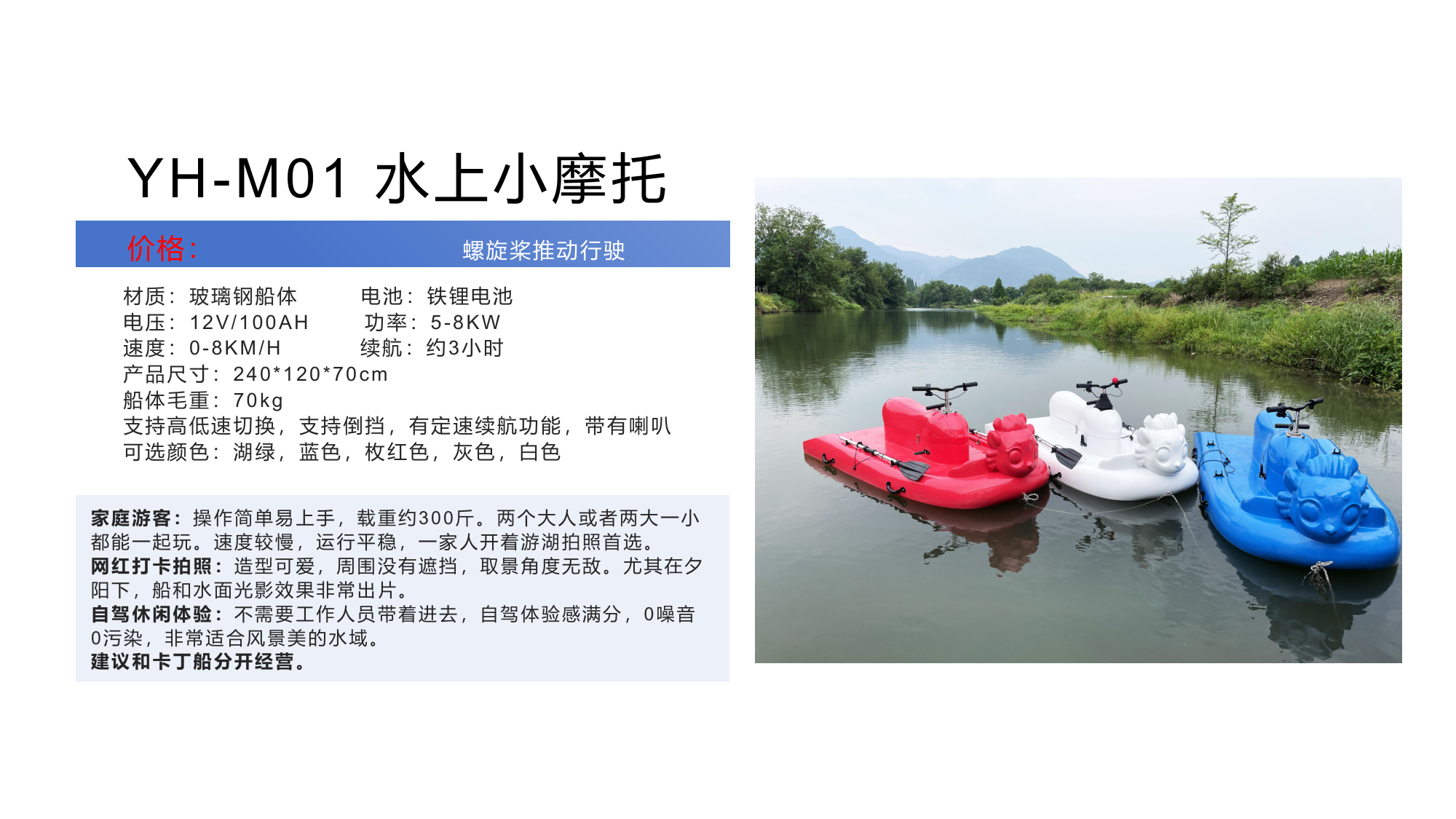
Most electric kart boats — also sold as water kart boats, go-kart boats, or mini jet boats — claim a top speed between 40 and 60 km/h and a runtime anywhere from 30 minutes to 3 hours. Both ranges are real. The spread comes from what the seller is measuring: full-throttle sprints vs cruising, a light solo rider vs a loaded rental, a fresh battery vs a mid-season pack. This page collects the performance numbers manufacturers and distributors published as of 2026, keeps each claim next to its source and date, and explains how to read the fine print before you use any of these figures in a fleet plan.
Key Takeaways- Claimed top speeds for mainstream electric kart boats cluster between 40 and 55 km/h; the strongest 15–18 kW models reach 60 km/h, and they are roughly half the speed of the fuel-fired SeaKart-style jet karts (80–100 km/h).- Claimed runtime spans 30 minutes to 3 hours on similar-looking boats. The difference is operating mode and battery capacity — not magic. A 5.5 kWh pack at cruising pace and an 11.2 kWh pack at partial throttle can both honest-quote "about an hour."- Almost no manufacturer publishes the three numbers that actually decide fleet economics: sustained cruise power draw, cycle life at rental duty, and charge time at fleet voltage. Where a spec is not published, this page says so instead of guessing.- Battery thermal and saltwater-corrosion performance have standard requirements (UN 38.3 transport tests, GSO 55 °C hot-climate testing, salt-spray methods) that you can demand in writing — no public "real-world" test data exists for most models.- Every table on this page is a public-sources compilation with the access date attached. It is not an independent instrumented test; treat contract-stage verification, not this page, as the final word.
Why do claimed kart boat performance numbers need calibration?
Three calibration axes explain most of the gap between a brochure number and what your fleet will actually deliver.
Operating mode. A 15 kW boat at full throttle can empty a 5.5 kWh battery in roughly 20–25 minutes; the same boat throttled to a comfortable drift-cruise pace can stretch the same pack past an hour. Sellers rarely state which mode their runtime claim assumes. When one brand quotes "45–60 minutes" and another quotes "3 hours," they are often both right — and measuring opposite things. The only way to compare two boats is to normalize to the same mode, which is why our motor power and payload guide walks through the kWh ÷ average-draw math instead of quoting runtimes.
Battery fit-out. Several platforms ship with a choice of packs (one battery for private play, two for rental duty, or an upgraded 8+ kWh option). The brochure may describe the best configuration while the quoted price corresponds to the smallest one. JDF's 74 V 11.2 kWh pack and Wave-Vo's optional 8.4 kWh upgrade are public examples — the base numbers and the upgraded numbers are different products.
Rider and water conditions. Payload, water temperature, and hull fouling all move real-world range. A claim measured with a 60 kg rider in flat warm water will not survive a 95 kg adult, two kids on a tandem seat, and 18 °C sea water. No manufacturer publishes a payload-vs-range curve; if a supplier implies one exists, ask for it in writing.
Public performance data: electric kart boats (2026)
The table below compiles what manufacturers and distributors published on their own pages and listings, as aggregated on 2026-08-16 to 08-19 from daily market monitoring, plus spot-checks against live pages on 2026-09-08. All speed and runtime figures are manufacturer-claimed; none are independently instrumented tests. Prices move frequently — Rush Wave's DTC price alone ranged from $2,499 to $7,990 within the monitoring window — so treat the price column as a signal, not a quote.
Brand / model | Motor power | Battery (stated) | Top speed (claimed) | Runtime / range (claimed) | Price signal (accessed 2026-08) | Notes |
|---|---|---|---|---|---|---|
Rush Wave | 15–16 kW | 72 V ternary Li, quick-swap | 50–55 km/h | 45–60 min | DTC $2,499–7,990; FOB $3,350–5,999 | Promo pricing swings widely; 2-year three-electric warranty via some channels |
Wave-Vo | 15 kW | 5.5 kWh (8.4 kWh optional) | 50 km/h | 30–45 min; ~40 km | DTC $5,999–6,999 incl. shipping | ~10 s battery swap; 5 h charge; 75 kg hull (live page, 2026-09-08) |
JDF (Jindifan) | 18 kW (24 kW dual-pump) | 74 V 11.2 kWh, air-cooled | 40 km/h | up to 3 h (claimed) | FOB $3,000–4,500; aluminum $3,800–4,800 | Aluminum hull variant; 6–8 units per 20 GP container |
NEKTON K7 | 15 kW | IP67 quick-swap pack | 45 km/h | not published | DTC €8,900 / $9,800; FOB $3,500–4,500 | Miami yacht-club deployments; 2-year US warranty |
SABO | 15–20 kW | 72 V 74.4 Ah (≈5.4 kWh) | 50–55 km/h | not published | FOB $3,499–4,999 | CE/RoHS/UN 38.3 documentation claimed in listings |
Wuyi/Yongkang cluster | 2×8 kW or 60/72 V | varies | 40–55 km/h | not published | $1,650–1,990 FOB (MOQ 2–5) | The price floor of the category; spec documentation thin |
eJetBoat (PL distributor) | up to 20 kW | varies by model | 35–60 km/h | not published | not published | 75 kg net weight excl. batteries (live page, 2026-09-08) |
E-SURFER water go-kart (retail) | 15 kW | not published | 45 km/h | not published | retail listing | 100 kg max driver weight (live page, 2026-09-08) |
Reference anchor for context — the fuel-fired benchmark this category is often measured against:
Brand / model | Power | Top speed | Price signal | Notes |
|---|---|---|---|---|
SeaKart 335 (fuel, Yamaha 110–180 hp) | 110–180 hp | 80–100 km/h | £32,400–37,920 | The original jet-kart; 3–5 riders, CE Cat C |
Two things stand out when the claims sit side by side. First, power and top speed correlate loosely: JDF's 18 kW boat claims the lowest top speed (40 km/h) of the 15 kW+ group, which is what you'd expect from a heavier aluminum hull built for durability rather than sprint. Second, runtime claims and battery size do not correlate either unless you know the mode — the 11.2 kWh JDF quotes "up to 3 hours" while the 5.5 kWh Wave-Vo quotes 30–45 minutes, and both are defensible at different throttle settings.
SinoKartBoat fleet specs — and what we don't publish
Our own line follows the same honesty discipline: where a number is not verified for the exact configuration you'd receive, the spec sheet says "not published" rather than quoting a brochure figure.
Model | Motor power | Top speed | Hull weight | Best fit |
|---|---|---|---|---|
SKB-K100 | 13 kW | 40 km/h | 53 kg | Solo rental / drift sessions |
SKB-K200 | 6–18 kW | 45 km/h | 50 kg | Adjustable-power family venue |
SKB-K300 | 15 kW | 60 km/h | 67 kg | Rental fleets and racing circuits |
SKB-K400 | 15 kW | 60 km/h | 72 kg | Two-seat family sessions |
SKB-D100 | 13 kW | 43 km/h | 28 kg | Drift-focused light hull |
SKB-M100 | 500 W (12 V) | — | 150 kg hull | Kids' slow-loop pools |
SKB-B100 | — | 5 km/h | 75 kg | Pool-side beginner loops |
Battery capacities, charge times, and cycle-life figures for the SKB line are being validated per configuration and are not yet published as blanket claims. If you need them for a fleet plan, ask — we provide configuration-specific numbers in the quotation with the test basis stated, which is exactly the treatment we recommend you demand from every supplier in the section below.
Do kart boat batteries overheat? What the standards require
Public "real-world" thermal data for kart boat batteries does not exist — but the requirements are public, and they make useful contract language.
- UN 38.3 is the transport-safety baseline every lithium pack must pass before shipping (the eight T1–T8 tests: altitude, thermal, vibration, shock, external short circuit, and more — the US DOT's PHMSA test-summary requirement explains what documentation shippers must hold). It is a shipping gate, not a performance rating: passing UN 38.3 says the pack survives transport, not that it lasts 800 rental cycles.
- ISO 23625 (Small craft — Lithium-ion batteries) specifies selection and installation requirements for lithium-ion battery systems on small craft, including fail-safe behavior, and is referenced in certification discussion for this category. Ask any supplier to state which standard their installation complies with, and get the certificate, not the claim — the same document-matching discipline we describe in our compliance guide.
- GSO 55 °C hot-climate testing is part of Gulf-region (Saudi/UAE) type-approval expectations for electric watercraft. If your venue operates above 40 °C ambient, asking whether the pack and controller were validated at 55 °C is a fair, standard-anchored question.
On the cooling side, public product pages in this category describe two approaches: air-cooled packs (simpler, field-serviceable; JDF's 11.2 kWh unit is a public example) and sealed packs with thermal management built into the BMS (the common approach for IP67 quick-swap packs like NEKTON's). What no vendor publishes is a temperature-rise curve — and until instrumented data exists, any "our pack stays at X °C" statement should be treated as marketing.
Which materials survive salt water?
Kart boats live in salt water, often sit docked between sessions, and get rinsed irregularly. The public material menu:
- Rotomolded PE hulls — the workhorse of the price-floor cluster; inherently corrosion-proof, heavier, and cheaper to repair.
- Fiberglass (FRP) with gelcoat — the mainstream finish on mid-price boats; corrosion-resistant but gelcoat suffers osmosis-style blistering if docked long-term without rinsing.
- Marine aluminum (5083-class) with welding + anodizing — JDF's aluminum variant is a public example; light and stiff, but weld seams are the corrosion hot spots to inspect at pre-shipment.
- 316L stainless fastenings and fittings — the dividing line between a boat that survives two seasons and one that seizes hardware by month six; worth specifying by name in the contract.
The standard test language you can demand is salt-spray exposure per ASTM B117 (the standard practice for operating salt-spray apparatus) or an equivalent method, with a stated hour count for the coating system. Few kart boat listings publish salt-spray hours — the ones that do tend to be the same suppliers willing to put the rest of their documentation in writing. That correlation is useful during supplier selection: it is one of the questions worth asking a manufacturer before wiring money.
How do you turn these numbers into fleet decisions?
Three moves turn a claims table into fleet decisions.
Normalize before comparing. Convert claimed runtimes into energy terms: a 5.5 kWh pack quoting 45 minutes implies roughly 7.3 kW average draw (near full throttle); an 11.2 kWh pack quoting 3 hours implies about 3.7 kW (a gentle cruise). Same category, 2× difference in assumed pace. The worked examples — and the red flags to spot on any spec sheet — are in the motor power and payload guide linked above.
Price the fleet, not the boat. Runtime and swap speed set your boats-per-hour throughput, which is the input that decides how many units the venue actually needs — the difference between quoting a $3,500 boat and a $28,000 fleet. The price guide covers per-unit landed cost; the startup cost guide builds the full stack including pool, permits, and staffing.
Demand the unpublished numbers in writing. Sustained cruise draw, cycle life at rental duty, charge time at your fleet voltage, and the salt-spray hours of the coating system — none of these appear reliably in public listings, and all of them belong in your RFQ. The procurement guide lists the four document packages to request alongside them.
Data boundary statement
This page is a compilation of public sources: manufacturer and distributor pages, retail listings, and daily market monitoring aggregated 2026-08-16 to 08-19, with live-page spot-checks on 2026-09-08. It is not an independent instrumented test, and no curve, temperature figure, or degradation claim on this page should be read as first-party measurement. Prices are volatile in this category; speed and runtime claims are vendor-supplied. When instrumented test data becomes available, this page will add a clearly separated test-data section — until then, the honest baseline is what vendors publish, with the fine print attached.
FAQ
How fast does an electric kart boat go?
Mainstream 2026 models claim 40–55 km/h, with the strongest 15–18 kW boats reaching 60 km/h. Fuel-fired jet karts like the SeaKart 335 reach 80–100 km/h at roughly ten times the price. For rental operations, the practical ceiling is usually set by the venue, not the boat.
What is the real range of an electric kart boat?
Published claims run from 30–45 minutes (5.5 kWh packs at speed) up to 3 hours (11.2 kWh packs at partial throttle), and roughly 40 km of range at cruise pace. Real range depends more on throttle discipline and payload than on the brochure number — plan fleets on average-draw math, not claim sheets.
How long does a kart boat battery take to charge?
Publicly stated charge times are sparse; Wave-Vo lists about 5 hours for its 5.5 kWh pack. With quick-swap systems (~10 s to swap), most rental operators charge packs dockside between sessions rather than waiting on the boat — which is why swap logistics, not charger speed, usually decides session throughput.
Which is faster: electric or gas kart boat?
Gas kart boats are faster — roughly 80–100 km/h for the SeaKart class vs 40–60 km/h electric. For commercial venues the trade is deliberate: lower running cost (~$0.20 vs $1.50+ per operating hour), quiet operation near guests, and no fuel logistics, per our electric vs gas comparison.
Do kart boat batteries overheat in hot climates?
No public instrumented data exists for sustained hot-climate operation in this category. What you can demand is standard-anchored evidence: UN 38.3 transport certification as the baseline, plus confirmation of 55 °C validation for Gulf-region deployment. Treat vendor temperature claims without a test basis as marketing.
Are electric kart boats OK in salt water?
Yes with the right materials and maintenance: rotomolded PE or gelcoat FRP hulls with 316L fittings are the corrosion-resistant mainstream, marine aluminum needs weld-seam inspection, and all of it benefits from post-session rinsing. Demand salt-spray (ASTM B117) hour counts for the coating system in your contract.
Sources: manufacturer and distributor public pages and listings (Rush Wave, Wave-Vo, JDF/Jindifan, NEKTON, SABO, eJetBoat, E-SURFER, SeaKart) aggregated 2026-08-16–19 from market monitoring, with live-page spot-checks 2026-09-08; standards referenced at the requirement level (UN 38.3, ISO 23625, GSO hot-climate testing, ASTM B117). Claims are vendor-supplied and unverified; figures may have changed since the access dates shown.
Get a Quote for Your Kart Boat Business
Tell us what you need — OEM/ODM specs, quantity, target market. Our team replies within 24 hours.
Prefer a quick chat?
Chat on WhatsAppFree B2B resources
Buyer guides, ROI calculators, customs checklists, and case studies — built on direct factory manufacturing experience.