CE, FCC & UN38.3: Water Sports Equipment Compliance
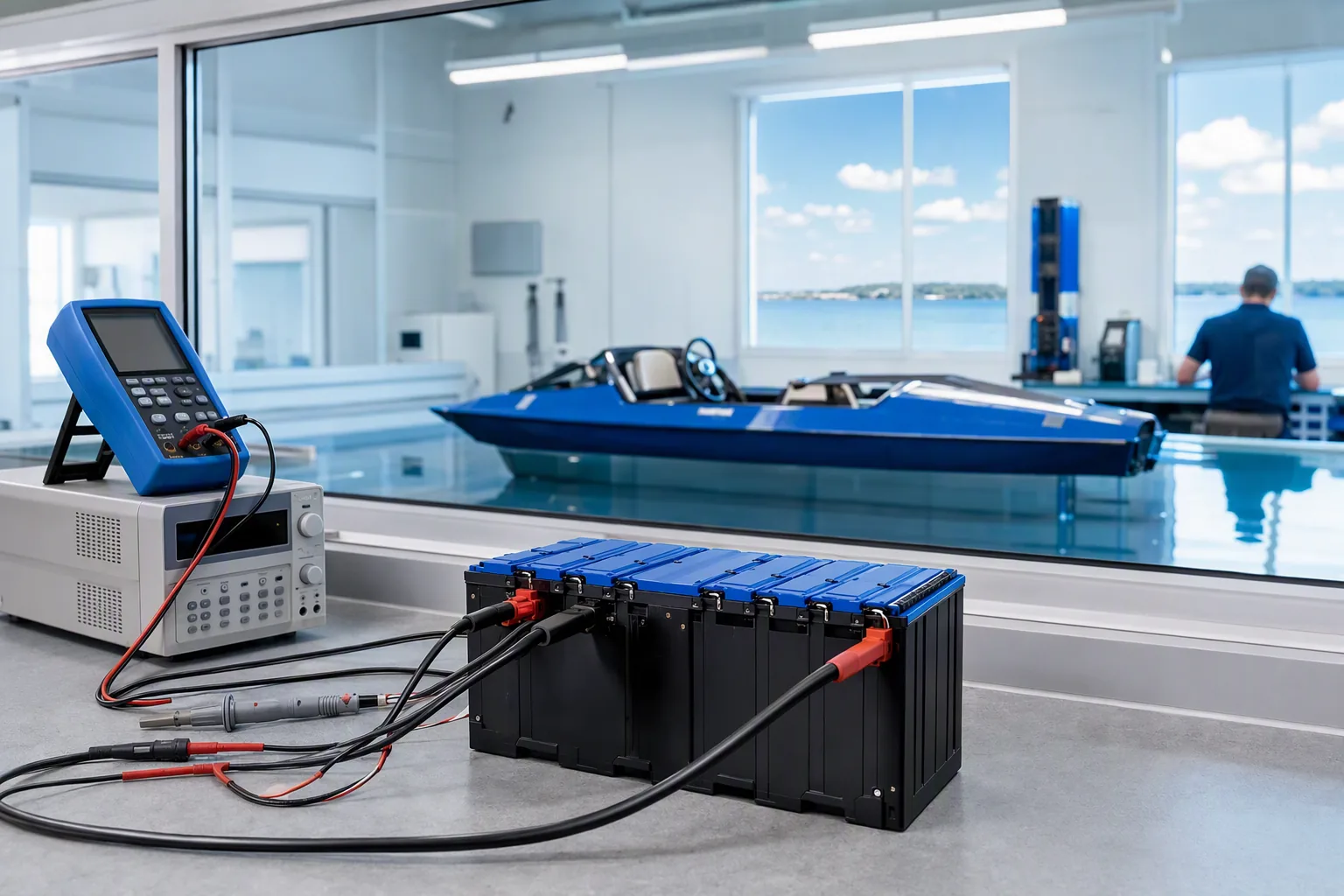
Quick answer: Three regimes decide whether an electric water sports import clears smoothly: CE for the European market, FCC rules for radio-equipped features sold into the United States, and UN38.3 for the lithium battery's right to travel at all. They attach to different things — market, radio modules, and the specific battery — so the practical question is never "do you have CE?" but "which document applies to this configuration, in this destination, and who holds it?"
Why Compliance Questions Go Wrong Before the Order
Most compliance failures in this category are not certificate failures — they are conversation failures. A buyer asks "is it CE certified?", hears "yes", and both sides walk away with different assumptions: the buyer assumes a certified boat with paperwork to follow; the supplier means the hull is built to the relevant directive, with documents to be assembled per destination at booking time. Weeks later the freight forwarder asks for a battery test summary that was never discussed, and the booking slips.
The fix is to treat compliance as a document map rather than a yes/no badge: for your destination country and your exact configuration (hull length, battery pack, whether radio modules like GPS or app connectivity are fitted), which documents exist, who provides them, who registers what, and who holds each certificate. That is the frame this guide uses, and it is the same one behind the battery-document questions in our 12-question supplier checklist.
What Does CE Actually Cover in Europe?
For electric kart boats and similar watercraft entering the European market, the relevant regime is the Recreational Craft Directive 2013/53/EU (RCD), which applies to recreational craft with a hull length from 2.5 m to 24 m. A boat inside that scope is CE-marked against the RCD's essential requirements, and the electromagnetic compatibility of the drive electronics is addressed within that framework. Two boundaries matter for buyers:
- Scope is length-based. Craft below 2.5 m fall outside the RCD's scope, and importing one into the EU does not make the directive apply retroactively. If your planned model sits near that boundary, settle applicability in writing before the order — it changes what "compliant" can even mean for your unit.
- CE is not one certificate. The boat's conformity is documented through declarations and technical file materials, and where the craft carries radio equipment (Bluetooth, GPS trackers, app-linked telemetry), the Radio Equipment Directive (RED) adds its own requirements for those radio functions.
This is why we tell buyers to treat "CE" as the start of a document conversation, not the end of one: what we can commit to in writing is the documentation pack mapped to your hull configuration and destination — and our pre-shipment process verifies that the delivered boats match exactly that pack. For buyers who want a second pair of eyes, our pre-shipment inspection guide covers how documents are checked against nameplates at the factory.
What Applies in the United States: FCC Rules, Not CE
The United States does not use CE. For electric water sports equipment, the US-specific compliance points are:
- FCC equipment authorization for radio features. If the boat carries intentional radiators — Bluetooth, wireless controllers, GPS/telemetry links — those radio modules must comply with FCC rules. A boat without radio modules has no FCC moment at all; this is why the configuration question ("what's fitted?") matters more than the destination question alone.
- Hull Identification Numbers. US-bound recreational vessels need hull identification under 33 CFR Part 181, which is why HIN verification is a standing line in US-bound inspections — the hull identity paperwork and the hull itself must match.
The practical US checklist is therefore configuration-first: list every radio function your boats carry, confirm the module-level evidence for each, and treat HIN as an identity document that the inspection verifies physically. None of this is exotic — but all of it is configuration-dependent, which is why a generic "US-ready" claim on a brochure is not a compliance document.
UN38.3: The Test That Unlocks the Booking
The lithium battery is where export compliance gets operational, because batteries are regulated dangerous goods in ocean freight. The anchor is UN38.3 — and precision about what it is (and is not) prevents most booking failures:
- UN38.3 is a transport test, not a product certification. It comes from the UN Manual of Tests and Criteria (Rev. 8, Amendment 1 is the current reference) and qualifies a specific battery design for transport. A summary for a "cousin" pack — same family, different model or cells — is not a match for your boats.
- It travels with companions. A usable booking pack pairs the UN38.3 test summary with the battery's SDS/MSDS and the dangerous-goods packaging documentation, and the freight forwarder confirms carrier acceptance from the cargo's actual form.
- Whole-boat shipping has its own pathway. When batteries ship installed in the boats rather than as standalone packs, the consignment moves under vehicle/battery-in-equipment classifications — the pathway our Chinese export documentation follows, with the dangerous-goods packaging certificate prepared where the shipment form requires it.
The failure mode is precise and worth memorizing: the booking is ready, and the battery documentation names a different pack than the one crated. That gap surfaces at carrier pre-approval or customs — the worst possible time. Our battery shipping compliance page walks the document chain in detail, and the nameplate-to-summary match is a standing check in our inspection protocol.
Who Provides Which Document?
The honest answer is: it depends on destination and configuration — which is why we map it in writing per quotation. But the pattern looks like this:
Document | Typically provided by | Verified by | Notes |
|---|---|---|---|
CE declaration + technical file materials (RCD scope) | Supplier | Buyer / notified body where applicable | Hull-length scope (2.5–24 m) confirmed per model |
Radio module evidence (RED / FCC) | Module maker via supplier | Buyer for destination match | Only when radio features are fitted |
HIN documentation | Supplier | US-bound inspection | 33 CFR Part 181 |
UN38.3 test summary | Battery maker via supplier | Buyer + freight forwarder | Must name the exact shipped pack |
SDS/MSDS | Battery maker via supplier | Forwarder | Accompanies the UN38.3 summary |
DG packaging / classification | Supplier + forwarder | Carrier | Depends on cargo form (installed vs standalone packs) |
Use this table as a negotiation artifact, not a promise: in the order's configuration annex, write down each row's answer for your destination — that annex is what the pre-shipment inspection checks against at the factory.
FAQ
Is CE required for the US?
No. The US does not use CE; CE marking under the Recreational Craft Directive applies to the European market for hulls from 2.5 m to 24 m. US-bound boats instead raise FCC questions for radio features and HIN requirements under 33 CFR Part 181.
Why is UN38.3 so important for the battery?
Because lithium batteries are regulated dangerous goods, and UN38.3 is the transport test that qualifies the specific battery design to ship. Without a test summary matching the shipped pack — together with the SDS/MSDS — carriers can reject the booking, and the shipment waits at the worst point of the logistics chain.
Do you provide the compliance documents to buyers?
We map documentation responsibility per destination and configuration in writing at quotation: which documents we supply (for example, the battery test summary and SDS chain that supports booking), which registrations are destination-side, and who holds each certificate. Our 12-question supplier checklist explains exactly which written commitments to request before payment.
Does the whole boat need certification, or just the battery?
Both hull and battery have their own regimes, and they do not substitute for each other: the hull answers to the recreational-craft regime of the destination market (CE-RCD in Europe), while the battery answers to transport rules (UN38.3 and dangerous-goods documentation). Radio features add a third layer when fitted.
Do compliance documents guarantee smooth customs clearance?
No document set is a guarantee — clearance also depends on the cargo's actual form, the carrier's acceptance, and destination-specific import handling. What a complete, matched document pack does is remove the most common self-inflicted delays: mismatched battery names, missing radio evidence, and identity documents that don't match the hull.
Data Caveats & Sources
- ✅ Primary-source anchored: RCD scope (hull length 2.5–24 m) per Directive 2013/53/EU on EUR-Lex; HIN under 33 CFR Part 181 via eCFR; UN38.3 as defined in the UN Manual of Tests and Criteria Rev. 8 Amendment 1 (UNECE); US shipper guidance from PHMSA's lithium battery guide; UK dangerous-goods transport rules via GOV.UK (all accessed 2026-08/09).
- ✅ Our published practice: documentation responsibility mapped per quotation, battery nameplate-to-summary matching at pre-shipment inspection, and the written-commitment framing come from our 12-question supplier checklist and inspection guide linked above.
- ⚠️ Configuration- and destination-specific: radio-feature requirements, classification pathways, and registration responsibilities vary by destination and by what is fitted — confirm in writing against your quoted configuration.
- ❌ Deliberately omitted: blanket claims that any boat is "certified for all markets"; specific notified-body identities; legal advice (this is an operational guide, not counsel).
Last updated: September 2026. Compliance applicability is configuration- and destination-specific — get your document map in writing against your quoted configuration.
Get a Quote for Your Kart Boat Business
Tell us what you need — OEM/ODM specs, quantity, target market. Our team replies within 24 hours.
Prefer a quick chat?
Chat on WhatsAppFree B2B resources
Buyer guides, ROI calculators, customs checklists, and case studies — built on direct factory manufacturing experience.