Kart Boats in Vietnam: Operator Guide to the Passenger Rule
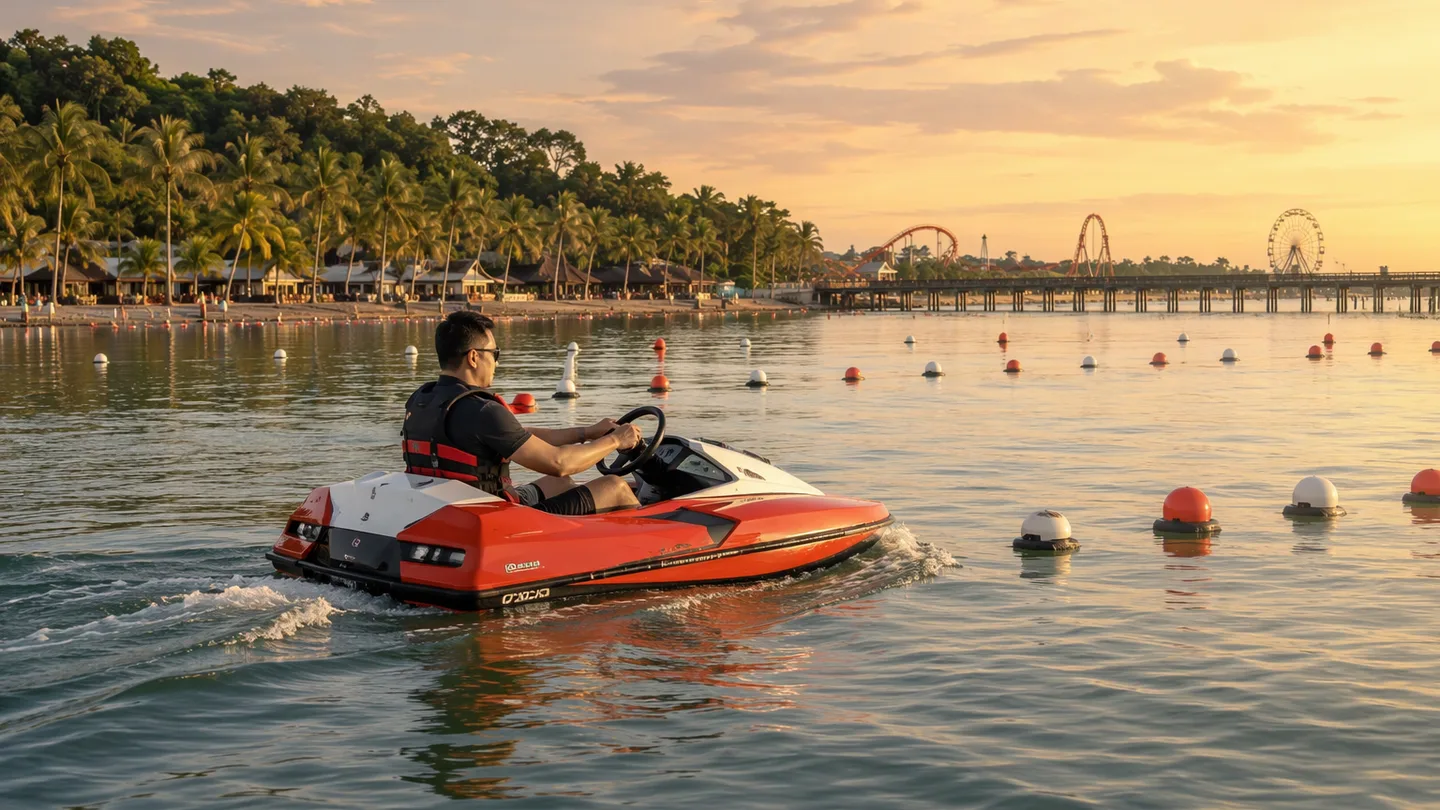
TL;DR: Vietnam closed 2025 with 21.2 million international visitors (+20.4% over 2024, past the 2019 record of 18 million) and 17.7 million more in the first three quarters of 2026 (+14.5%). The regulatory track that matters is Decree 48/2019/ND-CP, Article 3.1: water-based amusement rides carrying five passengers or fewer register at the provincial People's Committee, with certification in three working days — a passenger-count axis, the third distinct regulatory axis this series has mapped (Thailand sorts by gross registered tonnage, Turkey by hull length, Vietnam by passenger count). China-origin equipment dominates the import flow, and under ACFTA Form E the HS 8903 duty line goes to zero, with VAT at a reduced 8% through 31 December 2026 — an import-cost window with an expiry date. And the uncomfortable fact: we found no scaled kart boat operations in Vietnam at all (public-data basis) — nobody has built here yet. That is either nothing, or it is the entry window the Thailand and Turkey guides wished they had documented.
Where this guide sits in the series
Every market in our operator series has asked the investor to accept a premise: Greece asked you to read visitor-flow management as an equipment-upgrade signal; Portugal, to trust a mature market's composition; Croatia, to accept a statute that sorts the equipment itself; Turkey, to hold a reformed licence system and a punishing currency in the same spreadsheet; Thailand, to price a 0% entertainment-vessel tax against a supply-constrained market. Vietnam asks you to accept something harder: the market data says build, the regulation says easy, and the competitive set says empty. When all three point the same way and nobody has moved, either everyone else knows something we do not, or Vietnam is the clearest first-mover case in this series. This is the second Southeast Asian stop, after the Thailand Phuket operator guide, the fourteenth guide overall, alongside the Mediterranean cluster — the Greece, Portugal and Croatia guides, the Turkey guide with its length-based ADB reform, and the Mediterranean fleet-planning pillar. Vietnam is not an EU market: no customs union, no AFIF funding channel, and a regulatory system that runs on decrees rather than directives — which is exactly why the passenger-count rule deserves its own guide.
Why does the five-passenger rule matter for kart boats?
One decree does most of the regulatory work: Decree 48/2019/ND-CP.
Article 3.1 of that decree defines "carriers of water-based amusement equipment" (phương tiện vận tải...) — and the practical reading, confirmed against the decree's full text, is: water-based amusement-ride carriers designed to carry up to five passengers, operating in approved waters, register with the provincial People's Committee and receive certification within three working days, on the strength of an import declaration, a technical safety certificate and a purchase contract. No licence exam for the vessel, no national-level gate, no tonnage computation. A four-passenger kart boat lands squarely in this track. The decree also draws two boundary lines we read in the full text: traditional festivals and diving activities sit outside it (Article 1.2), and a vessel that works as both an inland-waterway craft and an amusement ride must comply with both frameworks at once (Article 2.2) — the second-hand-boat conversion scenario, named so you can plan around it.
Put it next to the rest of the series and the pattern completes. Greece draws its licence-free line in power (~30 hp), Croatia's statute line is 5 kW, Thailand sorts entertainment vessels by gross registered tonnage, Turkey's 2026 reform drew a length line (ADB 10 at 10 metres). Vietnam sorts by passenger count — the third distinct axis this series has mapped. The practical consequence: a standard four-passenger kart boat needs no seat-math, no length-measurement, no tonnage certificate — it is in-or-out by design. And a six-to-eight passenger configuration steps out of the amusement-ride track entirely, into the inland passenger-vessel framework (QCVN 72:2025/BGTVT, with Circular 39/2019/TT-BGTVT) — a different and heavier regime. The fleet-mix decision is also a regulatory-track decision. Our Turkey guide made the same point from the length axis: spec for the track, not against it. The series' three axes, side by side (Thailand figures from our Thailand guide):
| Thailand | Turkey | Vietnam |
|---|---|---|---|
Regulatory axis | Gross registered tonnage | Length (ADB 10/ADB 24) | Passenger count (≤5) |
Entry line for a 4-passenger kart boat | GRT entertainment-vessel registration | ≤10 m sits in ADB 10 | Provincial registration, 3 working days |
Import tax position | 0% entertainment-vessel tax | 20% KDV | ~0% duty + 8% VAT (to 31 Dec 2026) |
What is the market signal actually saying?
The demand engine is the strongest first datapoint in this series. Vietnam closed 2025 at 21.2 million international visitors (+20.4%), past the 2019 record of 18 million; the first three quarters of 2026 added 17.7 million (+14.5%). The source mix matters as much as the total: China ~5.2 million (+41% — the fastest-growing and largest single source), South Korea ~4.3 million, Taiwan ~1.23 million — with Asia at nearly 80% of arrivals. A Chinese-dominant, family-oriented visitor base is precisely the customer profile a supervised, low-speed, family-format kart boat circuit serves — and, pragmatically, a market where Mandarin-language crew capability is a revenue line, not a nice-to-have.
Three destination clusters carry the demand:
Phu Quoc is the growth story. The island logged 7.6 million visitors in 2025 with international arrivals up 65.8% — the fastest international growth in Vietnam — on 30-day visa-free access with direct international flights, and Sun Group's announced $3.5 billion programme building 17,400 rooms ahead of APEC 2027. VinWonders Phu Quoc (~50 hectares) and Vinpearl Safari anchor the amusement density; VinWonders Phu Quoc adult admission lists at VND 950,000 (~$36), Nha Trang's park at 1,050,000 — a price band where a supervised water session priced between the parasailing line (VND 400,000–500,000 per 15 minutes) and the jet-ski line (VND 800,000 per 15 minutes) has clear room. Sun World Hon Thom, Sun World Ha Long and Ba Na Hills round out the Sun Group portfolio.
Da Nang is the volume story: ~17.3 million visitors in 2025 (7.6 million-plus international), with a 2026 target of 19.5 million — and, as covered below, it is now the enforcement-tightening sample of the whole country. Nha Trang (Khanh Hoa) is the hotel-density story: 16.4 million visitors (5.5 million international) served by roughly 100,000 rooms, 75% of them three-to-five-star — the room stock that turns day visitors into overnight guests for a two-session-per-day water circuit.
Now the honest part. We found no scaled kart boat operations anywhere in Vietnam — and we want to be precise about what that means. Public data shows bumper boats (thuyền đụng) running at two Dalat amusement venues, and social posts describing a "water karting mini" format (8–20 boats per circuit, 8–10 minute sessions, advertised ticket prices above conventional water rides) — but every one of those signals is [T3], social-tier evidence, and none of it constitutes a scaled, documented, multi-unit kart boat operation. On the public-data basis this series uses, scaled operations are zero. We cannot rule out unpublicized installations; we can rule out documented ones. The same public data shows Chinese-origin equipment dominating the water-park import flow (the Guangdong and Hengshui manufacturing clusters), with regional ride suppliers appearing in public project listings — a supply chain already oriented toward Vietnam. Either way, an operator entering now is not displacing incumbents; they are writing the category's first chapter, and the demand numbers say the chapter is overdue.
One honest note, consistent with the whole series: no Vietnamese inquiry has reached our inbox yet. The Kuwait buyer journey remains our only first-hand case. Everything here is public-data inference, and we label it as such.
The licensing chain, end to end
For the boats: import on your own HS 8903 declaration (duty math below), then provincial registration under Decree 48/2019 — three working days, on the file of import declaration + technical safety certificate + purchase contract. Vietnam's CR-mark (STAMEQ/QCVN) list does not include complete recreational craft, so the technical gate is the Vietnam Register (VR) inspection regime under QCVN 72:2025/BGTVT (which replaced 72:2013 in the 2025 revision wave, with safety equipment under QCVN 42:2015). CE documentation has no statutory mutual-recognition route in Vietnam; in practice it serves as technical supporting evidence in the file. We say "in practice" deliberately — the acceptance mode of CE material is one of the items we flag for confirmation with counsel rather than restate as settled law.
For the business: pure equipment rental runs on an Enterprise Registration Certificate plus local conditions — the light track. The moment the business model includes arranging travel services (packages, ticket-plus-transfer bundles sold as a tour), the international travel-service licence regime under Law 09/2017/QH14 applies, and that is where the foreign-investment ceiling bites: WTO commitments do not open 100% foreign ownership for international travel services — a Vietnamese JV partner is required, with a deposit regime behind it (Decree 168/2017: VND 250 million for inbound tour operators, with reduction schedules whose current status we flag for confirmation). The structural advice mirrors our Thailand guide: keep the rental operation on the ERC track and route any packaged-tour revenue through a partner — the corporate-structure question is a day-one decision, not a retrofit.
For the water itself: Decree 48/2019 runs a two-zone system. Vùng 1 (navigation-channel waters) sits with the transport/maritime authorities; Vùng 2 waters are designated by provincial announcement, and operating there requires a safety-and-rescue plan plus a buoy-and-flag scheme with specific dimensions on the record — buoys of at least 50 cm, flags of 50×60 cm, spacing at 10-metre intervals. These are cheap physical-compliance items, and the operation that has them drawn into the site plan on day one never has a surveyor's argument to lose.
For the riders: life jackets are mandatory for the entire ride — the decree is explicit across its passenger clauses. The driver's-licence line sits at 5 horsepower: engines above 5 hp require the operator to hold a driver's licence; at or below 5 hp, operator safety training suffices. Read that line against your spec sheet honestly: a typical electric kart boat's peak motor rating (ours: 15 kW, about 20 hp) sits above the line, while its supervised-session cruising output — roughly 2.5–3.3 kW, about 3.4–4.4 hp — runs inside it. Which figure the province applies to a session boat is a classification question to raise at registration, not a given. Greece's license-free line (about 30 hp) sits above a kart boat's peak rating, which is why that market never had this question. And tourist accident insurance has no national mandatory clause we could find — we present that as "no national mandate found plus a rescue plan as the operative safeguard," not as legal permission to skip insurance; some provincial practice may require coverage locally, and that is a confirm-with item, not a footnote.
The import tax stack: zero duty plus 8% VAT — with an expiry date
Here is the arithmetic that makes Vietnam unlike any other market in this series, and it is the hardest number in the guide: through 31 December 2026, the effective import position on a Chinese-origin electric kart boat is approximately 0% duty plus 8% VAT.
The layers, from the top: HS 8903 (recreational/sport vessels) carries an MFN duty of roughly 10%, with VAT at the standard 10%. Two instruments compress that stack. First, ACFTA (the ASEAN–China FTA): a Form E certificate of origin moves the HS 8903 duty line to 0% under the agreement's tariff schedule (Decree 07/2023/NĐ-CP governs the preferential regime). Second, VAT on imported goods runs at the reduced 8% rate through 31 December 2026 under Decree 174/2025/NĐ-CP, the extension decree. Net: the buyer's import cost line drops by roughly ten points of duty plus two points of VAT — on a $100,000 fleet order that is real four-figure-to-five-figure savings per boat — versus buying into a 10%-duty environment after the window closes.
Three qualifications, stated plainly. First, the 31 December 2026 expiry is real: VAT reduction decrees in Vietnam have been extended before (this one already is an extension), so the window may be extended again — but an operator who signs inside the window locks the 8% rate; one who signs after it bets on an extension decree they do not control. Second, the Form E route requires Chinese origin and correct 8-digit heading alignment — the exact 8-digit duty rate under ACFTA is one of our confirm-with items (preferential schedules are amended mid-year more often than buyers expect); get the certificate right at the Chinese factory gate, not at Vietnamese customs. Third, this math is China-specific: a non-ACFTA origin faces the full ~10% MFN duty. Against the series: Thailand prices entertainment vessels at a 0% tax position (its own zero-duty story), Turkey carries 20% KDV, the EU members 21–25% — Vietnam is the only market in the series where the tax argument and the supply-chain argument point at the same origin. See our HS-code and duty guide for the layer-by-layer method and our price guide for how a landed-cost stack is built; run your own numbers before signing.
Where the demand sits: Phu Quoc, Da Nang, Nha Trang
The classic season is October–April on the south coast (Phu Quoc peaks in the dry season) and roughly April–September in the centre (Da Nang, Nha Trang) — a geography that lets a two-site operator smooth seasonality the way our Mediterranean fleet-planning pillar argues for, and pairs with the Gulf cluster (the Kuwait operator guide makes the mirror argument) into a year-round circuit.
Siting-wise, we would rather enter Phu Quoc first — the fastest international growth in the country (+65.8%), the amusement density (VinWonders, Safari, Hon Thom) that feeds a water-park-adjacent format, the $3.5 billion Sun Group build-out ahead of APEC 2027, and 30-day visa-free access doing the marketing for you. That is a judgment call, and the data supports other reads: Da Nang is the larger absolute market with the enforcement-tightening signal to plan around, and Nha Trang's 100,000-room stock is the deepest overnight-guest base. What the data does not support is treating Vietnam as one market — the decree is national, the demand is not. Cost-side anchors, for the model: Region I minimum wage VND 5,310,000/month from 1 January 2026 (+7.2%); commercial pool entry tickets VND 40,000–200,000 per person; mobile pool full-day hire VND 400,000–950,000 (Hanoi listings). Our startup-cost guide and the 15-boat venue ROI case carry the full cost-stack model; the maintenance guide carries the running-cost lines. Vietnam-specific wage and venue-cost lines slot straight into the same model.
Safety after the accidents: the compliance dividend
Two accidents reshaped the enforcement climate, and we name them because an operator's risk model must include them. The Wonder Sea capsizing in Ha Long Bay in July 2025 (37 dead) — the deadliest maritime accident in Vietnam's recent record — was followed by a Phu Quoc incident in 2026 with 15 dead, and the response has been administrative: Da Nang moved to mandatory pre-season inspections; the technical framework was revised (QCVN 72:2025 replacing 72:2013, new circulars 02–06/2025); inspection authority transferred to the Ministry of Construction (Circular 28/2026/TT-BXD); a yacht-industry decree remains in planning (not yet issued); and a consolidated maritime code draft went to consultation in May 2026 (not in force). We report the reform list at the system level — we have not read each implementing text, so we do not restate its terms.
Here is the counter-intuitive read: an enforcement-tightening cycle is a compliance dividend for the operator who arrives with documentation. Every tightened gate — pre-season inspections, revised QCVN technical standards, transferred inspection authority — is a gate that undocumented or second-hand-converted fleets fail and a documented fleet clears by design. A new-build fleet with import declarations, factory technical certificates and provincial registration papers walks through the same inspection cycle that squeezes improvised operators out. Our electric-versus-gas comparison makes the same argument in every protected-water jurisdiction; in post-2025 Vietnam it applies double — the regulatory wind is at the back of the operator whose paperwork was right from day one. Wonder Sea's death toll is stated as 37 throughout — sources differ on 38–39, and we use the lower figure only.
The honest gaps
Three gaps, stated as found. Charging infrastructure: zero pilots found. We found no marina or venue fast-charging pilot announced for 2025–26 in Vietnam — no VinGroup or Sun Group charging announcement surfaced in multiple search rounds. Charging-at-berth follows vessel electrification historically, not the other way around, so plan charging as private infrastructure — the model our 15-boat venue ROI case is built on. The yacht decree is planning-stage only — we note its existence without restating terms, consistent with how we treated Turkey's unretrieved regulation text. The insurance question has no national mandatory clause — presented as confirm-with, as above. And one more, already stated: the zero-scaled-operations finding is public-data-based [T3]-floor evidence; treat it as an absence of documentation, not proof of absence.
FAQ
Do kart boat operators need a licence in Vietnam?
A four-passenger kart boat registers as a water-based amusement-ride carrier under Decree 48/2019/ND-CP, Article 3.1: provincial People's Committee registration, certification within three working days, on an import declaration, technical safety certificate and purchase contract. The 5-horsepower driver's-licence line applies to operation: above 5 hp the driver holds a licence; at or below, operator safety training. Life jackets are mandatory for the entire ride. Confirm current procedures with the provincial authority — the framework was revised in the 2025 wave and a consolidated code is in draft.
What does importing a kart boat to Vietnam actually cost in duty and VAT?
Through 31 December 2026, the effective position on Chinese-origin HS 8903 imports is approximately 0% duty (ACFTA Form E certificate of origin) plus 8% VAT (Decree 174/2025/NĐ-CP reduction). Without Form E, the MFN duty is roughly 10% and post-window VAT returns to 10%. The exact 8-digit preferential rate should be confirmed against the current ACFTA schedule with your customs broker before contracting. See our HS-code and duty guide for the method.
Can a foreign investor own a kart boat rental business outright in Vietnam?
Pure equipment rental runs on an Enterprise Registration Certificate plus local conditions — no WTO ownership ceiling applies to that activity as we read it. The ceiling bites when the model includes travel services: international travel-service licences under Law 09/2017/QH14 do not open 100% foreign ownership (a Vietnamese JV partner is required), with a VND 250 million deposit regime behind it (Decree 168/2017). Structure rental on the ERC track and route packaged-tour revenue through a partner; confirm the exact ownership boundary with counsel before incorporation.
Where should I site a first fleet — Phu Quoc, Da Nang or Nha Trang?
Our read: Phu Quoc first — fastest international growth (+65.8% in 2025), the country's densest amusement cluster (VinWonders, Vinpearl Safari, Sun World Hon Thom), the $3.5 billion Sun Group build-out ahead of APEC 2027, and 30-day visa-free access. Da Nang is the larger absolute market with a 2026 target of 19.5 million visitors but now carries mandatory pre-season inspections; Nha Trang has the deepest hotel base (~100,000 rooms, 75% three-to-five-star). The decree is national; the demand is not — site for the cluster you can serve daily, not the country you can name.
How does Vietnam's regulatory track differ from Thailand and Turkey?
By axis. Thailand sorts entertainment vessels by gross registered tonnage; Turkey's 2026 reform sorts private vessels by hull length (ADB 10/ADB 24); Vietnam sorts water-based amusement rides by passenger count (≤5 = provincial registration in three working days). A standard four-passenger kart boat clears all three by design. The difference is administrative weight: Vietnam's track is the lightest of the three for a compliant four-seater — no tonnage computation, no length survey, a provincial desk and a three-day clock.
How long does delivery to Vietnam take?
Six to nine weeks of production plus roughly three to four weeks of ocean transit to a Vietnamese port (Hai Phong for the north, Cat Lai/Ho Chi Minh City for the south, with Phu Quoc typically fed via Ho Chi Minh City), then customs clearance and provincial registration — the latter now measured in days under Decree 48/2019, not weeks. Working back from a dry-season opening on Phu Quoc (November), order by early autumn; and with the ACFTA VAT window closing 31 December 2026, earlier contract signatures lock the 8% rate.
Data caveats
Tourism figures (21.2M international visitors in 2025, +20.4%, past the 18M 2019 record; 17.7M in the first three quarters of 2026, +14.5%; source mix China ~5.2M/+41%, Korea ~4.3M, Taiwan ~1.23M, Asia ~80%) come from the Vietnam National Administration of Tourism (VNAT) and official tourism-statistics reporting [T1]. Destination figures: Da Nang ~17.3M (7.6M+ international; 19.5M target) via Baodanang [T2]; Khanh Hoa/Nha Trang 16.4M (5.5M international) with ~100,000 rooms (75% three-to-five-star) via VNAT-basis reporting [T1/T2]; Phu Quoc 7.6M with international +65.8% and the Sun Group $3.5B/17,400-room APEC 2027 programme via VietnamPlus/The Investor [T2]. Amusement pricing: VinWonders Phu Quoc adult admission VND 950,000 and Nha Trang VND 1,050,000 as listed on official VinWonders/Vinpearl pages at research time (seasonal and subject to change); parasailing VND 400,000–500,000 and jet-ski VND 800,000 per 15 minutes from operator listings [T1/T2]. The regulatory spine — Decree 48/2019/ND-CP Article 3.1 (five-passenger amusement-ride carriers, provincial registration, three working days), Articles 1.2 and 2.2 boundary lines, the two-zone waters system, the buoy/flag dimensions, the lifejacket and 5-hp licence clauses — was read against the decree's full text via VCCI's republication and cross-checked against a second pass of the official text [T1]. The import-tax stack (HS 8903 MFN ~10%, VAT standard 10%, 8% reduced rate through 31 December 2026 under Decree 174/2025/NĐ-CP, ACFTA Form E zero duty under Decree 07/2023/NĐ-CP) comes from KPMG Vietnam and luatvietnam [T2]; the exact 8-digit ACFTA preferential rate is flagged for confirmation against the current schedule. CR-mark exclusions and the VR inspection regime (QCVN 72:2025/BGTVT replacing 72:2013; safety equipment QCVN 42:2015; Circular 39/2019/TT-BGTVT; Circular 28/2026/TT-BXD inspection transfer) come from trade.gov.vam vr.org.vn [T1/T2]. The travel-service licence regime (Law 09/2017/QH14, WTO 100%-foreign-ownership exclusion, Decree 168/2017 VND 250M deposit) comes from Invest Danang and legal commentary [T1/T2], with the deposit-reduction schedule flagged for confirmation. Wage data (Region I VND 5,310,000/month from 1 January 2026, +7.2%) is Baker McKenzie reporting [T2]. Pool-entry and mobile-pool hire ranges are Hanoi-area listings [T3]. The zero-scaled-operations finding rests on [T3]-tier signals: bumper boats at two Dalat venues and social-post descriptions of a "water karting mini" format; we treat it as absence of documentation, not proof of absence. The accident record (Wonder Sea, Ha Long Bay, July 2025, 37 dead; a 2026 Phu Quoc incident with 15 dead; Da Nang mandatory pre-season inspections) comes from Reuters, chinhphu.vn and national press [T1/T2]; death-toll discrepancies (38–39) are resolved to the lower figure throughout. We explicitly did not use: independent 2025 Ha Long Bay visitor counts (no verifiable official figure), pool-circuit hourly rental rates (no public market), industry model citations without primary sourcing, and any Wonder Sea toll other than 37. CE documentation acceptance in VR files is practice-level evidence, flagged for confirmation. Nothing in this guide is legal, tax or investment advice; confirm licences, tax positions, ownership structures and insurance obligations with Vietnamese counsel before contracting.
Sources
- VNAT / vietnamtourism.gov.vn (retrieved 2026-11-04) — 2025: 21.2M international visitors (+20.4%), past the 18M 2019 record; 2026 Q1–Q3: 17.7M (+14.5%); source mix China ~5.2M (+41%), Korea ~4.3M, Taiwan ~1.23M; Asia ~80% of arrivals
- Baodanang.vn (retrieved 2026-11-04) — Da Nang 2025: ~17.3M visitors (7.6M+ international); 2026 target 19.5M
- VNAT-basis reporting (retrieved 2026-11-04) — Khanh Hoa/Nha Trang 2025: 16.4M visitors (5.5M international); ~100,000 rooms, 75% three-to-five-star
- VietnamPlus / The Investor (retrieved 2026-11-04) — Phu Quoc 2025: 7.6M visitors, international +65.8% (fastest in Vietnam); Sun Group $3.5B / 17,400 rooms ahead of APEC 2027
- VinWonders / Vinpearl official pages (retrieved 2026-11-05) — VinWonders Phu Quoc adult admission VND 950,000; Nha Trang VND 1,050,000; children under 100 cm free
- Operator listings (retrieved 2026-11-04) — parasailing VND 400,000–500,000 per 15 min; jet-ski VND 800,000 per 15 min
- VCCI republication of Decree 48/2019/ND-CP (retrieved 2026-11-04) — Article 3.1 five-passenger amusement-ride carriers; provincial registration within three working days; Articles 1.2/2.2 boundary clauses; two-zone waters system; buoy ≥50 cm / flag 50×60 cm / 10 m spacing; lifejacket clauses; 5-hp driver's-licence line
- Law 95/2015/QH13 (Maritime Code) and wto.org/economica.vn analysis (retrieved 2026-11-04) — maritime code excludes small pleasure craft in inland waters; dual-track reading
- QCVN 72:2025/BGTVT (replacing 72:2013), Circular 39/2019/TT-BGTVT, QCVN 42:2015 (safety equipment) — vr.org.vn / trade.gov.vn (retrieved 2026-11-04) — inland passenger-vessel framework and inspection regime
- Decree 174/2025/NĐ-CP — VAT reduction to 8% through 31 December 2026; KPMG Vietnam / luatvietnam (retrieved 2026-11-04) — HS 8903 MFN ~10%, VAT 10%, ACFTA Form E zero duty, Decree 07/2023/NĐ-CP preferential regime
- Law 09/2017/QH14 (Tourism), Decree 168/2017 (VND 250M inbound deposit) — Invest Danang (retrieved 2026-11-04) — travel-service licence regime; WTO 100%-foreign-ownership exclusion
- Baker McKenzie Vietnam (retrieved 2026-11-04) — Region I minimum wage VND 5,310,000/month from 1 January 2026 (+7.2%)
- Reuters / chinhphu.vn / national press (retrieved 2026-11-04) — Wonder Sea capsizing Ha Long Bay July 2025 (37 dead); 2026 Phu Quoc incident (15 dead); Da Nang mandatory pre-season inspections; QCVN 72:2025 revision wave; Circular 28/2026/TT-BXD inspection transfer to Ministry of Construction; consolidated maritime code draft in consultation May 2026 (not in force)
- Hanoi-area listings (retrieved 2026-11-04) — commercial pool entry VND 40,000–200,000 per person; mobile pool full-day hire VND 400,000–950,000
- Dalat venue listings / social posts (retrieved 2026-11-04) — bumper boats (thuyền đụng) at two venues; "water karting mini" format descriptions (8–20 boats/circuit, 8–10 min sessions) [T3]
Lecturas relacionadas
Get a Quote for Your Kart Boat Business
Tell us what you need — OEM/ODM specs, quantity, target market. Our team replies within 24 hours.
Prefer a quick chat?
Chat on WhatsAppFree B2B resources
Buyer guides, ROI calculators, customs checklists, and case studies — built on direct factory manufacturing experience.