Kart Boats in Turkey: Operator Guide to Licence Reform
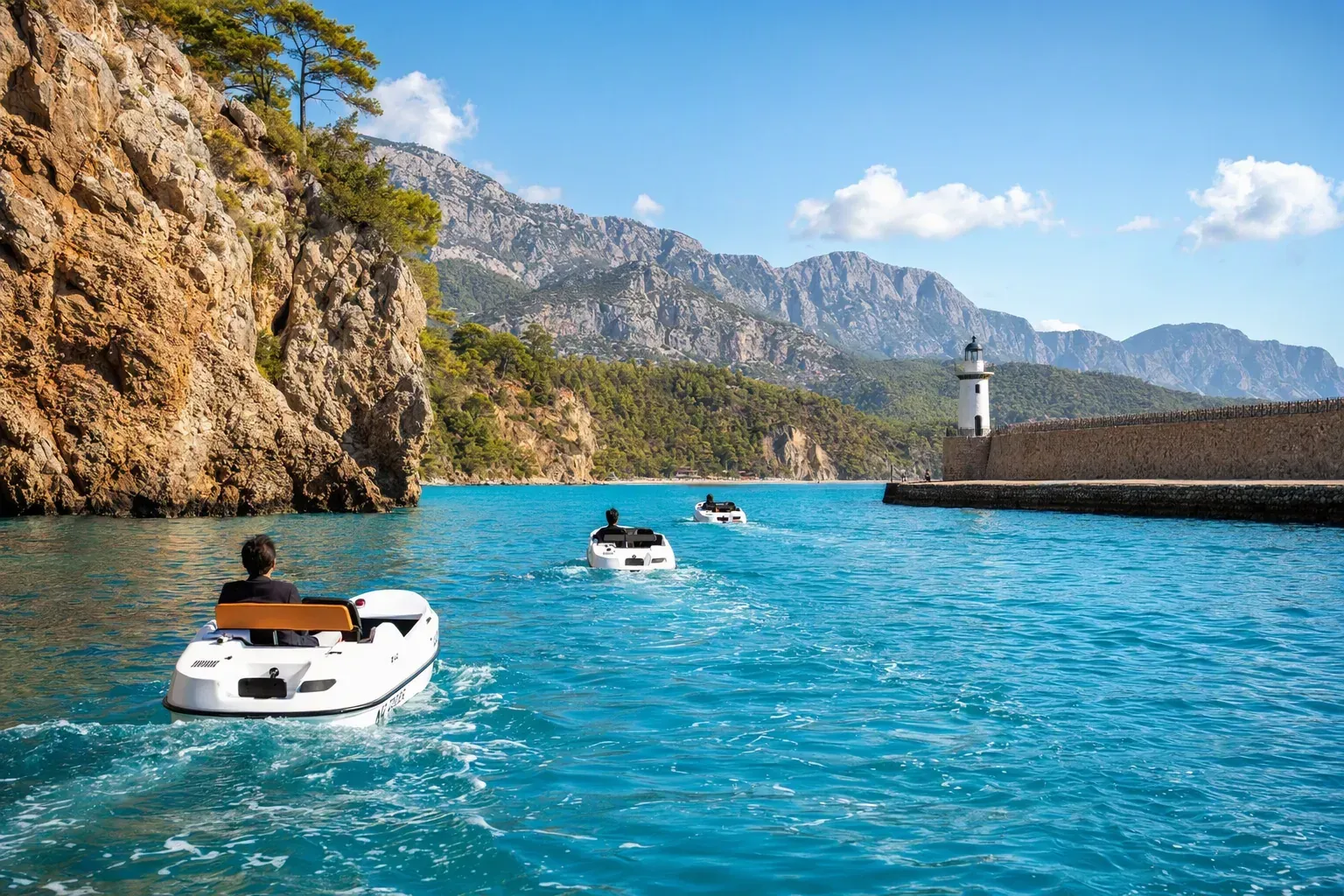
TL;DR: Turkey closed 2025 with roughly 64 million visitors and $65.2 billion in tourism revenue (+6.8%) (TÜİK-basis reporting), a record 17 million-plus arrivals in Antalya, and 2,138,136 cruise passengers — the first year above 2 million since 2013. From 17 January 2026, the private-boat licence (Amatör Denizci Belgesi, ADB) splits into ADB 10 (vessels up to 10 m) and ADB 24 (up to 24 m) — a length-based system, where Greece runs a power-based one. The lira traded near 49/USD as of end-September 2026 with inflation running near 30%, which makes the electric drivetrain a currency hedge, not just an environmental one: it replaces an imported, dollar-priced fuel line with domestic electricity. And GCC arrivals collapsed by nearly 80% in 2025 for war-related reasons — a reminder that customer-source concentration is an equipment-investment risk too.
Every market in our operator series has asked the investor to accept a premise: Greece asked you to read visitor-flow management as an equipment-upgrade signal, Portugal asked you to trust a mature market's composition, Croatia showed you a law that sorts the equipment itself. Turkey asks you to hold two things at once — a regulatory system newly reformed, and a currency that punishes anything priced in dollars. We think those two facts belong in the same spreadsheet. This is the fourth stop in our Mediterranean cluster, alongside the Greece operator guide, the Portugal operator guide, the Croatia operator guide and the Mediterranean fleet-planning pillar — and the first market in the series that is not an EU member. Turkey sits in the EU customs union, which changes the conformity paperwork but not the currency math. This guide covers the demand engine behind 64 million visitors, the 2026 ADB reform, the tax stack (20% standard KDV), the two-flagship-species protected waters, and the currency arithmetic no other market in this series offers.
Why does the 2026 licence reform matter for kart boats?
One date does most of the regulatory work: 17 January 2026.
On that date Turkey's official Gazette (Resmî Gazete, No. 33140) published a reform of the amateur seaman's licence — the ADB (Amatör Denizci Belgesi) — that replaces a single licence covering vessels up to 24 m with a two-tier, length-based system: ADB 10 for vessels up to 10 metres (minimum age 16, online training plus examination) and ADB 24 for vessels up to 24 metres (minimum age 18, plus twelve months of sea service). Historically, engines above roughly 10 BG — about 10 horsepower — already required an ADB. We report the tier structure and the fact of Gazette publication because that is what the multiple Turkish industry sources agree on and what a district governorship notice under the Ministry of Transport confirms; the transition arrangements for existing licence-holders are contested between those sources, so we do not restate them. Verify the current text with a Turkish counsel or the harbour master before you structure a rental operation.
Read the reform next to the rest of the series and a pattern appears. Greece draws its license-free line in power (about 30 hp), Portugal's rental practice sits near 15 hp, Croatia's statute line is 5 kW. Turkey has chosen a length axis instead. For an operator, the practical question shifts from "what motor is aboard" to "how long is the hull" — and small electric kart boats clear a 10-metre line the way they clear a 5 kW line: by design, not by detuning.
The rental-side practice runs on a different track. In practice, tourists renting personal watercraft on Turkish beaches are not asked for a formal licence; operators verify age (18+) and supervise use in designated zones, with coastal distance limits that date back to 2005 and Coast Guard (Sahil Güvenlik) checks on operators ahead of each season. We write "in practice" deliberately — this is operator-side reporting from tourism and industry pages rather than statute text we have read. The B2B consequence holds either way: compliance weight sits on the operator's paperwork, not on the customer's certificate. A fleet that is easy to supervise, quiet enough for shared beaches, and simple to document is the fleet that survives an operator-responsibility regime.
What is the market signal actually saying?
Turkey's tourism engine is the largest in this series by revenue. 2025 closed with about 64 million total visitors (+2.7% year-on-year), 52.78 million foreign visitors (a record), and $65.2 billion in tourism revenue, up 6.8% — past the $64 billion target — with Russia, Germany and the UK as the top three source markets. The official 2026 target is $68 billion, and the first half of 2026 already logged 25.76 million visitors and $25.75 billion.
Antalya is the engine room. The province broke its own record with more than 17 million visitors in 2025, its airport handled 39.2 million passengers, and a €865 million terminal expansion completed in April 2025 doubled capacity — with the airport's operator stating the goal in public: a "12-month tourism season". October 2025 alone recorded roughly 2.2 million foreign arrivals in the province, which is what a lengthening season looks like in the data. The Aegean coast tells a calmer story: industry reporting has Muğla-region hotels at 64.1% occupancy in 2025 and Bodrum falling short of the season's industry expectations (we label that "industry expectations" because the source is local trade press, not an official tally). Two coasts, two tempos — for siting purposes that is information, not noise.
Cruise traffic is the third leg. Turkey handled 2,138,136 cruise passengers in 2025 — the first year above 2 million since 2013 — with Kuşadası leading at 617 calls and 995,303 passengers, and Istanbul's Galataport setting records on both counts. Cruise passengers are shore-excursion revenue, and shore excursions are precisely the water-sports format — short, supervised, high-turnover sessions near a berth — that a kart-boat circuit serves.
Now the uncomfortable number. Arrivals from the GCC — Kuwait, the UAE, Qatar, Bahrain — fell by nearly 80% in 2025. That collapse had a specific cause: the Iran war and airspace closures in mid-2025, and coverage from Skift and regional sources treats it as a geopolitical shock, not a preference shift. We flag the background because the same number makes two opposite arguments. Read carelessly, it says "GCC demand is gone." Read correctly, it says a market whose visitor mix can lose a region overnight is a market where revenue diversification is structural, not optional — and equipment that serves the walk-up family session, the school group, and the cruise shore-excursion side by side hedges that risk better than a single-premium-niche fleet. Our Oman operator guide makes the mirror-image point from the GCC side: Oman's Khareef season gains when regional travel is cheap and close. Turkey 2025 is what the downside of that dependence looks like.
One honest note, consistent with the whole series: no Turkish inquiry has reached our inbox yet. The Kuwait buyer journey remains our only first-hand case. Everything here is public-data inference, and we label it as such.
The licensing chain, end to end
For the boats themselves: private vessels register through the harbour master's office (harbour master), with a survey report and proof of ownership in the file; maritime qualifications and surveys sit under the Ministry of Transport and Infrastructure. For foreign-flagged private vessels entering Turkey, the transit-log procedure applies — reported at roughly USD 35 per year — and registration paperwork in practice lists a CE Declaration of Conformity among the documents.
For the business itself: water-sports operators work within the Ministry of Culture and Tourism's İşletme Belgesi (operation certificate) framework, layered with beach and water-sports regulations and municipal beach concessions. We describe that framework at the system level only — we were unable to retrieve the underlying regulation number and text, so we will not cite one. The Coast Guard's seasonal operator inspections are the enforcement layer operators actually plan around.
For the renters: the ADB tiers described above apply to private operation. Rental tourists, in practice, ride under operator supervision in designated zones. If your fleet concept is a family kart-boat session inside a marked bay at planing-free speeds, you are designing for the easiest version of every one of those gates: short sessions, visible supervision, low wake, a hull class the inspectors do not argue with.
Currency math: the hedge no other market in this series offers
Here is the arithmetic that makes Turkey unlike Greece, Portugal or Croatia. The lira traded near 49 per US dollar as of late September 2026, after losing about 20.4% against the dollar across 2025; inflation is running near 28–30% (the official end-2026 forecast was revised up to 28.4%), and the central bank's policy rate sits at 37%. All figures carry their timestamps; currency and inflation numbers age fast, and ours are dated to late September 2026.
Now put an operator's cost stack on top. Revenue in the tourist season is substantially foreign currency — the rental market quotes foreign guests in euros: Bodrum jet-ski sessions run roughly €60–70 for 15 minutes, €150 for 30 minutes, €250–300 for an hour, with shoulder-season discounts of 15–30%; Antalya listings span €55–80 for 15 minutes. But wages, dock fees and utilities are largely lira-denominated. A weaker lira therefore passively widens an operator's gross margin in dollar terms — unless a large cost line is itself imported and dollar-priced. Fuel is exactly that line: Turkey imports most of its energy, so a combustion fleet's running cost rides the exchange rate in the wrong direction, twice.
That is the structural argument for the electric drivetrain in Turkey, and it is stronger than the environmental one: an electric fleet replaces an imported, dollar-priced fuel line with domestically generated electricity, converting the most volatile variable cost into a local-currency one. The kWh that charges a battery is priced in lira. In a 30%-inflation, 49/USD economy, that substitution is a hedge — the first market in this series where the propulsion choice is also a treasury decision. Our price guide and startup-cost guide model the cost stack in stable-currency terms; in Turkey, run the same model twice — once in euros, once in lira — before you sign. The dual-currency pricing you see on Turkish booking pages (euros for guests, lira for locals) is the market already telling you how it hedges.
One caveat we owe you: the same inflation that hedges operating costs also inflates import capex. Batteries and motors are import goods; a fleet ordered today prices in today's exchange rate, and the 28–30% inflation environment presses on equipment invoices too. The hedge argument is strongest on operating costs; treat capex timing and payment currency as a negotiation item with your supplier, and see our HS-code and duty guide for the duty layer.
The comparison with the rest of the Mediterranean cluster, in one table (Greece and Croatia figures from our earlier guides in this series):
| Greece | Croatia | Turkey |
|---|---|---|---|
Licence axis | Power | Power (statute) | Length |
Entry / licence-free line | ~30 hp license-free | 5 kW license-free | ADB 10 (≤10 m) / ADB 24 (≤24 m) |
Standard VAT | 24% (17% island band) | 25% (13% on charter rental) | 20% KDV |
Currency | EUR | EUR | TRY — near 49/USD as of late September 2026 |
Tax and market access
The standard VAT (KDV) rate is 20% (raised from 18% by presidential decree in July 2023), with reduced bands at 10% and 1% carried into 2026. The band that matters to a resort operator: accommodation services sit at the 10% reduced rate — confirmed by the tax authority's own rulings for hotel and resort overnight stays, with catering and spa billed separately — while the overnight accommodation tax (Konaklama Vergisi) runs at 1%, reduced from 2% by decree. A tourism-investment incentive law (Law 5225) has historically carried VAT and customs exemptions for certified tourism investments; we could not retrieve current English-language implementing detail for 2025–26, so we note the law's existence without restating its terms.
Market access rides the customs union. Turkey is a member of the EU customs union but not the EU, and a WTO trade-policy review confirms the alignment mechanism that pulls EU technical legislation into Turkish law; in practice, CE documentation appears in private-vessel registration checklists. We deliberately do not claim a Turkish type-approval route for recreational craft — we could not find the official text, and the honest statement is the weaker one: align your CE file as for the EU members in this series, and confirm the acceptance path with the harbour master before shipping.
Protected waters: two flagship species, one management template
Two internationally flagship species anchor Turkey's protected-waters story, and both come with rules an operator can read as a template.
The first is the loggerhead turtle (Caretta caretta) at Iztuzu Beach near Dalyan — a 4.5-kilometre nesting beach where the delta channels run a 7 km/h speed limit, the nesting season (roughly May–September) brings a night closure from 18:00 to 08:00, boats may land only at the designated western end while the eastern end is off-limits, and day-trip boats operate under a daily capacity cap. Nest counts fell from 308 (2023) to 249 (2024), and the site's protection has been contested in court — which is precisely why an operator should read it as a fixed constraint, not a negotiable one.
The second is the Mediterranean monk seal. The Foça special environmental protection area, established in 1991, includes a restricted navy zone where boating and diving are banned; Turkey's monk-seal population is estimated at around 700 (METU research) — one of the world's most endangered marine mammals — and national marine spatial planning uses a 25-kilometre monk-seal buffer.
Read those two files together and Turkey hands you the clearest argument in the series: where a beach runs a speed limit, a night window, a landing point and a capacity cap, the propulsion class that fits all four constraints at once is quiet, zero-emission, low-wake electric — the same reading we gave Croatia's Natura 2000 density, but here with two flagship species instead of one. A kart-boat circuit that schedules around a night closure and a 7 km/h channel limit is not fighting the management regime; it is the fleet class the regime was written to keep.
Infrastructure: the honest gap, and the signal behind it
The blunt finding from our research: we found no marina or yacht-basin fast-charging pilot announced for 2025–26 — no public project from the Istanbul ferry operator, İzmir's urban lines, or the major marina groups surfaced in multiple rounds of searching. We will not dress that up. What we did find runs the other way and is worth weighing: an IMO Green Voyage 2050 study published in late 2026 concludes Turkey has the potential to become a regional leader in electric ferry deployment, and Turkish brokerage coverage reports growth in hybrid and electric leisure-boat transactions. Charging-at-berth follows vessel electrification historically, not the other way around; an operator entering before the build-out should plan charging as private infrastructure — the model our 15-boat venue ROI case is built on — rather than as a utility service. And against Croatia's EU-port electrification mandates, note what Turkey's non-membership means here: no AFIF funding channel, no EU shore-power obligation. The gap is real, and so is the first-mover window it leaves open — the position our electric-versus-gas comparison takes in every protected-water jurisdiction applies double where no regulator is coming to build the chargers for you.
Where a kart boat circuit fits
The classic season runs April–October, with Antalya claiming 300-plus days of sunshine and the Mediterranean coast staying warmer than the Aegean into late October. The 12-month-season ambition is official policy at the airport if not yet the calendar, and the October 2025 arrival figures are the strongest shoulder-season datapoint in the series so far. The Gulf-complementarity argument (a November–March season pairing with venues like those in our Kuwait operator guide) holds here as it does across the Mediterranean cluster — and Turkey's own GCC collapse in 2025 is the strongest possible case for building that pairing into the business plan rather than treating it as a bonus.
Siting-wise, the two-coast structure gives a cleaner A/B than any market we have covered: Antalya for volume, air capacity and a lengthening season; the Bodrum–Muğla Aegean coast for a calmer, lower-cost entry where the season is shorter but the incumbents are fewer. We would rather enter Bodrum early with a differentiated electric fleet than fight for Antalya beach concessions at peak prices — but that is a judgment call, and the data we have supports both reads. What the data does not support is treating Turkey as one market; the licensing chain is national, the demand is not.
FAQ
Do renters need a licence for a kart boat in Turkey?
Private boat operation requires the ADB (Amatör Denizci Belgesi), which from 17 January 2026 is tiered by length: ADB 10 for vessels up to 10 m (age 16+) and ADB 24 for up to 24 m (age 18+, with sea service). Tourists renting personal watercraft on beaches are, in practice, not asked for a licence — operators verify age and supervise use in designated zones. Confirm current requirements with the harbour master; the reform is recent and transition details are still settling.
What does Turkey's customs-union status mean for importing electric boats?
Turkey is in the EU customs union but outside the EU. A WTO review confirms the mechanism aligning EU technical legislation into Turkish law, and CE documentation appears in practice in vessel registration checklists. Import duties follow the customs-union schedule for EU-origin goods; treat the conformity file as you would for an EU member, and confirm the acceptance route with the harbour master before shipping. See our HS-code and duty guide for the layer-by-layer costs.
How should I price rentals given the lira's swings?
The market already answers this: foreign guests are quoted in euros (Bodrum jet-ski sessions run roughly €150 for 30 minutes; Antalya €55–80 for 15 minutes), while local customers are quoted in lira. Price your foreign-currency line in euros with a review trigger against the exchange rate, keep your cost base lira-aware, and note that an electric fleet's energy line is lira-denominated — the hedge works for you on operating costs, while imported equipment invoices carry the inflation. Our numbers are dated to late September 2026; re-run them at contract time.
How long does delivery to Turkey take?
Six to nine weeks of production plus roughly three to four weeks of ocean transit to a Turkish Mediterranean or Aegean port, then customs clearance and inland transport. Working back from an April opening on the Antalya coast, order by mid-winter — and in Turkey's inflation environment, earlier contract signatures have historically been the cheaper ones.
Data caveats
The ADB 10/24 tier structure and the 17 January 2026 Gazette publication are reported consistently by multiple Turkish industry sources (turkiyeturizm.com, denizhaber.net, nacikaptan.com); we did not retrieve the Gazette original, we do not restate the contested transition arrangements, and the historic 10 BG (~10 hp) threshold comes from the same secondary sources. The rental-side "no licence in practice" description is tourism-operator reporting (MatchOnWay, Bodrum Guru, DenizHaber), not statute text. The İşletme Belgesi water-sports operator framework is described at system level from Legal500 and Turkish legal directories; we could not retrieve the underlying regulation number. The transit-log fee (~USD 35/year) and the appearance of CE declarations in registration checklists come from registration-service pages (T3). Tourism figures (64M visitors, 52.78M foreign, $65.2B revenue, 2026 H1 25.76M/$25.75B) are TÜİK-basis reporting via Daily Sabah and travel trade press; Antalya's 17M-plus record, the 39.2M airport figure and the €865M expansion are industry and airport-operator reporting; the "12-month season" goal is the operator's stated aim. Cruise figures (2,138,136 passengers; Kuşadası 617 calls/995,303) come from CruiseMapper, Global Ports Holding and Daily Sabah. The GCC near-80% decline is Skift and regional trade reporting for the 2025 war year and should not be projected forward. Currency (lira near 49/USD late September 2026, −20.4% in 2025), inflation (28–30%, official end-2026 forecast 28.4%) and the 37% policy rate come from TCMB, BBVA Research and market coverage; all are timestamped figures, not forecasts. KDV rates and the 10% accommodation band are from vatcalc/GIB and the tax authority's own rulings; Konaklama Vergisi at 1% is multi-source trade reporting. Law 5225 is noted without current implementing detail. Iztuzu rules (7 km/h, 18:00–08:00 night closure, western landing point, capacity cap, 249 nests in 2024) come from KÖYÇEV, the Muğla Governor's Office and national press; the Foça SEPA structure, the ~700 monk-seal estimate (METU) and the 25-km buffer come from UNEP/CBD documents, SAD-AFAG and World Bank planning material. Rental prices are 2025–26 platform and operator listings, seasonal and negotiable. We explicitly did not use a reported 2026 Antalya visitor decline figure — the only source we found was a weak non-primary outlet, so the datapoint is dropped rather than hedged. Nothing in this guide is legal, tax or investment advice; confirm licences, concessions, VAT positions and currency terms with Turkish counsel and the harbour master before contracting.
Sources
- Daily Sabah (2026-08-21) / traveldailymedia — TÜİK-basis 2025: ~64M visitors (+2.7%), 52.78M foreign (record), $65.2B revenue (+6.8%), top sources Russia/Germany/UK (retrieved 2026-10-03)
- multimulk.com (2026-08-04) — 2026 target $68B; H1 2026: 25.76M visitors / $25.75B (retrieved 2026-10-03)
- turkeyhomes.com / heyhaber.com / routesonline / Xinhua — Antalya 2025: 17M+ visitors (record), 14.09M foreign Jan–Sep, ~2.2M in October; airport 39.2M passengers; €865M expansion completed April 2025; "12-month tourism season" goal (retrieved 2026-10-03)
- haritahaber.com (2026-01-23) / turizmgazetesi — Muğla hotel occupancy 64.1%; Bodrum short of industry expectations in 2025 season (retrieved 2026-10-03)
- CruiseMapper / Global Ports Holding / Daily Sabah (2026-06-01) — 2025 cruise passengers 2,138,136 (first 2M+ year since 2013); Kuşadası 617 calls / 995,303 passengers; Galataport records; Aroya Cruises first call June 2025 (retrieved 2026-10-03)
- turkiyeturizm.com (2026-01-17) / denizhaber.net (2026-07-17) / nacikaptan.com (2026-07-01) — Resmî Gazete 17 January 2026: ADB split into ADB 10 (≤10 m, 16+) and ADB 24 (≤24 m, 18+, 12 months' sea service); historic ~10 BG threshold; transition details contested between sources (retrieved 2026-10-03)
- Tuzla District Governorship (tuzlaliman.uab.gov.tr) — notice under the Ministry of Transport and Infrastructure confirming the Resmî Gazete January 2026 (No. 33140) ADB-10/ADB-24 length-based structure; private non-commercial vessels under 10 hp (7.45 kW) exempt (retrieved 2026-10-15)
- MatchOnWay (Marmaris) / Bodrum Guru / DenizHaber — rental practice: no tourist licence, operator age verification and supervision, 2005-era coastal distance limits, seasonal Coast Guard checks (retrieved 2026-10-03)
- boatandyachtregistration.com — transit log ~USD 35/year; CE Declaration of Conformity in registration document lists (retrieved 2026-10-03)
- Legal500 Turkey / turizm.legalbank.net — Ministry of Culture and Tourism İşletme Belgesi framework for water-sports operators; regulation number not retrieved (retrieved 2026-10-03)
- vatcalc.com / GIB (gib.gov.tr) — KDV standard 20% (July 2023 decree), 10%/1% reduced bands into 2026; 10% accommodation band per tax-authority rulings; short-term tourist rentals at 20% (retrieved 2026-10-03)
- Trade reporting (multiple sources) — Konaklama Vergisi 1% (reduced from 2%, presidential decree 11263) (retrieved 2026-10-03)
- WTO WT/TPR/S/369 — customs-union alignment mechanism for EU technical legislation (retrieved 2026-10-03)
- TMGM / Commerzbank / US State Dept ICS / TCMB — lira near 49/USD late September 2026; −20.4% vs USD in 2025 (retrieved 2026-10-03)
- TCMB / BBVA Research / Visual Capitalist — inflation ~28–30%, official end-2026 forecast revised to 28.4%; CBRT policy rate 37% (held 2026-09-10) (retrieved 2026-10-03)
- jetskibodrum.com / diamondyachtrental.com / easybooktours — Bodrum: €60–70/15 min, €150/30 min, €250–300/1 h, full day €700; shoulder-season −15–30% (retrieved 2026-10-03)
- GetYourGuide / Katerblue / operator pages — Antalya: €55–80/15 min; Alanya lira-priced listing ≈₺4,000/person (retrieved 2026-10-03)
- KÖYÇEV (dalyankoycev.org) / Muğla Governor's Office / Daily Sabah-Hürriyet — Iztuzu: 4.5 km beach, 7 km/h delta limit, 18:00–08:00 night closure in nesting season, western landing point, daily capacity cap, 249 nests 2024 vs 308 in 2023; 2024 court challenge dismissed (retrieved 2026-10-03)
- The Monachus Guardian / UNEP-CBD / SAD-AFAG / World Bank marine spatial planning — Foça SEPA (1991), restricted navy zone, ~700 monk seals nationwide (METU), 25-km planning buffer (retrieved 2026-10-03)
- IMO Green Voyage 2050 Network (late 2026) — Turkey electric-ferry deployment potential study; investment.com.tr — hybrid/electric leisure-boat brokerage growth (retrieved 2026-10-03)
Get a Quote for Your Kart Boat Business
Tell us what you need — OEM/ODM specs, quantity, target market. Our team replies within 24 hours.
Prefer a quick chat?
Chat on WhatsAppFree B2B resources
Buyer guides, ROI calculators, customs checklists, and case studies — built on direct factory manufacturing experience.