Kart Boat Battery & Maintenance Guide for Rental Fleets
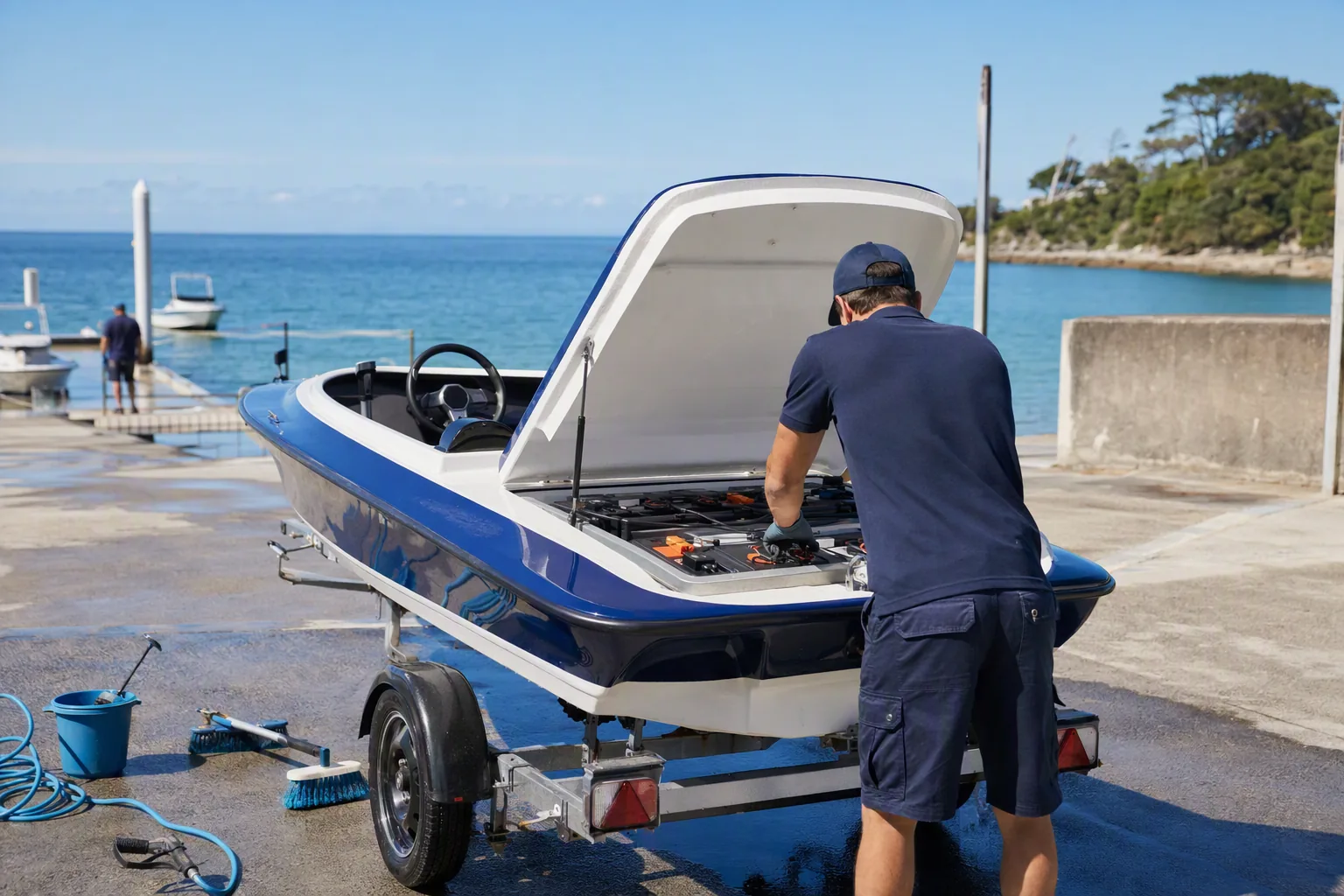
Quick answer: On an electric kart boat fleet, the battery pack is both your fuel and your largest maintenance line item. Daily pre-ride checks, disciplined charging rotation, and seasonal storage at partial charge are the three practices that separate fleets that run all season from fleets that ground boats one by one. Budget battery replacement as a recurring reserve — not a surprise.
Why Battery Care Is the Whole Game in Electric Fleet Rental
In a gas-powered rental fleet, the engine is the machine and fuel is someone else's problem — you buy it by the liter and burn it. In an electric kart boat fleet, the battery pack is the machine's heart and your single most expensive consumable. Hulls last years with only cosmetic attention; batteries age with every cycle, every hot afternoon on a charger, and every week stored at the wrong state of charge.
This is why experienced operators treat battery care as an operations discipline, not a technical chore. A fleet with healthy packs keeps its full revenue capacity through peak season; a fleet with degraded packs silently loses boats per day, and with them, the utilization math that makes the whole venture profitable. The bumper boat rental economics only work when the boats are actually in the water.
Three habits do most of the work: daily pre-ride checks that catch problems while they are still cheap, charging and swap practices that avoid the two things lithium chemistry hates most — deep discharge and heat — and storage discipline in the off-season.
What Does a Kart Boat Battery System Consist Of?
Before the checklist, a sixty-second orientation. A rental-grade electric kart boat typically carries:
- One or more lithium battery packs — the energy source, sized for a session of roughly one to two hours of mixed-throttle running depending on the model and configuration.
- A battery management system (BMS) — the electronics that monitor cell voltage and temperature and cut off on anomalies. Our optional smart-BMS upgrade adds real-time monitoring of exactly these values, which is why we point fleet buyers at it: battery health you can see is battery health you can plan around.
- A charger matched to the pack — voltage and current specs matter; mixing chargers across pack generations is a silent killer.
- The swap mechanism — our fleets are designed around a tool-less, quick-swap pack architecture, so staff can exchange packs between sessions without engineering skills.
If you are still comparing models, our motor power and payload selection guide explains how battery capacity interacts with rider load and throttle profile — the same session length on paper can mean very different battery stress in practice.
Daily Pre-Ride Checks (5 Minutes per Boat)
Run this checklist every operating day, before the first session. It is deliberately short — the goal is catching the failures that ruin a guest session or a pack, not a full service inspection.
- Hull exterior and drain points. Walk the hull: look for new cracks, impact marks from the morning's docking, and debris around the intake and drain areas. Clean anything wrapped around the jet or prop region before it becomes a performance complaint.
- Kill switch and safety tether function. Pull the magnetic kill switch while the drive is engaged; the boat must cut power immediately. This is the single most safety-critical function on the boat — and it is the same function we recommend buyers function-test at pre-shipment inspection, so it should stay honest through the fleet's life. If your boats are fitted with a tilt shut-off, trigger-test it according to the supplier's procedure.
- Battery lock and watertight seals. Confirm the pack is locked into its bay and the bay seal is clean and seated. Water intrusion into a battery bay is the failure mode with the most expensive consequences on this list.
- Throttle, steering, and battery indicator. One quick pass: smooth throttle from zero, full left-right steering sweep, and a battery percentage readout that matches what the BMS (or the display) reported at last charge.
Log the check per boat, per day. A paper sheet is fine; a shared note per fleet is better. The point is trend visibility: a pack that drops from 100% to 78% overnight used to be normal and now is not — that is a warranty conversation you want to start early.
How Should You Charge a Rental Fleet Without Killing the Packs?
Lithium packs age fastest under three conditions: sitting at very low charge, charging while hot, and being stored at 100% for long stretches. Rental operations drift into all three by accident. The countermeasures are operational, not technical:
- Set a discharge floor. Retire boats from the rotation when packs reach roughly 15–20% rather than running them to empty. Deep discharge is the most damaging routine stress you can apply, and the last 20% of a session delivers the least guest value anyway.
- Let hot packs cool before charging. A pack that just finished a midday session in direct sun should rest before going on the charger. If your venue has a shaded or indoor charge area, use it — heat while charging is the compounding version of heat alone.
- Charge to full for operating days, but do not park boats at 100%. Full charge before a busy day is correct; a boat that will sit for a week should not. (Storage practice is its own section below.)
- One charger per two boats as the planning baseline. We recommend planning at least a 1:2 charger-to-boat ratio, with pack rotation if you run above roughly 8 boats. Charging cost itself is a rounding error in your P&L — at typical commercial electricity rates, a full charge of a common 72V/40Ah-class system costs well under a dollar. The constraint is time, not money, which is exactly why the swap architecture matters.
Battery Swap and Rotation: Design Your Dock Around It
The quick-swap architecture is what turns charging from a fleet-wide bottleneck into a background task. Instead of taking boats out of service for hours, staff exchange packs at the dock: the depleted pack goes to the charge rack, a charged pack goes in, and the boat is back in the rotation in minutes.
Run the swap rack like a library, not a closet:
- Label every pack with an ID and its in-service date. Mixing packs of different ages within one boat is how you get mysterious "one weak boat" complaints.
- Track cycles per pack even roughly. Packs used in the morning/afternoon double-shift will age visibly faster than spares — rotate them so the fleet ages as a set.
- Stage charged packs before the rush. The operators who love swap architecture are the ones who pre-stage packs before the 2 PM wave, not during it.
For fleet buyers, this is also a question to settle before ordering: confirm in writing that the swap mechanism, pack format, and BMS reporting are specified per boat, and add them to the configuration annex that your supplier questionnaire should already have pinned down.
How Do You Store Kart Boat Batteries in the Off-Season?
If your venue closes for the season, the storage routine determines whether the fleet wakes up healthy or wakes up into a replacement order:
- Store packs at partial charge — roughly 50–70%. This is standard lithium practice: full-charge storage accelerates degradation, and near-empty storage risks the pack drifting below safe minimums over months.
- Store packs dry, cool, and off concrete. A shaded indoor shelf beats a hot boathouse roof; temperature swings are the enemy.
- Cycle stored packs about monthly — a partial charge/discharge pass keeps the BMS calibrated and lets you catch a weak cell before it becomes a dead pack.
- Winterize the hulls the way any watercraft fleet does: drain, dry, and cover; rod-proof the battery bays.
- Tropical "no off-season" fleets are not exempt. Southeast Asia and Gulf operators run year-round, but should still rotate which boats work the heaviest shifts and watch for shelf-aging on spare packs that never rotate into service.
Maintenance Schedule at a Glance
Interval | Task | Why it matters |
|---|---|---|
Daily (pre-ride) | Hull walk, kill-switch test, battery lock/seal check, throttle-steering-charge pass | Catches session-ruining and safety-critical failures at zero cost |
Daily (post-shift) | Rinse hull if operated in salt water; put packs on charge per the floor rules | Salt corrosion is cumulative and mostly invisible until it isn't |
Weekly | Inspect charge connectors and battery-bay seals; verify charger-fan/ventilation; review per-boat charge logs | Connectors and seals fail gradually; logs surface the drifting pack |
Monthly | Full pack rotation audit; cycle any stored packs; test spare pack under load | Evens out fleet aging; invalidates "it worked last time I used it" |
Seasonal | Partial-charge storage routine (temperate climates); heavy-shift rotation audit (tropical climates) | Off-season is where packs quietly die |
Per contract | Battery health report from BMS data against the warranty terms | Warranty claims are won with records, not memories |
Budgeting for Battery Replacement
Batteries are a scheduled cost, not a failure event. In our rental economics model we advise operators to budget a meaningful fraction of equipment cost annually — commonly in the low-to-mid teens as a percentage — as a battery reserve, with actual replacement typically occurring a few years into a fleet's life in well-maintained operations. Abuse the packs and that timeline compresses; the reserve is what keeps a degraded pack from becoming a stranded boat mid-season.
Two discipline points that protect the budget:
- Keep the paper trail. Charge logs, incident notes, and BMS readouts are what turn a "the battery degraded abnormally" conversation from opinion into evidence.
- Get the spare-parts picture in writing before the order. Pack price, lead time, and whether battery spares are covered by any support commitment should come out of the sourcing process — not be discovered in year two. Our 12-question supplier checklist includes the spare-parts price-list question for exactly this reason.
The Biggest Maintenance Mistake We See
Running batteries to empty because the boat still moves. The boat moving is not the health signal — the BMS data is. Deep-discharge routines will not show up as a failure tomorrow; they show up in month eight as a pack that no longer holds a session, right when your season is peaking. The operators with the healthiest fleets are almost always the ones with the most boring checklists, enforced daily.
FAQ
How long do kart boat batteries last?
It depends on chemistry, duty cycle, and above all on the habits in this guide. Well-managed rental packs typically reach replacement age after a few years of service; abused packs can need replacement within a single long season. This is why we tell operators to budget the annual battery reserve rather than trying to predict an exact cycle count — and to ask for BMS data access so the fleet's actual aging is visible instead of guessed.
Can non-technical staff swap batteries themselves?
Yes — that is the design intent of the tool-less quick-swap architecture. Swap training is part of operator onboarding, and the daily checklist makes staff responsible for noticing a damaged seal or connector before it becomes a fault. The swap itself requires no tools and no engineering background.
What is the biggest maintenance mistake?
Skipping the daily kill-switch test. It takes under a minute, it is the boat's most important safety function, and a failed kill switch discovered by a guest is a far more expensive event than one discovered by your staff at 9 AM.
Do batteries need special storage in the off-season?
Yes — partial charge (roughly 50–70%), dry and cool, cycled about monthly. Fleets stored at full charge or left uncharged for months are the two patterns we see behind most "the fleet degraded in storage" surprises.
How do I know when a pack should be retired?
Watch the trend, not the number: a pack whose session-end percentage keeps dropping relative to its twins, or that triggers BMS thermal warnings repeatedly, is telling you it is done — even if it still technically works.
Data Caveats & Sources
- ✅ Well-established practice: partial-charge storage (~50–70%), avoiding deep discharge and hot charging, and monthly cycling of stored packs are standard lithium-battery care guidance, not vendor claims.
- ✅ Our published operating guidance: 1:2 charger-to-boat planning ratio, charging cost as a negligible line item, and the low-to-mid-teens annual battery reserve percentage come from our bumper boat rental business guide linked above, which anchors its economics to a verified operator case.
- ⚠️ Configuration-specific: pack capacity, swap mechanism details, and BMS data access vary by model and optional configuration — confirm against your quotation and configuration annex.
- ❌ Deliberately omitted: specific cycle-life numbers (chemistry- and usage-dependent; publishing a number we can't honor helps nobody), and any claim about certification status of optional radio features (see our export compliance guide for how wireless options change certification scope).
Last updated: September 2026. Maintenance outcomes are duty-cycle specific — model your fleet's session profile with us in writing against your quoted configuration.
Get a Quote for Your Kart Boat Business
Tell us what you need — OEM/ODM specs, quantity, target market. Our team replies within 24 hours.
Prefer a quick chat?
Chat on WhatsAppFree B2B resources
Buyer guides, ROI calculators, customs checklists, and case studies — built on direct factory manufacturing experience.