Kart Boats in Oman: Operator Guide to Licensing & Costs
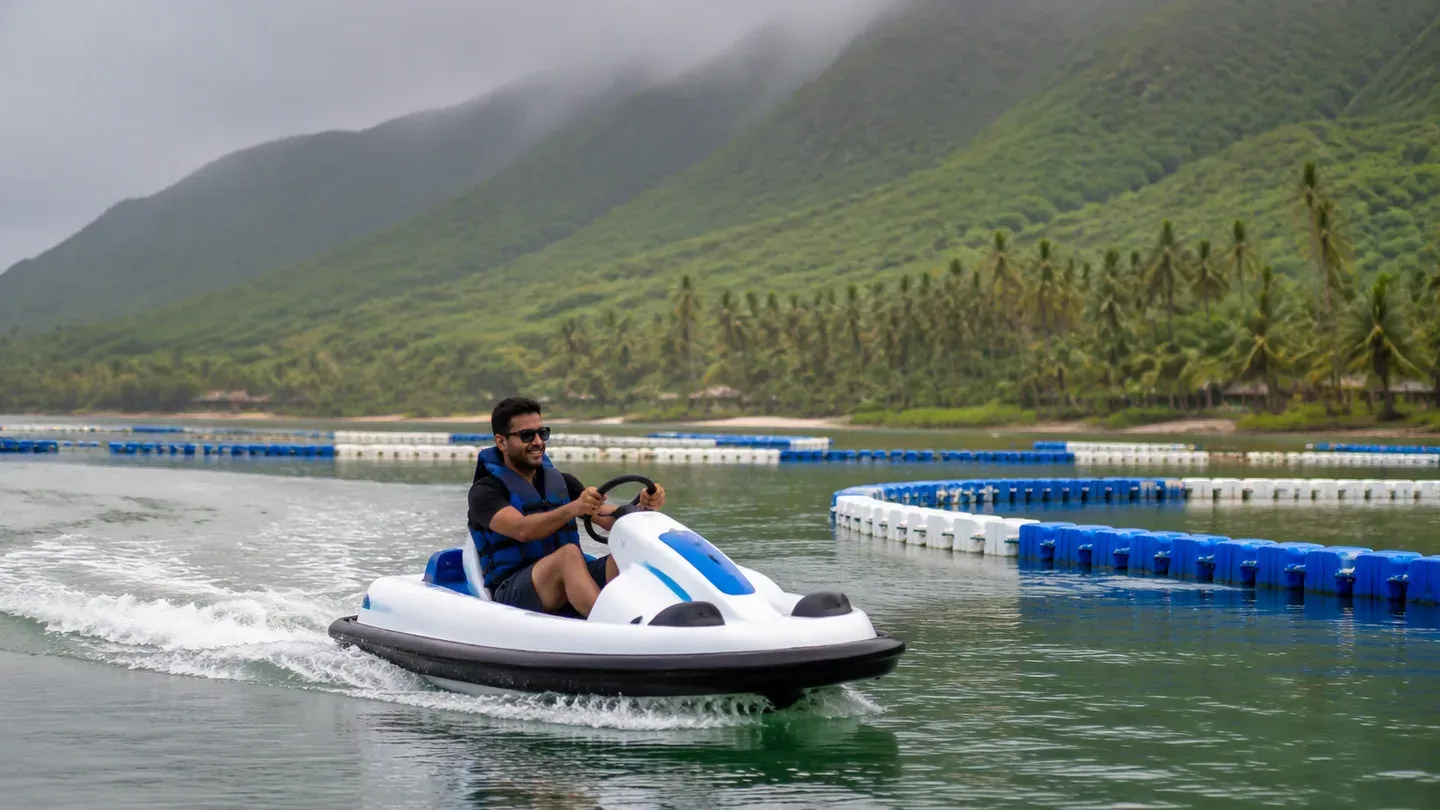
Every other market in our Gulf series fights the same battle: a winter peak, then a summer when 45°C heat empties the waterfront and operators survive on early-morning shifts. Oman is the exception that proves the rule — and then breaks it twice. In Muscat, the calendar looks familiar (winter high season, brutal summer). But in Salalah, the summer Khareef monsoon turns Dhofar green and cool at exactly the months every other Gulf waterfront goes dark — more than one million visitors came for the 2025 Khareef season (21 June–31 August), and the 2026 season already beat it at 1.12 million, up 8.6%. A kart boat operator who understands Oman is not buying into one season; he is looking at the only Gulf market where two venues in one country can run opposite peaks.
This guide covers the demand picture (4 million visitors a year and climbing, Vision 2040 targets of 11.7 million), the licensing chain under Royal Decree 19/2023 and the Royal Oman Police, the landed-cost math — Oman charges the GCC-standard 5% duty plus a 5% VAT that registered businesses can reclaim — and the two-climate operating model that makes an Omani fleet different from anything else we have written about in this series.
Why does Oman suit electric kart boats?
Start with the scale, which is smaller than Qatar's but growing on a cleaner curve. Oman welcomed about 4 million visitors in 2025, with inbound tourism expenditure exceeding OMR 1 billion (roughly USD 2.6 billion) per Times of Oman's reporting on NCSI data. The hotel sector tells the same story: 3-to-5-star hotels hosted about 2.4 million guests in 2025, up 11% year on year, with occupancy around 57% and revenue growth of 17–18%. Vision 2040 sets the official ambition: 11.7 million annual visitors and tourism at 5.3% of GDP by 2040, against roughly 2.9% today — a doubling commitment that keeps waterfront hospitality on the national investment agenda.
The Khareef is Oman's structural ace. While Dubai and Doha spend June through September marketing indoor attractions, Salalah's monsoon drops temperatures to the mid-20s and wraps the Dhofar coast in green. The 2025 season drew 1,027,255 visitors (21 June–31 August) per Oman News Agency data, Oman Air flew a record ~270,000 passengers into Salalah for the season, and the 2026 season crossed 1.12 million — growth compounding at 8.6% while the rest of the Gulf shuttered for the heat. Family traffic dominates: the Khareef crowd is GCC families escaping the summer, exactly the multi-rider, multi-generational audience a kart boat circuit serves.
The waterfront supply side is real but thin in the right places. Muscat's prime frontage — Al Mouj Muscat's marina complex, the Shangri-La Barr Al Jissah resort capes (Al Waha and Al Bandar are the family properties), Qantab and Yiti beaches — offers jet ski rentals at 20–30 OMR per hour and diving day trips to the Daymaniyat Islands nature reserve from about USD 100 per person. What it does not offer, in either Muscat or Salalah's beach belt, is a compact, staffed, multi-rider water attraction that a hotel or marina can run from its own frontage. The gap is the same one kart boats fill in every mature market — and in Oman it comes with an ecological angle worth reading.
What is the market signal actually saying?
Two signals matter, and one of them is unique to this market. The first is regional: the Kuwaiti buyer signal we documented in our Kuwait guide — a plain Google search for manufacturers, a page-by-page catalog review, a same-morning WhatsApp first contact — describes a demand structure that Oman shares: high household purchasing power, GCC family traffic, and no local kart boat operators yet. The second is Omani and regulatory: Royal Decree 19/2023 replaced the old maritime framework with a modern Merchant Shipping Law, and the follow-on Ministerial Decision 30/2026 moved foreign-vessel registration into the Royal Oman Police customs electronic system — the state is actively formalizing small-craft channels, not leaving them in gray zones.
The third signal is environmental, and honest operators should read it as a purchase criterion rather than a slogan. The Daymaniyat Islands are a protected nature reserve — Oman's premier dive destination, where the operators who hold permits run under conservation conditions, and where a waterside attraction's noise and emissions profile is part of what regulators and guests notice. An electric kart boat fleet is quiet, emission-free at the point of use, and visibly different from a two-stroke jet ski fleet. We do not claim any Omani regulation mandates electric craft — none that we can verify does — but in a market whose tourism brand is built on untouched nature, the electric option is the one that fits the room.
For a fleet buyer the honest summary: Oman pairs a compounding, counter-seasonal demand engine (the Khareef) with an emerging formalized licensing system and a nature-first brand that electric craft align with. What it does not yet have is any kart-boats-specific rule — the confirm-with items below are real.
What does licensing and compliance actually require?
Oman's maritime authority structure runs through two institutions. Ship and craft registration sits with the Ministry of Transport, Communications and IT (MTCIT) under Royal Decree 19/2023: owners or their representatives must file a registration application within 30 days of a vessel's construction or acquisition, and the government's gov.om portal issues permanent registration certificates for ships and maritime units as an e-service. On the water, the Royal Oman Police — including its Coast Guard — controls clearance, enforcement and, under Ministerial Decision 30/2026, the electronic registration of foreign vessels in the ROP customs system. The division is the same craft-versus-water split we describe in our Qatar guide, with the police rather than a transport-side coast guard holding the water.
Three confirm-with items apply, per our series honesty rule. First, whether a 3–4 m electric kart boat used for paid rides registers as a small craft on the standard MTCIT track or attracts a passenger-vessel class under the new law's technical rules should be confirmed in writing before ordering — the 30-day registration window and certificate process are published, the class assignment for battery-powered ride craft is not. Second, the commercial licence for paid rides at a hotel beach, marina or Khareef festival site runs through Oman's municipality and Ministry of Commerce, Industry and Investment Promotion channels; the ride-category licence for your specific venue belongs in the pre-order file. Third, protected-area permits: any operation touching the Daymaniyat reserve or other protected waters needs the Environment Authority's permits, which are a separate track from vessel registration — and, frankly, a track where an electric, low-impact fleet reads better than a combustion one.
Insurance follows the same pattern as the rest of the Gulf: no published minimum for small commercial craft in the sources we verified, so size the policy with your insurer against the registration certificate and venue requirements.
What does importing a fleet into Oman actually cost?
Oman sits in the Gulf's middle tax tier: 5% customs duty on CIF value plus 5% import VAT, collected through the Royal Oman Police customs Bayan system on the duty-paid value. The VAT has run since April 2021 and — the line that matters for a registered operator — input VAT on an imported fleet is generally recoverable as input tax against your Omani VAT registrations, per the Oman Tax Authority's taxpayer guides. The headline math:
Market | Duty | VAT | Landed-cost headline |
|---|---|---|---|
Kuwait | 5% | none (earliest window 2028+) | lightest headline |
Qatar | 5% | none | lightest headline |
Oman | 5% | 5% (recoverable if registered) | +10% nominal, partly a timing cost |
UAE | 5% | 5% (recoverable if registered) | +10% nominal, partly a timing cost |
Saudi Arabia | 5% | 15% | +20% permanent cost |
Two planning notes. First, the recoverable-VAT point means an Omani operator's effective permanent cost sits near Kuwait's and Qatar's — the cash-flow timing difference is what your accountant models, not a permanent 10-point penalty. Second, freight feeds the duty base: production runs six to nine weeks before a two-to-three-week ocean transit to Sohar or Port Salalah, and the MOQ and lead-time math holds unchanged. Battery logistics are the international split we describe everywhere: installed batteries by sea under IMDG Class 9 with UN 38.3 summaries, spares as UN 3480 air cargo — details in our import duty and HS code guide. Sequence the file — MTCIT classification in writing, venue licence, protected-area permits if relevant, insurance, pre-shipment inspection — then the deposit.
What does the operating year look like?
Oman is the one market in this series where the answer is two calendars, not one. Muscat runs the familiar Gulf pattern: October to April is the high season — mid-20s to low-30s temperatures, cruise calls, the resort beach belt at full load — while June through September pushes past 45°C and moves daytime demand to the malls (Mall of Oman even runs an indoor ski slope). Salalah inverts it: the Khareef monsoon (late June to early September) is the absolute peak, with temperatures in the mid-20s, coastal fog, green hills and more than a million visitors — while Salalah's winter is merely pleasant.
For a fleet owner the practical read is a two-venue, two-season model: a Muscat-frontage fleet (Al Mouj marina belt, the Shangri-La resort capes, Qantab/Yiti beaches) earns October through April; a Dhofar venue — Salalah's beach resorts and the Khareef festival sites — earns the summer block. We are not suggesting moving one fleet a thousand kilometers twice a year; we are pointing out that Oman is the only Gulf market where a second venue earns the months the first one loses. Ramadan shifts about eleven days earlier annually and compresses evening operations in both cities — in 2027 it is expected to run from early February to early March, which lands inside Muscat's high season and needs staffing plans, the same logic we flag for Egypt's Red Sea operators.
How should a first fleet be sized?
The same pilot logic as every market in this series: MOQ is a single unit, and the sensible Omani starter set is 3–5 boats on one frontage — an Al Mouj-adjacent hotel beach or a Salalah resort belt for the Khareef — with a shaded dock, a marked circuit and the two-shift staffing any Gulf summer requires outside the monsoon zone. Our compact SKB-004 Electric Drift Boat is the family entry: drift-mode handling that reads as "bumper boat skills with a safety envelope," and an electric, low-noise profile that matters more in Oman than elsewhere because of the nature-tourism brand the country sells. Model the economics against the price guide and the fleet ROI calculator with a two-venue scenario if you hold frontage in both cities.
The pilot's job is calibration: Khareef-family session lengths in Salalah versus Muscat evening sessions, the pricing band against the 20–30 OMR jet ski hour, and whether the Daymaniyat-adjacent eco positioning earns a price premium. Oman's hospitality market is small enough that a well-run visible attraction gets noticed fast — which cuts both ways, so run the SOP tight from day one.
FAQ
Do I need a license to operate kart boats commercially in Oman?
The stack runs: craft registration with MTCIT under Royal Decree 19/2023 (within 30 days of acquisition), venue/commercial licensing for paid rides, and Royal Oman Police jurisdiction on the water — with protected-area permits if your site touches reserves like the Daymaniyat Islands. Guests on a supervised ride do not need their own license; the operator's SOP and the craft's design envelope carry the safety case.
Is there VAT in Oman?
Yes — 5% import VAT since April 2021, collected at customs on the duty-paid value through the Bayan system. The operative detail: input VAT is generally recoverable for a VAT-registered business, so the permanent landed-cost adder is close to Kuwait's and Qatar's 5% duty-only math, with a cash-flow timing component your accountant should model.
Which authority handles boat registration?
The Ministry of Transport, Communications and IT (MTCIT) registers ships and craft under Royal Decree 19/2023 — applications within 30 days of acquisition, certificates issued through the gov.om portal. The Royal Oman Police (Coast Guard and Customs) controls waterborne clearance, foreign-vessel electronic registration and enforcement.
Can the boats run during the Khareef?
The Khareef is precisely when they should run — Salalah's monsoon season is cool (mid-20s), green and packed with GCC families. Design for coastal fog and drizzle: non-slip decking, covered charging, and electrical systems spec'd for humid conditions, configured to the destination market at quotation.
How long does delivery to Oman take?
Six to nine weeks of production, then roughly two to three weeks of ocean transit to Sohar or Port Salalah plus customs clearance at 5% duty and 5% VAT. Time a spring arrival against the June Khareef opening or an autumn arrival against Muscat's October season — the timeline math is in our MOQ and lead-time guide.
Data caveats
Visitor counts for the Khareef seasons come from Oman News Agency/NCSI releases; national totals (around 4 million for 2025) and hotel statistics come from NCSI and Times of Oman reporting, and definitions of "visitors" vary between total arrivals and international-only figures — the 2026 Khareef figure (1.12 million) is reported season-to-date data. Jet ski and dive-trip price bands are compiled from operator and booking-platform listings and move with season. Registration-class treatment of electric ride craft under the 2023 law is not published in a form we can verify — the confirm-with items are genuinely open questions. Nothing in this guide should be read as claiming Omani law mandates or incentives electric craft; the eco alignment is a market-fit argument, not a regulatory one.
Sources
- Oman News Agency — Khareef 2025 visitor statistics — 1,027,255 visitors, 21 June–31 August 2025 (retrieved 2026-10-02)
- Khareef 2026 season reporting — 1,116,051 visitors by end-August, +8.6% (retrieved 2026-10-02)
- Times of Oman — inbound tourism expenditure exceeded OMR 1 billion in 2025 — ~4 million visitors 2025 (retrieved 2026-10-02)
- NCSI Oman — hotel sector statistics — 2.4M guests 3–5 star, occupancy 57% (retrieved 2026-10-02)
- MTCIT — Royal Decree 19/2023, the Maritime Law (retrieved 2026-10-02)
- Times of Oman — ship registration under the Maritime Law, 30-day application window (retrieved 2026-10-02)
- decree.om — Ministerial Decision 30/2026, foreign vessels registration in ROP customs system (retrieved 2026-10-02)
- gov.om — permanent registration certificate for ships and maritime units (retrieved 2026-10-02)
- Oman Tax Authority — VAT Taxpayer Guide — 5% VAT, input-tax recovery (retrieved 2026-10-02)
- US International Trade Administration, trade.gov — Oman import tariffs, GCC 5% baseline (retrieved 2026-10-02)
- Platinumlist / Ootlah / Viator operator listings — Muscat jet ski and Daymaniyat price bands, 20–30 OMR/hr (retrieved 2026-10-02)
- JLL — Vision 2040 tourism targets, 11.7M visitors and 5.3% GDP by 2040 (retrieved 2026-10-02)
Get a Quote for Your Kart Boat Business
Tell us what you need — OEM/ODM specs, quantity, target market. Our team replies within 24 hours.
Prefer a quick chat?
Chat on WhatsAppFree B2B resources
Buyer guides, ROI calculators, customs checklists, and case studies — built on direct factory manufacturing experience.