Kart Boats in Qatar: Operator Guide to Licensing & Costs
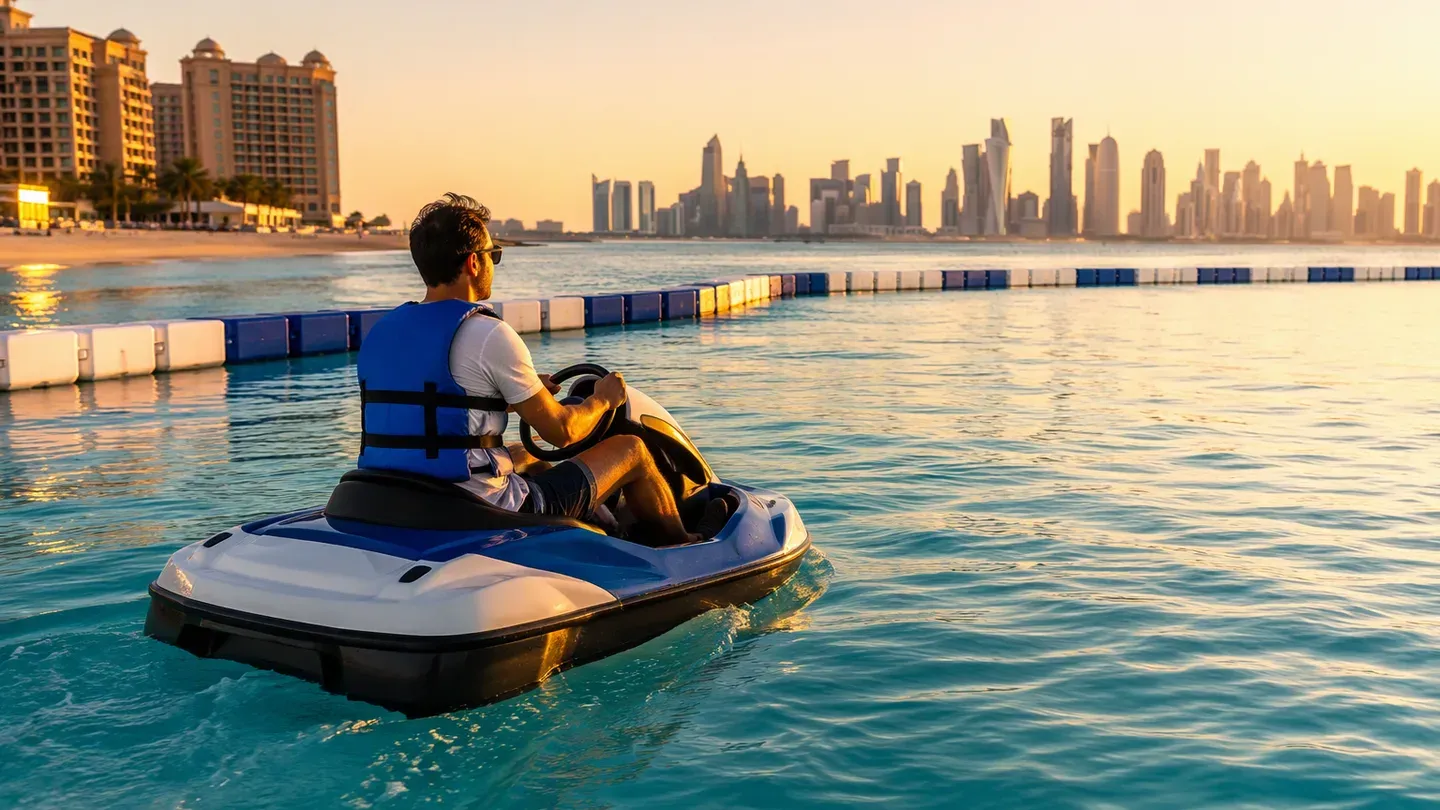
Qatar has spent the last four years converting a World Cup into a tourism machine, and the numbers are no longer promises: 5.1 million international visitors in 2025, a record year, with accommodation revenue up 12% to QAR 8.3 billion and the national strategy targeting 6 million visitors by 2030. Yet the waterfront where all these guests actually walk — the Doha Corniche, West Bay's hotel beaches, the marinas of Lusail — offers them essentially one thing to ride: a jet ski, at QAR 250–800 per half hour depending on the operator. The family water-ride slot that kart boats occupy in every mature market is empty on Qatar's most valuable promenade, and the closest large-format water park, Desert Falls, sits more than an hour's drive from the city at the Salwa beach resort. Cost is not the obstacle: Qatar shares with Kuwait the lightest import math in the Gulf — a 5% CIF duty and no VAT.
This guide covers what an operator needs to put a kart boat fleet on the Doha waterfront: who the demand really is, how the Ministry of Transport registers small craft under the 1980 Maritime Law, what the Coast Guard expects before a boat touches water, the landed-cost table, and the operating calendar that a 45°C summer imposes. Where a rule has not been written down for a 3–4 meter electric kart boat specifically, we say so and flag it as a confirm-with item rather than guessing.
Why does Qatar suit electric kart boats?
Start with the demand engine, which is the strongest in our Gulf table. Qatar welcomed 5.1 million international visitors in 2025 — up 3.7% on 2024 and a national record, per Qatar Tourism's official releases — with December alone drawing 674,000 arrivals, up nearly 16% year on year. The money follows: accommodation revenue rose 12% to QAR 8.3 billion (roughly USD 2.3 billion), 10.8 million room nights were sold at above 71% occupancy, and hotel inventory expanded to 42,469 keys. Tourism contributed about QAR 55 billion to GDP in 2024 — some 8% of the economy — and the Qatar National Vision 2030 tourism strategy targets 6 million annual visitors, backed by a country that jumped ten places in the WEF travel-and-tourism competitiveness ranking on the strength of its price competitiveness.
The guest profile matters as much as the volume. Qatar's tourism board has spent four years marketing the country as a family destination — Visit Qatar's family-break pages lead with theme parks, water parks and beach clubs — and the hotel map concentrates that demand exactly where a kart boat track wants to be: West Bay's beach hotels, the Corniche hotel strip, Katara's cultural beach, and the Lusail Marina promenade. These guests already pay for water time. Operator-listed jet ski rates run QAR 250 for 30 minutes at the accessible end (Qatar Living's compiled listings) to QAR 600 per 30 minutes for a supercharged two-seater at Sealine Beach Resort in Mesaieed, with Lusail Marina's Aqua World in between at QAR 275/400. A family of four cannot ride those together; a kart boat is designed so they can.
The supply side completes the case. Qatar's large-format water park — Desert Falls at the Hilton Salwa Beach Resort, 19 attractions and more than 30 slides — is a destination park over an hour southwest of Doha, priced at QAR 85 per session. Inside the city, the water-adjacent offering is indoor (Angry Birds World, Snow Dunes at Doha Festival City) or beach-club day passes. What the Doha waterfront does not have is a compact, staffed, multi-rider water attraction that a hotel or marina operator can run from its own frontage. That is precisely the asset class a kart boat fleet is.
What is the market signal actually saying?
The clearest signal comes from the neighbor we covered in our Kuwait operator guide. In late September 2026, a Kuwait-based buyer found our manufacturers comparison guide through a plain Google search, reviewed the catalog page by page, and opened a WhatsApp conversation the same morning — in a market with zero kart boat operators. Kuwait and Qatar share the demand structure that produces that behavior: high household purchasing power, a family-entertainment culture concentrated in malls and waterfronts, and a local operator base that has not yet met this category. Qatar adds to it a tourism engine (the 5.1 million visitors above) that Kuwait's domestic-led market does not have.
The regulatory signal is the opposite of Kuwait's — and that is good news for operators who dislike moving targets. Kuwait is mid-transition, regularizing small-craft operation under its new Decree-Law 61/2026. Qatar has been running a settled system for decades: vessel registration sits with the Ministry of Transport under Law No. 15 of 1980 (the Maritime Law), administered as an e-service with registration offices at Doha Port, Al Khor and Al Ruwais, while the Coast Guard under the Ministry of Interior controls sailing permits and on-water enforcement through the Metrash2 app. Nothing about kart boats specifically has been written into that system yet — but the two doors an operator must knock on (MOT for the craft, Coast Guard for the operation) have published processes, official portals and physical offices.
For a fleet buyer the honest summary is this: Qatar combines the Gulf's strongest tourism demand with an empty family water-ride slot and the region's most settled small-craft bureaucracy. The window is not regulatory urgency, as in Kuwait — it is that every year of World-Cup-grade marketing raises guest expectations faster than the waterfront's ride supply expands.
What does licensing and compliance actually require?
Qatar splits maritime authority the same useful way the UAE does: one ministry owns the craft, another owns the water. Small-craft registration runs through the Ministry of Transport — individuals, private companies and government institutions register vessels through the MOT e-services portal, and the registration certificate (Certificate of Qatar Registry) is issued after document verification. The legal basis is Law No. 15 of 1980, which ties Qatari nationality of a vessel to registration at a Qatari port; the practical detail that matters for an operator is that company-owned commercial craft follow the same MOT channel as private ones, with the department's published document list.
On the water, the Coast Guard (Ministry of Interior) runs sailing permits through Metrash2 — Qatar's government services app — where operators register, edit and cancel sailing requests, and where on-water enforcement campaigns originate. For a commercial ride operation the sequence is: register each craft with the MOT, arrange insurance, then work the Coast Guard channel for the operating permits your venue requires.
Three confirm-with items follow the same honesty rule we apply across the Gulf. First, whether a 3–4 m electric kart boat used for paid rides is classed as a small pleasure craft (MOT track) or attracts a commercial-vessel requirement is a question to put to the MOT in writing before ordering — the small-craft registration service covers "individuals, private sector companies, and government institutions," which suggests the commercial path exists inside the same portal, but we do not assume the fee class. Second, the municipality and venue licensing for operating paid rides from a hotel beach, marina frontage or park — Qatar's hospitality licensing runs through the Ministry of Commerce and Industry and the relevant municipality, and the ride-category licence should be confirmed for the specific venue. Third, product conformity: Qatar has no published conformity schedule for electric ride-on watercraft comparable to the UAE's ECAS; chargers and control units should be quoted with destination-market certification per our standard practice, and a conformity conversation with Qatar authorities belongs in the pre-order file.
Insurance deserves one plain sentence: none of the sources we reviewed publish a minimum-coverage figure for small commercial craft, so size the policy with your insurer against the registration and venue requirements — not a generic marine number.
What does importing a fleet into Qatar actually cost?
The landed-cost formula matches Kuwait's: 5% customs duty on CIF value, no VAT. Qatar applies the GCC common external tariff at 5% of CIF for most goods including pleasure craft under HS heading 8903, and — together with Kuwait — remains one of the two GCC states that has not implemented the GCC VAT agreement, with no implementation date on the table. Regional comparison at a glance:
Market | Duty | VAT | Landed-cost headline |
|---|---|---|---|
Qatar | 5% | none | lightest in the GCC (with Kuwait) |
Kuwait | 5% | none (earliest window 2028+) | lightest in the GCC (with Qatar) |
UAE | 5% | 5% (recoverable if registered) | +10%, mostly a timing cost |
Saudi Arabia | 5% | 15% | +20% permanent cost |
Two planning notes. The no-VAT status is a present fact, not a permanent one — both holdout states will introduce VAT eventually, so keep a VAT scenario in the payback model the same way we advise Kuwait readers. And with duty calculated on CIF, the freight leg feeds the duty base: production runs six to nine weeks before a two-to-three-week ocean transit to Hamad Port, and the MOQ and lead-time math holds unchanged.
Lithium battery logistics are international, not Qatari: a completed fleet with installed batteries ships by sea under IMDG Class 9 with UN 38.3 test summaries and MSDS in the file; spare batteries move as UN 3480 air cargo — the same split as every Gulf market, detailed in our import duty and HS code guide. Sequence the file: written craft classification from the MOT, venue licence confirmation, insurance sized to requirements, pre-shipment inspection per our turnkey delivery guide — then the deposit.
What does the operating year look like?
Qatar's calendar is the Gulf two-shift pattern at its most event-rich. June through September pushes past 45°C and hands the daytime to indoor venues — but Doha's summer evenings are the busiest the waterfront ever gets, with the Corniche and Box Park crowds staying out late and hotel pools running at capacity. October through April is the reward: sustained mid-20s to low-30s temperatures, the region's densest events calendar (the Formula 1 weekend, the tennis, the National Day festivities in December — which alone drew 674,000 visitors), and full-day throughput on any frontage with shade and lighting.
Two structural notes for a kart boat operator. First, event-driven spikes are Qatar's signature: a Grand Prix weekend or a winter festival moves more prospective riders past a Corniche-adjacent track in three days than a normal month — fleet utilization models should carry an event-multiplier scenario, which the fleet ROI calculator handles explicitly. Second, Ramadan compresses evening operations and shifts staffing; it moves about eleven days earlier each year, and in 2027 it is expected to run from early February to early March — plan the winter maintenance window around it, the same off-peak logic we recommend to Egypt's Red Sea operators.
How should a first fleet be sized?
The same pilot logic we give every new market: start small, learn fast. Qatar's MOQ is a single unit, and a sensible Doha starter set is 3–5 boats — one charging while two run, matched to a shaded dock and a marked circuit on a West Bay hotel beach, a Lusail Marina frontage or a Mesaieed day-resort operation. The ride mix should lean family: our compact SKB-004 Electric Drift Boat reads as "bumper boat skills with a safety envelope" to first-time riders, and the drift-mode novelty is what turns a one-ride tourist into a repeat guest. Model the numbers against the price guide with Qatar's event spikes built in.
The pilot's real job is calibration: session length against QAR pricing, the age mix on family nights versus event weekends, and whether the track configuration should flip between the winter day pattern and the summer evening pattern. Qatar's venue operators iterate quickly — the mall and theme-park culture here demands it — and a fleet that can reconfigure between seasons will match that rhythm.
FAQ
Do I need a license to operate kart boats commercially in Qatar?
The stack runs: craft registration with the Ministry of Transport (Law 15/1980 framework), insurance, venue/municipality licensing for the paid-ride activity, and Coast Guard sailing permissions through Metrash2 for on-water operation. Guests on a supervised kart boat ride do not need their own marine license — the operator's SOP and the craft's design envelope carry the safety case.
Is there VAT in Qatar?
No. Qatar, with Kuwait, is one of two GCC states that has not implemented the unified VAT agreement, and no implementation date is on the table. Landed cost on a kart boat fleet is currently the 5% CIF duty plus freight — build a VAT scenario into your payback model for the medium term.
Which ministry handles boat registration?
The Ministry of Transport registers small craft through its e-services portal, with registration offices at Doha Port, Al Khor and Al Ruwais. The Coast Guard (Ministry of Interior) controls sailing permits and on-water enforcement through the Metrash2 app. One ministry owns the craft, the other owns the water.
Can the boats handle Qatar's summer?
The operation has to be designed for it: two-shift days (early morning and evening), shaded charging away from peak afternoon heat, and battery specification configured to the destination market at quotation. What shortens battery life in the Gulf is charging a hot pack at noon in the open sun — not the rides themselves.
How long does delivery to Qatar take?
Six to nine weeks of production, then roughly two to three weeks of ocean transit to Hamad Port plus customs clearance at the 5% CIF duty. A spring order lands before the October season opening — the timeline math is in our MOQ and lead-time guide.
Data caveats
Visitor, revenue and room-night figures come from Qatar Tourism official releases and Qatar's national planning documents as reported in press; the 2024 GDP-contribution figure (QAR 55 billion) is the latest full-year number we could verify. Jet ski rate bands are compiled from operator listings (Qatar Living, operator sites) and move with season and promotions. Desert Falls' distance and pricing are from the resort's own published rates. MOT registration-class details for electric ride-on watercraft are not published in the form we can verify — the confirm-with items above are genuinely open questions, not hedging.
Sources
- Qatar Tourism — press release, record 2025 visitor numbers — 5.1M visitors, QAR 8.3B accommodation revenue (retrieved 2026-10-02)
- Qatar National Vision 2030 / Qatar Tourism strategy reporting — 6M visitors by 2030 target, QAR 55B GDP contribution 2024 (retrieved 2026-10-02)
- Ministry of Transport, Qatar — Registering a Small Craft — MOT e-services registration (retrieved 2026-10-02)
- Almeezan — Qatar Law No. 15 of 1980 (Maritime Law) — vessel nationality and registration framework (retrieved 2026-10-02)
- Qatar Ministry of Interior — Metrash2 Coast Guard sailing services (retrieved 2026-10-02)
- Qatar Living — jet ski rental listings — QAR 250/30min, QAR 450–500/hr compiled rates (retrieved 2026-10-02)
- Aqua World Lusail Marina / Sealine Beach Resort operator rates — QAR 275–800 bands (retrieved 2026-10-02)
- Hilton Salwa Beach Resort — Desert Falls Water & Adventure Park — 19 attractions, QAR 85/session (retrieved 2026-10-02)
- US International Trade Administration / GCC common tariff references — 5% CIF duty (retrieved 2026-10-02)
- VATCalc / regional tax advisories — Qatar VAT non-implementation status (retrieved 2026-10-02)
Get a Quote for Your Kart Boat Business
Tell us what you need — OEM/ODM specs, quantity, target market. Our team replies within 24 hours.
Prefer a quick chat?
Chat on WhatsAppFree B2B resources
Buyer guides, ROI calculators, customs checklists, and case studies — built on direct factory manufacturing experience.