Kart Boats in Kuwait: Operator Guide to Licensing & Costs
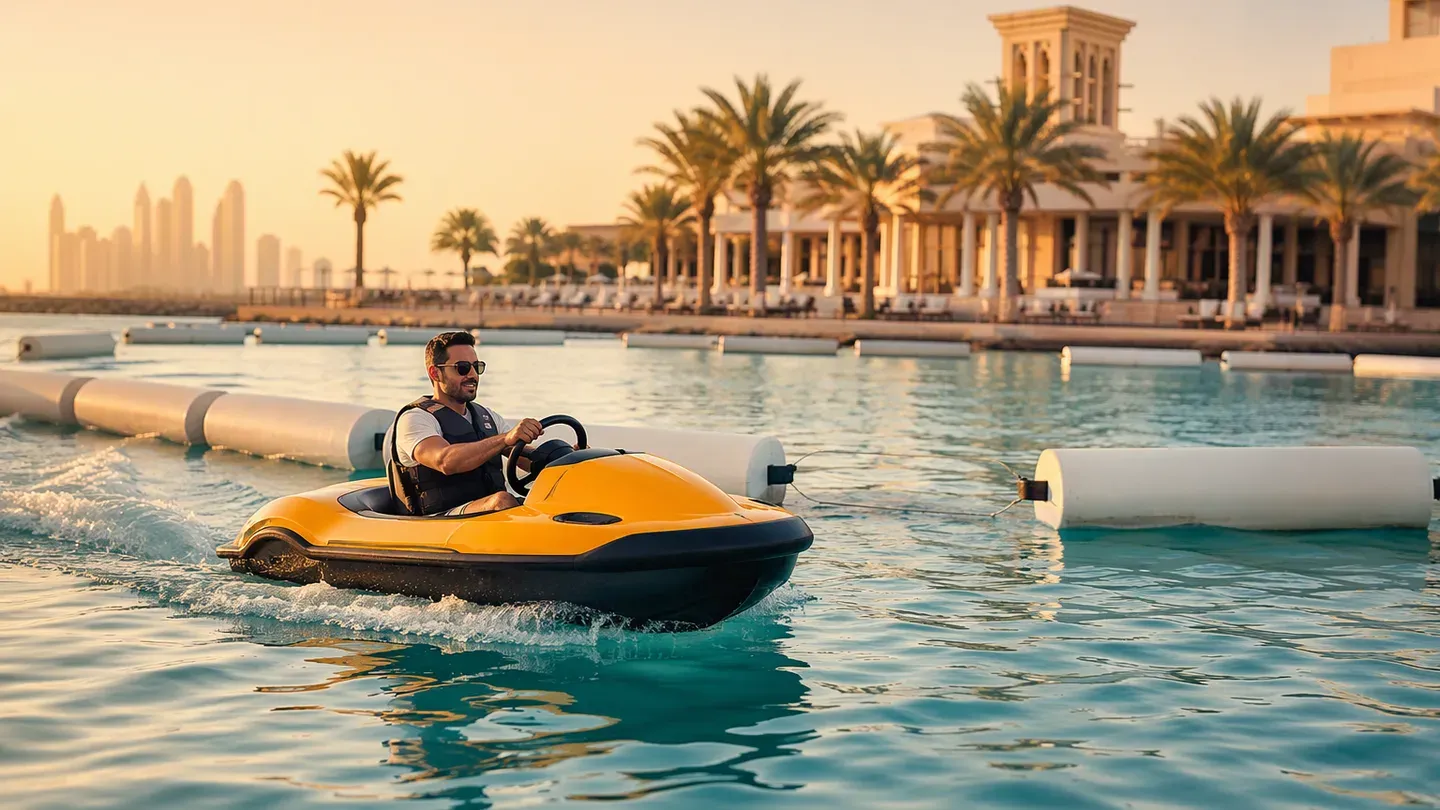
Kuwait is the quietest waterfront market on the Gulf — and that is precisely the case for reading it carefully. The country pairs one of the region's highest income levels with a family entertainment culture that runs on malls, marinas and beach clubs, yet its dedicated water-attraction supply is thin: the flagship Aqua Park near the Kuwait Towers has been flagged as permanently closed on TripAdvisor while the city's evening crowd keeps circling Marina Crescent with nowhere new to go. Nobody has established a kart boat operation here yet. We know the demand is real because we see it directly: in late September 2026, a Kuwait-based buyer found our manufacturers comparison guide through a plain Google search, reviewed the product range page by page, and opened a WhatsApp conversation the same morning — no ad, no intermediary, just a search box and intent.
Two regulatory facts make this a moment rather than a maybe. First, Kuwait issued Decree-Law No. 61 of 2026 on marine facilities and floating units, in force since June 2026, which for the first time consolidates registration, licensing, inspection and insurance of small craft under one framework with a six-month regularization window. Second, Kuwait remains one of only two GCC states with no VAT, which makes its landed-cost math the lightest in the region. This guide covers who actually buys and rides kart boats in Kuwait, what the new maritime law requires, what importing a fleet really costs, and how a 45–50°C summer reshapes the operating calendar rather than canceling it.
Why does Kuwait suit electric kart boats?
Start with purchasing power. Kuwait's GDP per capita sits around USD 31,900 — roughly three times the global average — and household expenditure is the second-largest component of its economy at about 43% of GDP, per Focus Economics and national accounts data. Consumer spending reached KD 45.96 billion in 2025 according to Central Bank of Kuwait data cited in local press, and while the first nine months of 2025 showed a cautious 4.7% dip, the base is enormous for a country of under five million people. Inbound tourism expenditure climbed to about USD 2.88 billion in 2024, up 15.3% year on year, per UN Tourism regional reporting. Families, not tourists, carry this market: the weekend ritual revolves around Gulf Road, Marina Crescent and the malls — The Avenues alone anchors an indoor ecosystem of theme rides, KidZania-style edutainment and aquariums that stays open past 10 p.m.
Water is already part of the leisure routine. Jet ski rentals operate along Gulf Road and at Marina Beach in Salmiya, with forum-reported rates in the KWD 15–20 per hour band, and yacht charters run from the Marina Hotel frontage. Khiran Resort in the south adds a resort-style water-sports base. What the market has never had is a multi-passenger, low-skill, photo-friendly ride that a family of four can do together for twenty minutes — the slot kart boats occupy in every market that has them. A bumper-boat-style electric kart fleet fills that gap without asking guests to hold a license, balance on a board, or get their clothes soaked.
The supply side is where the opportunity lives. Kuwait's largest dedicated water venue — the 60,000 m² Aqua Park by the Kuwait Towers, built for roughly 10,000 daily visitors per its facility profile — is listed as permanently closed on TripAdvisor at the time of writing, though visitors have reported activity on site; treat its status as unconfirmed. Either way, the city's biggest water-entertainment asset is not operating at capacity, family entertainment demand has not left the market, and no operator has parked a kart boat fleet in front of it. That combination — demand intact, supply vacated, category empty — is the structural setup we look for before recommending any market to an operator.
What is the market signal actually saying?
The demand signal reached us before it reached this page. The Kuwaiti buyer we mentioned above did not arrive through a campaign: the referral log shows a Google search landing on our comparison of Chinese kart boat manufacturers, followed by a page-by-page pass through the product catalog and a same-morning WhatsApp first contact — the fastest query-to-conversation sequence we have logged from the Gulf. When a buyer in a market with zero kart boat operators searches manufacturer terms on his own initiative, the market is pulling, not waiting to be pushed. We expect that pull to strengthen as the category gets a local reference point.
The regulatory signal is even more concrete. In May 2026 Kuwait issued Decree-Law No. 61 of 2026, the Law on Marine Facilities and Floating Units, published in the official gazette on 7 June 2026 and in force from publication. It extends the 1980 Commercial Maritime Law (Law No. 28) and assigns registration, licensing, inspection and insurance of marine units to the Ministry of Interior side of the system — with owners given six months from entry into force to regularize status, and fines of KD 2,000–3,000 for operating an unregistered unit. Unlicensed commercial maritime activity carries additional penalties, up to and including jail time under the press summaries of the law.
Read those two facts together and the takeaway is straightforward: Kuwait is formalizing small-craft operation at exactly the moment the category is empty. Operators who enter during the regularization window arrive with their compliance file already built — registration, insurance and inspection papered from day one — while anyone who waits will inherit a mature enforcement environment without the early-mover positioning. This mirrors what we told readers in our Dubai and Abu Dhabi guide: being early to a Gulf market as its rules crystallize is an advantage, but only for operators who budget for the paperwork from the start.
What does licensing and compliance actually require?
Kuwait's maritime authority structure is simpler than the UAE's. The Coast Guard — the General Department of Coast Guard under the Ministry of Interior — handles vessel registration, marine licenses and enforcement; Kuwait's government portal (e.gov.kw) hosts the marine-license inquiry service under the MoI. There is no equivalent of Dubai's separate maritime city authority to coordinate with, which shortens the licensing chain for a single-site operator.
Under the new law, the compliance path for a kart boat fleet reads as follows. Every unit must be registered with the competent authority — the decree-law assigns this to the MoI structure — using the official application form and vessel details. The framework also contemplates insurance and inspection as standing obligations rather than one-off import formalities, and the six-month regularization window from June 2026 set the deadline rhythm for existing craft; a newly imported fleet should register at the border, not retroactively. If your operation uses VHF or other radio equipment on the water, the communications regulator CITRA issues marine radio permits (roughly KD 50 per transmit/receive device) — a small line item that foreign operators routinely discover late.
Three honest gaps remain, and we flag them the way we flag all Gulf compliance questions — as items to confirm in writing, not to guess. First, the decree-law's implementing details for small electric pleasure craft — whether a 3–4 m battery-powered kart boat follows the same registration class as a pleasure yacht or a lighter commercial-ride class — should be confirmed with the Coast Guard before you commit a fleet configuration. Second, product conformity: Kuwait's Public Authority for Industry runs conformity assessment for regulated products, and where electric ride-on watercraft sit in that schedule is not published in a form we can verify — budget for a conformity conversation the way UAE importers budget for ECAS on chargers. Third, the commercial activity licence for operating paid rides at a beach, marina or park frontage runs through the municipality and licensing authorities; the class of licence for water-attraction rides should be confirmed for your specific venue. None of these gaps are unusual for a category this new — they are exactly the questions our turnkey delivery process sequences for operators before a deposit is wired.
What does importing a fleet into Kuwait actually cost?
The landed-cost formula is the best in the Gulf: 5% customs duty on CIF value and no VAT. Kuwait adopted the GCC Single Customs Tariff on 1 April 2003, setting the 5% CIF-based duty that still applies to most goods including pleasure craft under HS heading 8903, per the US International Trade Administration country profile. Unlike the UAE (5% + 5% VAT), Saudi Arabia (5% + 15% VAT) and Bahrain and Oman (5% + 5%), Kuwait has not implemented the GCC VAT agreement — parliamentary opposition has repeatedly stalled it, and the government's current planning horizon pushes any introduction to 2028 or later. Regional comparison at a glance:
Market | Duty | VAT | Landed-cost headline |
|---|---|---|---|
Kuwait | 5% | none (earliest realistic window 2028+) | lightest in the GCC |
UAE | 5% | 5% (recoverable if registered) | +10%, mostly a timing cost |
Saudi Arabia | 5% | 15% | +20% permanent cost |
Egypt (Red Sea) | 5% | 14% | plus licensing-freeze dynamics |
Two planning notes on that table. The VAT line is not permanent — when Kuwait eventually introduces VAT, fleet pricing should absorb a mid-cycle margin conversation, so build the 2028 scenario into your payback model rather than assuming today's math forever. And the duty itself is calculated on CIF, so the freight leg of a five-boat project (production runs six to nine weeks before a two-to-three-week ocean transit to the Gulf) feeds the duty base — the MOQ and lead-time math works unchanged here.
Lithium battery logistics follow international rules, not Kuwaiti ones. A completed fleet with batteries installed ships by sea under IMDG Class 9 with UN 38.3 test summaries and MSDS in the file; spare batteries move as UN 3480 air cargo with their own paperwork — the same split we describe in our import duty and HS code guide. Sequence the compliance work in this order:
- Confirm the craft's registration class with the Coast Guard under Decree-Law 61/2026 — before committing a fleet configuration.
- Confirm product-conformity scope with the Public Authority of Industry for the chargers and control units.
- Size insurance against the law's standing obligations, not a generic marine policy.
- Paper the pre-shipment inspection file, and only then wire a deposit.
Our turnkey delivery guide walks the full pre-shipment file.
What does the operating year look like?
Kuwait's calendar is a season shift, not a season shutdown — and it is the most extreme version of the Gulf pattern we describe in the Red Sea and NEOM guide. June through September pushes past 45°C with regular excursions toward 50°C, which rewrites the daily schedule: water-sports operators run a two-shift day — early morning and post-sunset — while the midday block belongs to air-conditioned malls. Kuwait's evening economy is genuinely strong: Marina Crescent and the Salmiya beachfront stay busy past midnight in summer, and the malls run their own late hours, so the post-sunset shift has real footfall behind it, not just cooler air.
The rest of the year is the reward. October through April delivers the region's best sustained weather, school holidays and the outdoor season when a beachfront or marina frontage earns full-day throughput. Plan fleet maintenance into the summer shoulder — the same off-peak logic we recommend to Egypt's Red Sea operators, whose seasonality runs opposite.
Two structure decisions matter more in Kuwait than anywhere else we sell. Shading and night lighting turn a fair-weather track into a two-shift asset: a shaded queue and charging area protects batteries from the 50°C ambient risk we flag across the Gulf, and floodlighting extends the paying window into the hours when Kuwait actually goes outside. And if your venue is an enclosed lagoon or park pool rather than open beachfront, say so early — enclosed-water projects have a different compliance conversation with the municipality, and it is the first question we ask when a Kuwait inquiry lands.
How should a first fleet be sized?
Start with one boat, not ten. Kuwait is an unproven category with no local reference points, and the correct first move is a pilot — our MOQ starts at a single unit, and the Kuwaiti buyer whose journey opened this guide gravitated to exactly that profile: the SKB-004 Electric Drift Boat, our compact drift-mode ride whose two-mode handling reads as "bumper boat skills with a safety envelope" to first-time riders. A sensible Kuwait starter set is 3–5 boats — enough for a rotation that keeps one charging while two run, matched to a shaded dock and a marked circuit — sized against the price guide and modeled through the fleet ROI calculator with Kuwait's two-shift summer assumption built in.
The pilot's real job is data: which age group rides, what session length holds, whether the drift mode or the steady cruise drives repeat rides. Kuwait's family entertainment culture rewards venues that iterate quickly — the mall operators here refresh attractions constantly — and a fleet that can reconfigure (track layout, session timing, pricing tiers) between seasons will match that rhythm.
FAQ
Do I need a license to operate kart boats commercially in Kuwait?
The operator-side requirements stack from the new maritime law and municipal licensing: vessel registration with the Coast Guard structure under Decree-Law 61/2026, insurance and inspection as standing obligations, and the commercial activity licence for your venue. Guests riding a supervised kart boat do not need their own marine license — the operator's SOP and the craft's design envelope carry the safety case, the same way supervised rides work across the Gulf.
Is there really no VAT in Kuwait?
Correct as of October 2026. Kuwait remains one of two GCC states that has not implemented the unified VAT agreement, and the government's current four-year plan pushes any introduction to 2028 or later. Model today's 5%-duty-only landed cost, but keep a VAT scenario in your payback model so a future introduction does not ambush your pricing.
What did the 2026 maritime law change?
Decree-Law No. 61 of 2026 consolidated registration, licensing, inspection and insurance of marine facilities and floating units under the Ministry of Interior structure, gave existing owners six months to regularize, and set fines of KD 2,000–3,000 for unregistered units. For a new importer the practical meaning is simple: register at the border, paper the fleet properly, and you are ahead of the enforcement curve rather than behind it.
Can the boats handle 50-degree summers?
The boats handle it; the operation has to be designed for it. Our fleet can be specified for high-ambient operation — battery chemistry, cooling margins and charging strategy are configured to the destination market at quotation — and the operating pattern that works in Kuwait is the two-shift day: early morning and evening, with shaded charging between sessions. What kills batteries in the Gulf is not the ride, it is charging a hot pack at noon in the open sun.
How long does delivery to Kuwait take?
Production runs six to nine weeks depending on configuration, followed by roughly two to three weeks of ocean transit to a Gulf port, plus customs clearance under the 5% CIF duty regime. A spring order lands comfortably before the October season opening — the timeline math is in our MOQ and lead-time guide.
Data caveats
Visitor-expenditure and consumer-spending figures come from national accounts and central bank data as reported by Focus Economics and local press; the 2025 spending dip covers nine months and may not annualize. Aqua Park's operating status is contested between a TripAdvisor closure listing and on-site reports — treat it as unconfirmed. Jet ski rate bands are forum-reported rather than published rate cards. Decree-Law 61/2026 details (registration classes, inspection cadence) are summarized from gazette publication and press coverage; the Arabic full text via legal databases governs. Where we wrote "confirm with the authority," we mean it — none of those items should be assumed from this guide.
Sources
- Focus Economics — Kuwait country profile — GDP per capita and consumption structure (retrieved 2026-10-01)
- Central Bank of Kuwait consumer spending data as cited in Kuwaiti press — KD 45.96B 2025 (retrieved 2026-10-01)
- UN Tourism / regional reporting — inbound tourism expenditure ~USD 2.88B 2024, +15.3% (retrieved 2026-10-01)
- Sakan.co — Aqua Park Kuwait facility profile, 60,000 m² / 10,000 daily capacity (retrieved 2026-10-01)
- TripAdvisor listing — Aqua Park Kuwait closure status, contested (retrieved 2026-10-01)
- US International Trade Administration, trade.gov — Kuwait import tariffs, GCC Single Customs Tariff 5% CIF (updated 2026-04-29, retrieved 2026-10-01)
- VATCalc — Kuwait VAT non-implementation status (retrieved 2026-10-01)
- Kuwait Al-Youm Official Gazette No. 1794 — Decree-Law No. 61 of 2026, Marine Facilities and Floating Units Law (published 2026-06-07; Arabic full text via EastLaws, retrieved 2026-10-01)
- Kuwait government portal e.gov.kw — marine license services under MoI (retrieved 2026-10-01)
- CITRA — marine radio service permits (retrieved 2026-10-01)
Get a Quote for Your Kart Boat Business
Tell us what you need — OEM/ODM specs, quantity, target market. Our team replies within 24 hours.
Prefer a quick chat?
Chat on WhatsAppFree B2B resources
Buyer guides, ROI calculators, customs checklists, and case studies — built on direct factory manufacturing experience.