Go Kart Boat Buyer's Guide: Top 3 Models Compared
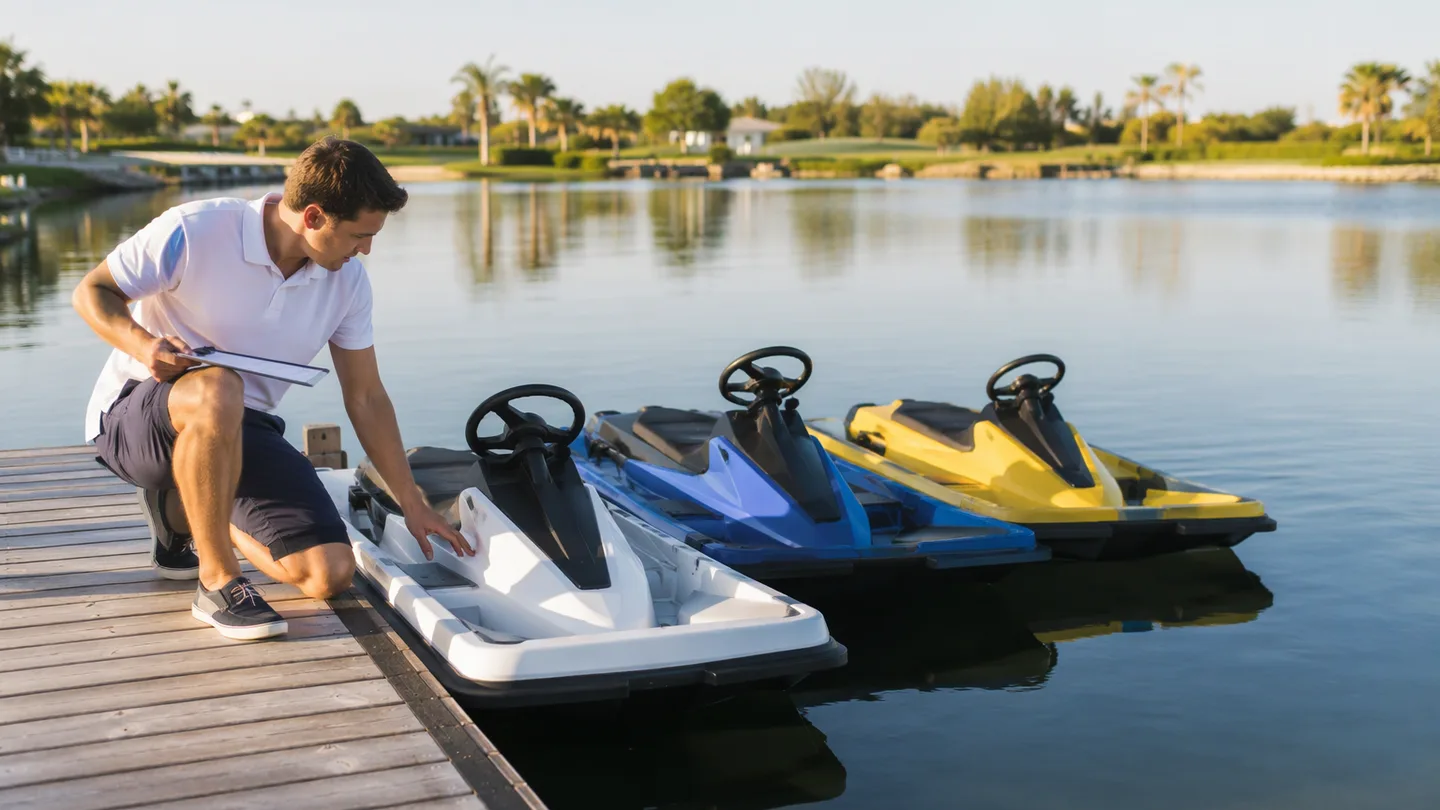
Type "go kart boat" into a search bar and you will find a dozen listings, half of them pointing at the same electric craft and half of them pointing at something else entirely. This page is the buying half of that question. If you already know the terminology (our kart boat terminology guide maps fifteen buyer names onto one hull), what you need next is a real comparison: which model, at what spec, for what water, at what price.
We build these boats in Guangzhou, China, on a company base dating to 2007, shipping a 20-model SKB line to operators in 50+ countries. The three models below are the ones most "go kart boat" inquiries actually land on: a single-seat sport hull, an ABS-shell mid-tier workhorse, and a two-seat family earner. Every number in the tables comes from our published product pages, and where a number is not published, we say so instead of guessing.
TL;DR: the shortlist
- SKB-001 (Sport): single seat, 13 kW, 38 km/h — the entry racing hull for lagoons and beginner programs.- SKB-010 (ABS): single seat, 15 kW, 45 km/h, 90-120 min runtime — the durable mid-tier pick for rental duty cycles.- SKB-002 (Family): two seats, 18 kW, 45 km/h — the highest-torque hull, built for two riders and heavy rental rotation.- Category price band in 2026: $3,600-$6,900 per unit factory-direct (single-seat); SKB-010 currently publishes $5,000-$6,900.- Water depth from 50-60 cm. Order quantities from one unit are industry-normal; confirm MOQ and lead time in writing.
What is a go kart boat, in buying terms?
Strip the name and the craft is simple to specify: a cockpit-style electric boat you operate seated, with a steering wheel or handlebar, a throttle, and enough speed to sell a driving experience instead of a slow ride. Published commercial lineups put the performance class at 13-15 kW with top speeds of 40-60 km/h, running in water from 50-60 cm deep. That is the product most "go kart boat" searches are shopping for, whether the buyer types that phrase, "electric go kart boat", "water go kart", or plain "kart boat".
In our inquiry inbox the name rarely predicts the purchase. Requests that open with "go kart boat" close on the same hulls as requests that open with "kart boat manufacturer" — because at order time the buyer stops describing a name and starts describing a venue: lagoon or pool, one rider or two, thirty sessions a day or three. The comparison below is organized the way those orders are.
The 3 best go kart boats for buyers in 2026
One framing note first: the three models compared on this page are SinoKartBoat's own lineup — the three configurations our catalog is most quoted on. We do not rank other makers' products here; the point is to show how three real, orderable configurations differ. One framing note first: the three models compared on this page are SinoKartBoat's own lineup — the three configurations our catalog is most quoted on. We do not rank other makers' products here; the point is to show how three real, orderable configurations differ. The trio covers the three buying situations we see most often from operators: a tight-budget racing entry, a mid-tier workhorse with the longest runtime, and a two-seat family earner. Here is the sheet.
Spec | SKB-001 (Sport) | SKB-010 (ABS) | SKB-002 (Family) |
|---|---|---|---|
Seats | 1 | 1 | 2 |
Motor (published rating) | 13 kW | 15 kW | 18 kW |
Top speed | 38 km/h | 45 km/h | 45 km/h |
Battery | NMC lithium, 60 Ah | SK-cell lithium, 80 Ah / 5.5 kWh | NMC lithium, 80 Ah |
Runtime per charge | 40-50 min | 90-120 min | 50-80 min |
Hull | Single-seat sport shell | ABS shell, 2,400 x 950 mm, 67 kg | PE rotomolded shell |
Max payload | Not published | 150 kg | Not published |
Published price | On request | $5,000-$6,900 | On request |
Best for | Racing-feel entry, calm lagoons | Rental fleets, long sessions | Family venues, two-rider revenue |
Three readings of this table are worth pausing on. First, the biggest motor number on the sheet belongs to the family boat, not a racing flagship — SKB-002's 18 kW exists to carry two adults through a full rental day, not to win a spec race. Second, runtime separates SKB-010 from the pack: 90-120 minutes per charge roughly doubles SKB-001's session ceiling, which in fleet math means fewer battery swaps per operating day. Third, wattage is quoted as published motor ratings; whether a supplier's figure means peak or continuous output changes real performance, so when you compare quotes across suppliers, ask that question in writing and keep the answers in the file.
SKB-001 Sport: the racing entry
SKB-001 is the single-seat sport hull: 13 kW, 38 km/h, the lightest spec sheet in the trio and the lowest seat count in the lineup. It is the boat we quote first to operators who want the racing feel on a constrained budget, or who run calm lagoons where 38 km/h is already the fastest thing on the water.
The honest boundary: 40-50 minutes of runtime per charge is the shortest of the trio, and one published spec line (max payload) is still marked "not published" on our own sheet. If your business model is back-to-back rentals, budget a second battery set or step up to SKB-010. If your model is scenic sessions with turnaround time built in, the runtime number matters less than the price you paid to enter the market.
SKB-010 ABS: the mid-tier workhorse
SKB-010 is the trio's runtime leader, and that number is what makes it the default mid-tier quote. The ABS shell takes rental knocks better than fiberglass, the 5.5 kWh SK-cell battery delivers 90-120 minutes per charge, and the 150 kg payload covers most adult riders with gear. At 2,400 x 950 mm and 67 kg, one person can handle it on a trailer or dock trolley.
It is also the model whose price we publish: currently $5,000-$6,900 per unit depending on configuration. That published band is unusual in this category — most listings hide behind "contact us" — and it exists because fleet buyers need a number to model against before they email anyone. If you want to test what the number does to your payback, the ROI calculator takes your session price and traffic and returns a payback month.
SKB-002 Family: the two-seat earner
SKB-002 is the revenue logic play: two seats at 45 km/h, an 18 kW motor sized for two adults, and a PE rotomolded hull built for heavy rotation. Family venues and resort activity desks buy it because a two-seat unit earns twice the ticket per session on the same water, same dock space and same safety briefing.
The trade is weight and runtime positioning: 50-80 minutes per charge sits between the other two, and the two-seat format needs a wider berth and a crew habit of balancing load. Operators who run mixed fleets often pair SKB-002 units for family sales with SKB-001 or SKB-010 singles for the speed-seekers; the rest of the K-series and D-series fills the gaps if the trio does not cover your venue.
What a go kart boat actually costs
The 2026 B2B band we track runs $3,600-$6,900 per unit factory-direct for single-seat models; SKB-010 currently publishes $5,000-$6,900. Treat every figure as a starting point rather than a landing number, because three things move the final number more than the hull does.
Battery configuration explains most quote gaps between suppliers listing "similar" boats — capacity, cell brand and certification documentation are where cheap quotes get cheap. Freight, duties and battery paperwork routinely add 30-50% to landed cost, which our 2026 price guide walks line by line. And order volume moves unit price in steps: a one-unit trial order is industry-normal, but the per-unit number for a five-unit fleet is a different conversation, which is exactly why we quote per order rather than publishing a fleet table.
Our warranty terms, for the record: motor and controller 12 months, battery 6 months, and hull life designed for 10-15 years of service — the hull conversation we are happy to have in detail once we know your water and duty cycle.
The pre-order checklist
Five items decide whether a go kart boat purchase lands well. None of them are the name on the invoice.
Water, confirmed in writing. The category runs in 50-60 cm of depth, but depth is not the only constraint — 45 km/h needs run-out room to reach and shed speed safely. Measure your water, note who controls it, and confirm any local power-threshold rules before you order: licensing usually keys off motor power and thresholds differ by market, so a hull that is license-free on one lake can need paperwork across a border.
Compliance status, asked precisely. Most kart boat hulls under 2.5 m fall outside the EU Recreational Craft Directive's scope, but the electrical system still touches EMC and battery rules, and destination markets layer their own requirements on top. Ask a supplier which design category the hull is intended for and what documentation ships with it; a factory that answers with a document list is a different species from one that answers with a logo wall. Our operators' guides for individual markets (Croatia, Greece, France and a dozen more on the blog) show what destination-country paperwork looks like in practice.
MOQ and lead time, as numbers. Industry-normal minimums run from one unit, and platform stocking periods cluster at 10-35 days. We do not publish a blanket MOQ promise — every order is quoted on its own configuration and volume — and we would rather you asked than assumed.
Documentation, before wiring money. Spec sheet with motor rating defined as peak or continuous, battery certification papers, packing dimensions for freight quoting, and parts availability for the consumables: fenders, throttles, chargers. A supplier who produces all four without being chased twice is telling you something true about the next three years.
Parts and service reach. Batteries age, throttles break, and a fleet that cannot source a spare controller in week one of a season loses revenue it cannot invoice. Ask what ships with the order, what is stocked for repeat shipment, and how controller tuning is handled remotely. Custom hulls, colors and controller tuning are available through our OEM and ODM customization program, and the same channel handles parts planning for fleets.
How to choose between the three
Match the hull to the business model, not to the biggest number on the sheet.
- Budget-first entry, calm water, single riders: SKB-001. Lowest seat count, lowest power, lowest entry cost — and plan the battery math honestly, because 40-50 minutes per charge is the constraint you will manage.
- Rental fleet on a duty cycle, long sessions, solo riders: SKB-010. The runtime doubles, the ABS shell forgives the dock, and the published price band lets you model payback before you write to us.
- Family venue selling two-seat tickets: SKB-002. Twice the revenue per session on the same water; just berth it and brief it like the two-rider boat it is.
If the decision still ties, send both scenarios to sales@sinokartboat.com with your water dimensions and expected sessions per day — the same hull data answers both, and the fleet-level comparison usually settles it in one reply. For the fleet-scale math, the commercial water kart ROI breakdown shows what operators at five units and above actually track.
FAQ
Is a "go kart boat" the same as a kart boat?
Yes, in buying terms. Both names describe the same cockpit-style electric craft; "go kart boat" is buyer language and "kart boat" is the manufacturer's trade name. Fifteen-odd phrases map onto this one hull — the terminology guide covers the full map, including the two names ("jet kart", "mini jet boat") that sometimes point at genuinely different products. Check the drivetrain line on any listing that mentions "jet".
How much does a go kart boat cost?
The 2026 B2B band runs $3,600-$6,900 per unit factory-direct for single-seat models, and SKB-010 publishes $5,000-$6,900 depending on configuration. Battery configuration and freight are the two lines that move a quote most — landed cost typically adds 30-50% over the ex-works figure, and the price guide itemizes the lines.
Do I need a license to operate one?
It depends on your market, because licensing usually keys off motor power and thresholds are set per country. Croatia, for example, runs a 5 kW license-free line that a racing-tier hull exceeds, while bumper-boat pools inside private venues typically need no watercraft license at all. Confirm the rule for your exact water in writing before ordering — we and any serious supplier will put destination-market compliance in the quote conversation, not after the boat lands.
What water depth does a go kart boat need?
Published planning figures for the category put operating depth at 50-60 cm, which covers shallow lagoons, park lakes and purpose-built waterways without dredging. Speed matters as much as depth: a 45 km/h hull needs run-out room, so compact pools suit beginner programs and restricted-speed modes better than performance tiers.
Can I order just one boat?
One-unit orders are industry-normal in this category — roughly three quarters of marketplace listings accept a single unit as a minimum. A single-unit order is also the cheapest way to test a supplier's documentation and packaging before committing a fleet budget. What changes with volume is the per-unit price, which is quoted per order rather than published as a table.
Which model should a first-time operator buy?
Most first-time operators we serve land on SKB-010: the runtime covers a full session day, the ABS shell survives the learning-curve dock handling, and the published price band makes payback modeling honest. SKB-001 if the budget is the binding constraint, SKB-002 if your venue sells to families and the two-seat ticket doubles your per-session revenue.
The bottom line for buyers
"Go kart boat" is a search phrase; the purchase is a spec sheet. Three models cover the three buying situations in this category, and the same five checklist items — water, compliance, MOQ, documentation, parts — sort a good order from an expensive lesson. SinoKartBoat has built electric kart boats for 8+ years in Guangzhou, shipping the 20-model SKB line to operators in 50+ countries. Send your water dimensions and session plan to sales@sinokartboat.com, or browse the full catalog to see the trio in context.
Sources
- SinoKartBoat published product pages, SKB-001 / SKB-010 / SKB-002 (motor ratings, top speeds, battery specifications, runtime, hull dimensions, payload, published pricing): sinokartboat.com/en/products, accessed 2026-11-21
- SinoKartBoat, "How Much Does a Kart Boat Cost? 2027 Price Guide" (2026 B2B single-seat band $3,600-$6,900; landed-cost lines; freight, duties and battery paperwork add 30-50%): sinokartboat.com/en/posts/kart-boat-price-guide, accessed 2026-11-21
- SinoKartBoat, "Kart Boat Terminology: Go Kart Boat, Jet Kart, Bumper Boat" (fifteen-name map; 13-15 kW racing tier definition; peak vs continuous warning; Croatia 5 kW line): sinokartboat.com/en/posts/kart-boat-terminology-guide, accessed 2026-11-21
- SinoKartBoat, "Kart Boat MOQ and Lead Time Guide" (one-unit MOQ industry-normal ~74% of listings; stocking periods 10-35 days mainstream): sinokartboat.com/en/posts/kart-boat-moq-lead-time, accessed 2026-11-21
- SinoKartBoat, "Kart Boats in Croatia: Operator Guide to the 5 kW Line" (license-free threshold example): sinokartboat.com/en/posts/kart-boat-croatia-operator-guide, accessed 2026-11-21
À lire également
Get a Quote for Your Kart Boat Business
Tell us what you need — OEM/ODM specs, quantity, target market. Our team replies within 24 hours.
Prefer a quick chat?
Chat on WhatsAppFree B2B resources
Buyer guides, ROI calculators, customs checklists, and case studies — built on direct factory manufacturing experience.