Kart Boat vs Jet Ski in Thailand: A Beach Operator's Guide
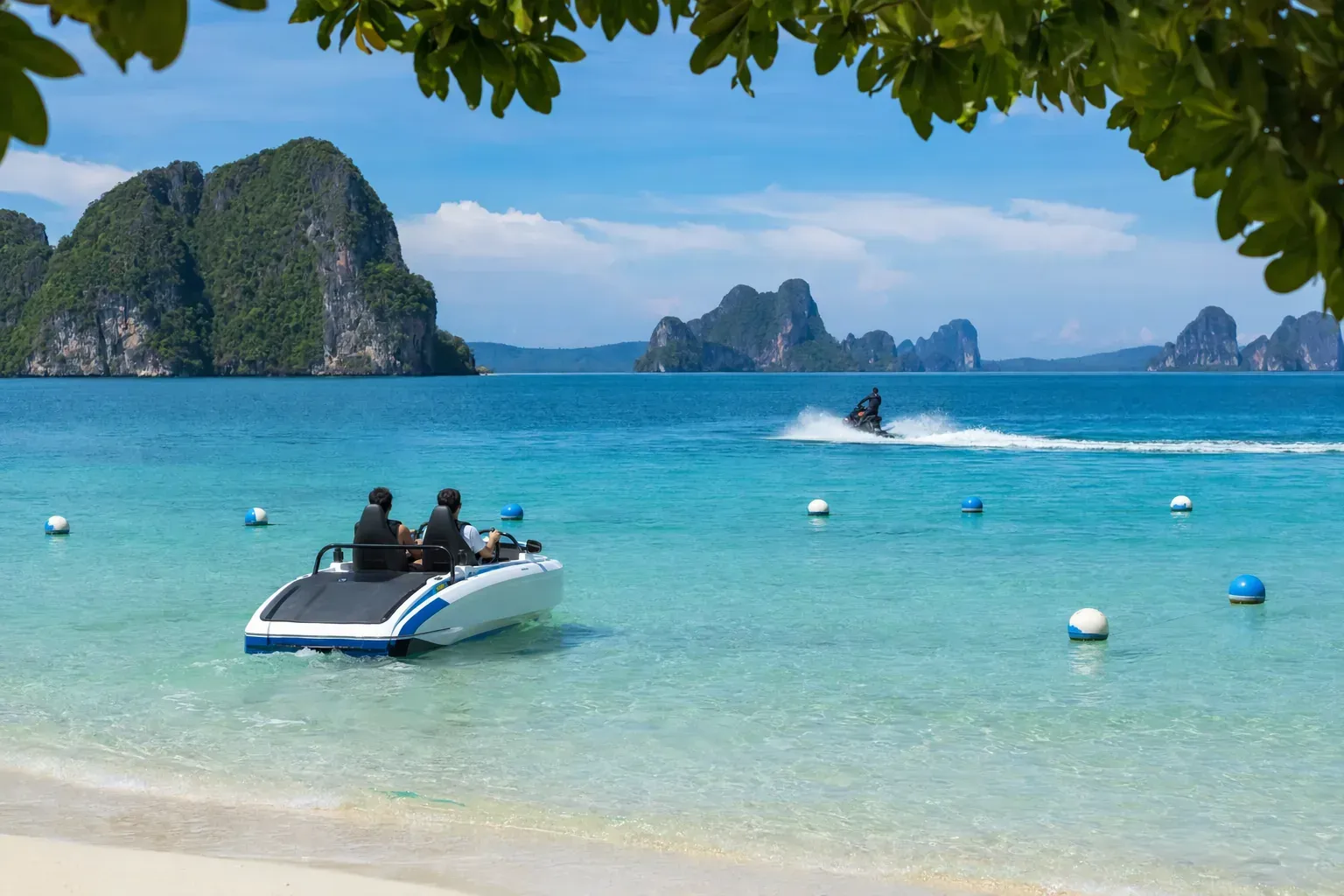
If you already operate jet skis on a Thai beach, you have already cleared the hard part of adding a kart boat line: a registered company that meets the ownership rules, a beach concession, insurance, and a crew that knows how to run paid water sessions safely. A kart boat is not a replacement for that operation — it is a second product line that reuses the same compliance chain, the same beach, and much of the same staff, while selling a different experience: two people sitting in a boat, bumping and racing at low speed in a marked area, versus one rider standing on a machine at speed.
In short: Kart boats and jet skis are complements, not substitutes. Jet skis monetize individual thrill-seekers in 15-minute bursts; kart boats sell a shared, low-speed session that families, couples and mixed groups actually book together. Regulation is mostly shared — the Vessel Act ownership rule, the operation permit, the life-jacket rule — so the incremental compliance cost of adding kart boats is low if your jet ski operation is already clean. The real decisions are commercial: what a kart boat session should charge against the jet ski anchors on your beach, and how the monsoon calendar shapes when the second line earns.
Is there real demand for kart boats in Thailand?
Thailand is the strongest water-activity market in Southeast Asia by volume. Phuket alone recorded 13.1 million visitor arrivals and 497.5 billion baht in tourism revenue in 2024 — the highest of any Thai province (The Phuket News, 2025; Bangkok Post, 2025-09). Koh Samui logged 3.19 million arrivals in the first eleven months of 2024 with a 70% average hotel occupancy (Daily News, citing TAT Koh Samui). On Patong Beach the water-sports strip already runs a dense jet ski rental economy with price competition visible on every OTA listing.
Kart boats specifically — the bump-and-race format with a steering wheel — have essentially zero local operating presence: no local operator runs them, no Thai-language content explains them, and yet Thai-language interest exists. A TikTok search for kart boat pricing in Thailand ("Go Kart Boat ราคาในเมืองไทย") shows demand signals in the thousands of likes on a single clip. When a format has demand signals but no local supply, the first movers set the price anchor for everyone who follows. Electric boats are no longer a foreign concept on Thai water, either: ten Candela P-12 electric hydrofoil ferries now serve the Koh Kood route from Trat, one of Asia's largest electric passenger-boat orders (Future Transport News), and Phuket's Amanpuri resort has run electric leisure boats for guest picnics since 2020.
One more demand signal comes from our own inquiry log: a European operator currently building a Thai water-kart project started with five jet karts and a modular course, after testing the format in Morocco. Cross-regional operators like this one treat kart boats as a portfolio decision — one more line in a beach portfolio that already includes jet skis. That is exactly the situation this guide is written for.
What exactly is different between the two formats?
Dimension | Jet ski | Kart boat (electric kart boat) |
|---|---|---|
Who rides | 1 rider, standing/sitting solo | 2 people per boat, seated with a wheel |
Experience | Speed and spray, individual thrill | Low-speed bumping and racing, shared laughter |
Who books it | Solo travelers, groups splitting up | Families, couples, mixed groups that want one ticket |
Session shape | 15-minute bursts, rider rotates | 5-10 minute laps in a marked course, 2-4 boats on water |
Beach footprint | Ramp/berth + riding zone far from swimmers | Shallow marked area or dedicated small course, close to shore |
Skill barrier | Higher — riders fall, need instruction | Low — steering wheel + throttle, anyone can drive |
Incremental compliance (for an existing operator) | — (already compliant) | Mostly reuses the jet ski compliance chain |
The formats sell to different moments of the same beach day. A couple lands at Patong at 14:00: one partner books the 15-minute jet ski burst, the other declines — the speed is not for them. Two hours later the same couple books a kart boat session together because it is slow, social and photographed well. That second ticket is the one jet skis cannot sell, and it is the entire commercial case for running both.
What do the price anchors look like on Thai beaches?
Jet ski pricing in Thailand is well established and publicly visible, which makes it a useful benchmark for kart boat session pricing:
- Pattaya, Jomtien Beach: ฿1,450 for a 15-minute solo jet ski session (Klook listing)
- Phuket, Patong Beach: jet ski packages from ฿600, tandem tours around ฿8,000 for two
- Koh Samui, Chaweng Beach: beach-rental jet skis from ~฿1,400 per session, plus island-hopping tours ฿12,000-15,900 for the whole boat (session economics detailed in our Phuket & Samui operator guide)
Against those anchors, a kart boat is priced per session, not per 15 minutes of solo ride time. The published ROI scenarios our calculator uses run $30-55 per 5-10 minute session depending on fleet stage — a family ticket that two people share, priced between a jet ski burst and a full island tour. Since the boat itself sits in the $5,000 class before freight, and Thailand levies 0% import duty and 0% excise tax on recreational boats (VAT 7% applies) — a 2004 reform that surprises most first-time importers (BOI, PwC Tax Summaries) — the landed-cost math is friendlier than most operators assume. Model your own beach's session price in the site ROI calculator before you commit to a fleet size.
What regulation applies — and how much of it is shared?
This is where the incremental-cost argument gets concrete. Thailand regulates boats through the Marine Department (กรมเจ้าท่า) under the Thai Vessel Act B.E. 2481, and the rules that bind a jet ski operation bind a kart boat operation almost identically:
- Ownership structure (the hard rule): Vessel Act Section 7 requires a company operating registered vessels in Thai waters to have at least half Thai directors and at least 70% of shares held by non-foreigners. If your jet ski company already meets this, a kart boat fleet registered under the same company inherits the structure — no new corporate work (FAOLEX tha181046, official English translation).
- Registration threshold is by GRT, not length: boats above 10-20 GRT must register; a 4-5 m kart boat falls far below and runs on the operation-permit track (ใบอนุญาตใช้เรือ) — 300 baht for ≤5 GRT, renewed annually (≤12-month validity for under-10-GRT vessels). Confirm the exact permit class with your regional marine office.
- Commercial hire safety: vessels let out for commercial hire fall under the Hire-of-Vessels Act B.E. 2551 (2008) safety regime — the same one your jet skis already satisfy through annual inspections.
- Life jackets: Marine Department-certified vests with a permanent 10×10 cm label, per the 2017 (B.E. 2560) regulation. Same rule for both formats.
- Licensing: jet ski riders need a boat driving license (ใบขับขี่เรือ, 5-year, ฿5,000). Whether low-speed electric boats of this class require the same license has no explicit published exemption — confirm with the Phuket Regional Marine Office in writing before setting your operations policy.
Two caveats keep this section honest. First, none of this is legal advice — structures involving foreign shareholders need a Thai maritime lawyer. Second, enforcement has teeth now: Phuket authorities fined 23 unlicensed operators ฿10,000 each in July 2026 (Straits Times), and jet ski registration-plus-insurance rules have been enforced since 2016 (Bangkok Post).
Same beach, two product lines: what does the operation look like?
Running both formats on one beach reuses four assets:
- The marked water area. A kart boat course is a shallow, buoyed rectangle or small oval — often the calm corner of the same riding zone jet skis already use, with swimmers' areas excluded the same way.
- The safety crew. The attendant who supervises jet ski sessions with a rescue board covers a kart boat course at the same time — same watch pattern, lower speed, smaller area.
- The booking desk. Same counter, same insurance rider, same waiver flow. A family that declined the jet ski menu now has a second option at the same desk.
- The charging or fueling logistics. If you run electric kart boats, a shore charger in the same footprint as your jet ski prep area; charging discipline follows the same rotation logic as any battery fleet.
The one thing that does not transfer: session rhythm. Jet skis rotate riders every 15 minutes through a single machine; kart boats run 2-4 boats simultaneously in laps, which changes how you schedule briefings, life-jacket rotation and turnaround. Plan the course so the two formats never share the same 20-meter strip of water at the same time — separation is a one-time course-design decision, not an ongoing cost.
The money question: what does each line actually earn?
Jet ski economics on a Thai beach are proven: a single ski doing fifteen ฿1,450 sessions a day in high season grosses ~฿21,750 daily before commissions and fuel. Kart boat economics are newer but structurally similar — sessions, not days, are the unit of revenue — with two differences that matter:
- Two tickets per session, not one. A kart boat session takes two people, so the per-customer revenue of a ฿1,200 session is ฿600 per head — closer to the ฿600 Patong jet ski packages, but sold as one shared ticket.
- Two-person sessions stack across 2-4 boats on water simultaneously — throughput that scales with fleet size, not rider stamina.
- Electric means lower run-cost variance. Electricity at Thai commercial rates is a small line item; the cost side moves with batteries (60/80/100 Ah, 72V) and maintenance windows, not fuel price swings.
The published scenarios (commercial-water-kart-roi) run from 1.5 sessions/boat/day at $30 (pilot) to 5 sessions/boat/day at $55 (fleet stage). Even at the conservative pilot scenario, a 2-boat kart boat line at $30 per session on a beach where jet skis already prove the demand exists — the fleet-scaling logic from our fleet guide applies unchanged: expand on turn-aways, not on good months.
The monsoon calendar affects both lines equally
Phuket's southwest monsoon season runs mid-May to mid-October and concentrates 85% of annual rainfall there (Thai Meteorological Department, The Climate of Thailand); waves above 2-3 meters ground small craft entirely. This affects jet skis and kart boats identically — the monsoon grounds both, so adding kart boats is a dry-season capacity play, not a hedge against the monsoon. During green season your jet ski line already proves what a shortened operating window does to fleet utilization; a second line doubles down on the same window rather than diversifying away from it.
One boundary note: Koh Samui sits in the Gulf of Thailand, where the monsoon phase differs from the Andaman coast. We deliberately make no Samui-specific seasonality claim here — verify locally before planning a Gulf-side operation.
When does adding the second line actually make sense?
- Your jet ski fleet turns customers away at peak. Same trigger as fleet scaling: paid refusals, not good months.
- You watch couples and families walk away from the jet ski menu. That is the kart boat customer standing right at your desk, unserved.
- Your beach has a calm, shallow corner that jet skis cannot monetize. Kart boats need exactly that footprint.
- You are planning a modular course. A fixed small course lets you sell timed racing, not just rentals — the highest-margin format in the ROI scenarios.
And when does it not make sense? If your beach is high-energy surf most of the season, if your permits cap total vessels on your concession, or if your operation is single-permit precarious — fix those first. A second product line multiplies whatever your operation already is.
Questions operators ask us
Do you need a license to operate kart boats commercially in Thailand? The operation-permit track (ใบอนุญาตใช้เรือ, ≤5 GRT class, 300 baht, annual renewal) applies, plus the commercial-hire safety regime for vessels let for hire. Whether drivers of low-speed electric boats need the boat driving license has no published exemption — get written confirmation from your regional marine office.
Are electric boats treated differently from petrol boats? No. Thai law classifies motor-driven vessels by the machine, not the fuel — electric boats follow the same track as jet skis, with no published special treatment either way.
How much does a kart boat cost delivered to Thailand? The boat sits in the $5,000 class before freight; Thailand levies 0% import duty and 0% excise on recreational boats, with 7% VAT. Quoting is one-to-one because landed cost moves with freight, battery configuration and delivery terms — request a quote with your beach and session plan.
Can kart boats and jet skis share the same beach? Yes, and usually do — separated by course design, not by distance. The kart boat course occupies the calm shallow corner of the riding zone; jet skis keep the open water beyond it.
What happens during monsoon season? Both lines ground together. Plan the second line's payback math on the dry-season window (November-April on the Andaman side), not on 12 months.
What is the minimum order? A pilot line starts at 2 boats plus a spare battery set. See our MOQ and lead-time guide for how a first order is packed, shipped and documented.
Sources
All sources retrieved and verified 2026-11-02. Media citations reference the publisher and publication window; figures cross-checked against the project research ledger (2026-09-20 two-agent T1 sweep).
- The Phuket News (2025-02-14) / Bangkok Post (2025-09-02): Phuket 2024 — 13.1M arrivals, ฿497.5B revenue
- Daily News (2024-12-05), citing TAT Koh Samui: 3.19M arrivals Jan-Nov 2024, 70.01% occupancy
- Thai Meteorological Department, The Climate of Thailand (climate.tmd.go.th): SW monsoon mid-May to mid-October, 85% of annual rain
- FAOLEX tha181046 (Council of State official English translation): Thai Vessel Act B.E. 2481, Sections 7, 8, 9
- info.go.th fee schedule: vessel operation permit ≤5 GRT — ฿300
- Royal Gazette (B.E. 2563) Marine Department regulations: under-10-GRT permits ≤12-month validity
- Hire-of-Vessels Act B.E. 2551 (2008): commercial hire safety regime
- Marine Department regulation B.E. 2560 (2017): life-jacket certification and 10×10 cm label
- Thai PBS (2024-08): boat driving license enforcement for jet skis; Lexology (2023): ฿5,000 / 5-year fee
- BOI (boi.go.th) / Excise Department database (lawelcs.excise.go.th): 0% duty + 0% excise on recreational boats; PwC Tax Summaries: 7% VAT (reduced rate to 2027-09-30)
- Bangkok Post (2016-01): Phuket jet ski registration + insurance rules; Straits Times (2026-07): 23 operators fined ฿10,000
- Future Transport News (2025-10): Candela × Seudamgo — ten P-12 electric hydrofoil ferries on the Koh Kood route
- Klook Pattaya listing: ฿1,450 / 15-min jet ski session; Patong packages from ฿600
Get a fleet plan for your beach
Tell us your beach, your existing jet ski operation and your season, and we will map a kart boat line onto it — course footprint, fleet size, session pricing and the permit path. Start with the ROI calculator, then contact us for a beach-specific plan. You can also reach us directly on WhatsApp for a faster reply.
Get a Quote for Your Kart Boat Business
Tell us what you need — OEM/ODM specs, quantity, target market. Our team replies within 24 hours.
Prefer a quick chat?
Chat on WhatsAppFree B2B resources
Buyer guides, ROI calculators, customs checklists, and case studies — built on direct factory manufacturing experience.