How Much Does a Kart Boat Cost? 2026 Price Guide
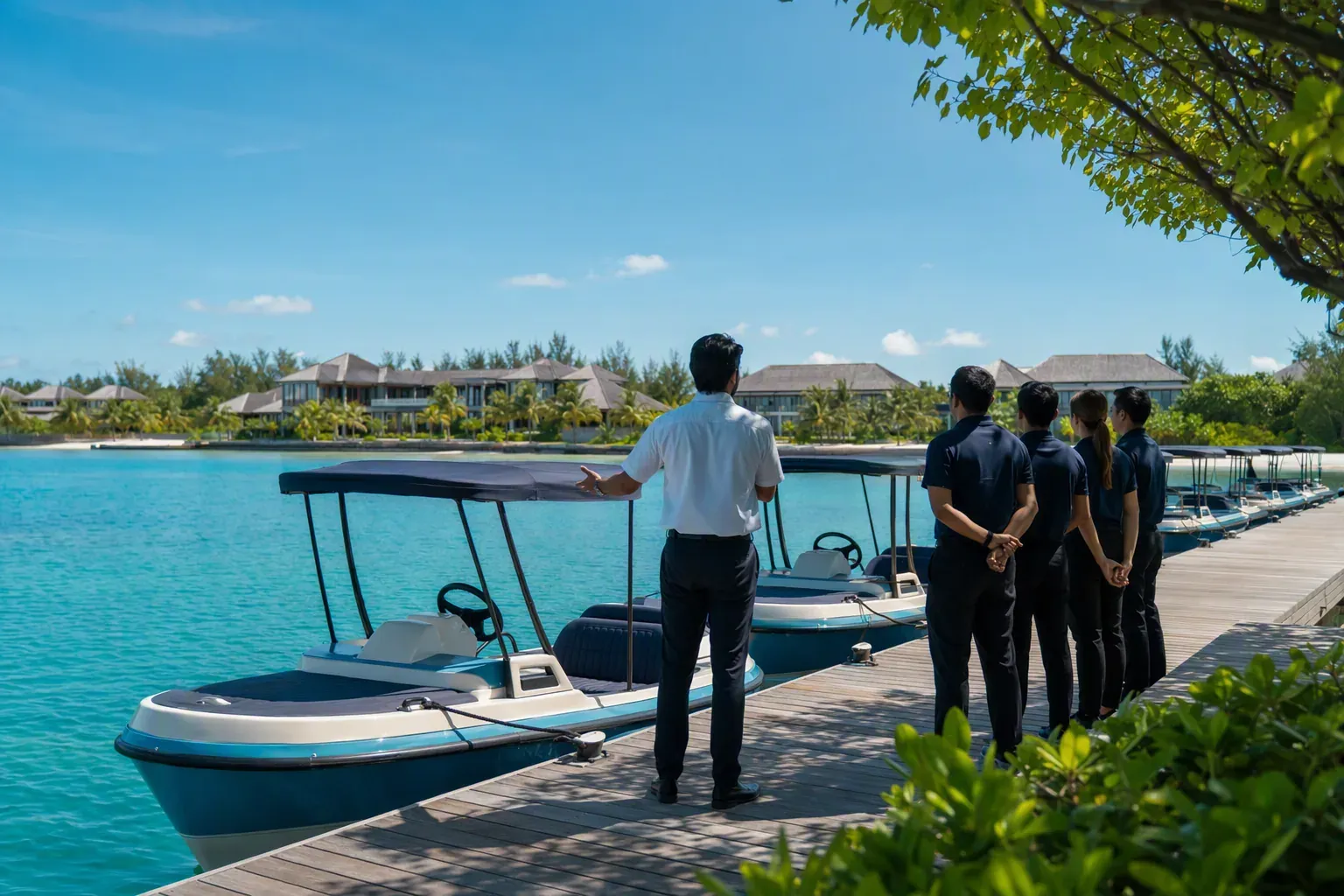
Most electric kart boats quote between $2,400 and $6,900 USD per unit on B2B platforms in 2026, depending on motor power, battery capacity, and order volume. Branded retail models list between $3,500 and $6,600. But the sticker is only the start: freight, duties, and battery documentation can add 30–50% to your landed cost — and the same physical boat has been observed quoted at five different prices, a 5.5x spread, across channels. This guide walks through what you are actually paying for, what real models listed for in 2026, and how to get a quote you can compare.
Kart boats sit in an awkward information gap. Search for a jet ski and you get dealer price lists; search for a kart boat and you get 3D renders with "contact us" buttons. That opacity isn't an accident — it's how low-quality suppliers hide behind vague listings. This page is our attempt to put real numbers and real structure around the question, using publicly listed prices observed in mid-2026, so you can budget before you ever send an inquiry.
If you are still deciding which configuration fits your venue, price only makes sense once the use case is pinned down — the motor power & payload selection guide walks that choice end to end.
TL;DR — 5 Quick Answers
- What does a kart boat cost in 2026? Factory-direct single-seat electric units listed between roughly $2,400 and $6,900 on B2B platforms; branded retail models between $3,500 and $6,600. Landed cost adds 30–50% depending on destination.- Why does the same boat get five different prices? Channel margin, volume tier, and content economics — one visible brand (Rush Wave K2) was observed from ~$3,600 (Alibaba volume tier) to $20,000 (press feature) across channels.- What is the single most useful comparison rule? Never compare quotes without normalizing for quantity tier, Incoterms, battery configuration, and included documentation. A $3,600 FOB quote and a $5,999 DDP quote can be the same money — or wildly different ones.- What does the landed-cost math look like? Factory price × (1 + duties + VAT) + freight + compliance fees. Malaysia lands at ~+6%, the UAE at ~+21%, the EU at ~+28–33%, the US at ~+30–40%, Brazil at up to ~+86%.- Why don't we publish a price on the product pages? Deliberate — see the position at the end of this guide. A single number on a page is a false anchor when the same configuration moves 50%+ across volume and terms.
What Are You Actually Paying For? The Anatomy of a Kart Boat Quote
A kart boat is not one product; it is a package of subsystems, and each one moves the price:
Subsystem | What it is | How it moves the price |
|---|---|---|
Hull | Rotomolded PE (budget workhorse), fiberglass FRP (smoother finish, more cost), ABS (impact-resistant middle ground) | Affects both unit price and freight class |
Electric drive | 6–18 kW motor typical for commercial units (our K300 racing model runs 15 kW) | More power means bigger controller, cooling, structural reinforcement |
Battery pack | Usually the most expensive component after the hull; capacity, cell grade, certification all price in | Determines whether the boat can legally ship at all — first thing verified in any pre-shipment inspection |
BMS and safety electronics | Battery management, kill switch, tilt shut-off | Cheap units cut here first; it shows up as warranty claims later |
Certification and documentation | CE files, battery shipping papers (UN 38.3 summary, MSDS) | Some quotes include them; some quietly exclude them and you discover the gap at the port |
Packaging and freight prep | A kart boat is bulky volume freight — roughly 2–2.5 CBM per unit crated | Packing and palletizing choices change your freight bill |
When a quote looks "too cheap," one of these six lines has usually been thinned. Our buyer trust center exists precisely because these are the lines that get blurred.
2026 Market Price Snapshot: What Kart Boats Actually Listed For
These are publicly listed or reported prices observed in August 2026. They are market snapshots, not offers — listings change, and volume pricing moves the number. Use them to calibrate, not to anchor a budget to the dollar.
Model / Source | Listed price (USD) | Notes |
|---|---|---|
Accio / Alibaba B2B listings (single-seat, China factories) | $2,388 – $6,899 | Factory-direct range across multiple suppliers; 1-unit MOQ common |
SABO 15 kW EPP (B2B tiered) | down to $2,999 at 500+ units | CE / MSDS / UN 38.3 listed; price floor of the segment |
Havospark 52 km/h jet kart | $3,499 – $3,599 | Shenzhen Hoverstar; direct competitor segment |
Bluepenguin KT-0602 | $3,980 | 40 km/h, brushless motor |
AdmitJet Micro Jet Boat | $4,850 | 45 km/h, ~45 min runtime, 185 lbs |
Minijet A2-10 / A2-12 | $5,195 / $6,595 | Kit format; A2-12 seats up to 4 |
Rush Wave K2 (Amazon retail) | $5,999 | Reported ~287 units/month, 4.6 rating (third-party sales data) |
New Zealand retail channel (Rush Wave line) | NZ $1,399 – $23,700 | Official partner pricing incl. compliance clearance; shows how far trim options spread |
Two structural facts sit behind these numbers. First, China's supply side is intensely commoditized: dozens of factories now list near-identical single-seat electric kart boats in the $2,400–$6,900 band, which is why price alone is a poor filter. Second, retail and B2B are different games: the same model that lists at $5,999 retail on Amazon can be quoted near $3,600 in B2B volume tiers — a gap that is legitimate (warranty, returns, channel margin) but easy to misread.
Why the Same Boat Can Be Quoted at Five Different Prices
Here is the case that made us build this page. One of the most visible kart boat brands of 2026 — Rush Wave — had its flagship K2 observed at five different prices across channels, a spread of roughly 5.5x:
Channel | Observed price |
|---|---|
Alibaba volume tier (20+ units) | ~$3,600 |
Alibaba single-unit tier | $5,999 |
JetDrift review coverage | $4,999 |
AliExpress retail | $8,052 |
Celebrity/press feature | $20,000 |
All five numbers describe merchandise that is, at best, marginally different. What varies is the channel margin, the volume assumption, the warranty backing, and — for the highest figure — pure content economics.
The most common first question in our inquiry inbox isn't about specs at all. It's some version of "why is your quote so much lower than the price I saw online?" I used to answer that boat by boat; now I answer it channel by channel, because the honest answer is structural: retail embeds warranty handling, returns infrastructure, and consumer-grade margins that a factory-direct commercial quote simply doesn't carry. Neither number is fake. They are prices for different jobs, and a buyer who anchors on the retail figure will read every factory quote as a red flag, while a buyer who anchors on the lowest B2B listing will be surprised by what lands at the port.
The practical lesson: never compare quotes without normalizing for (a) quantity tier, (b) Incoterms, (c) battery configuration, and (d) what documentation is included. The questions to ask a kart boat manufacturer checklist exists so your RFQ forces every supplier onto the same baseline.
From Factory Price to Your Dock: The Landed-Cost Math
The listed price is the beginning of the budget, not the end. The working rule:
Landed cost ≈ factory price × (1 + duties + VAT/sales tax) + freight + compliance & clearing fees
Using a $4,000/unit factory price and roughly 2–2.5 CBM of crated volume as the baseline, add-on burden observed across destination markets (freight-forwarder and customs data collected July 2026) spans from single digits to worse-than-doubling:
- Malaysia ~+6% — 0% duty under ACFTA plus SST exemption; the cheapest clean lane in the dataset. Vietnam (~+13%) and Thailand (~+15%) sit close behind on 0% duty and low VAT.
- UAE ~+21% — 5% duty + 5% VAT; one of the most cost-effective premium markets.
- EU (Germany/Italy) ~+28–33% — VAT 19–22% dominates; duty treatment depends on the exact HS classification (verify in TARIC before budgeting).
- US ~+30–40% — MFN duty (1.7–6%) plus Section 301 additions on Chinese-origin goods (7.5–25% combined is the working band; headline tariff actions in 2025–2026 have pushed some watercraft lines far higher — verify the current HTS rate for your exact classification before budgeting).
- Saudi Arabia ~+42–49% — 5% duty + 15% VAT + inland freight.
- Mexico ~+48% / Brazil ~+50–86% — the heavy end of Latin America: duty stacking, multi-level taxes, and per-model certification (NOM in Mexico). Chile, by contrast, is among the cleanest LatAm entries (~+29%, 0% duty under the China–Chile FTA).
Batteries are their own freight story. Lithium packs ship as Class 9 dangerous goods by ocean; the UN 38.3 test summary, MSDS, and packing certification determine whether your boat leaves the port on schedule or sits in a warehouse. Our battery shipping & compliance page covers the document set, and our CE / FCC / UN 38.3 overview explains what each certificate actually attests to.
DDP (delivered duty paid) quotes fold all of this into one number. They're easier to compare and harder to hide behind — which is why we quote DDP to most destinations. But know the edges: in heavy-tax markets like Brazil, a DDP number comes back looking alarming, and the alarm is the tax burden, not the boat — buyers there are usually better served quoting ex-works and running clearance through their own broker. And DDP only works where the exporter has a real clearing partner at the destination port; where we don't, we say so and quote FOB instead of pretending. If a supplier quotes DDP to every destination on Earth without asking which one, that's a number to distrust.
What Moves the Price Up or Down
Here's the counterintuitive part: when two quotes differ by more than freight can explain, most buyers assume they've found negotiating room. In our experience the spread is usually not about margin at all — it's about missing lines. A quote 40% below the cluster is rarely a 40% better deal; it's a 4 kWh pack quoted against a 6.2 kWh pack, or certification files quietly excluded, or freight prep reduced to shrink-wrap. The price didn't drop. The boat did. With that in mind, the legitimate variables:
- Battery capacity and chemistry. A 6.2 kWh pack versus a 4 kWh pack is a real cost difference — and runtime on the water is where fleets feel it.
- Motor power tier. 13–15 kW performance units carry more controller, cooling, and hull reinforcement than entry 6–10 kW leisure units.
- Hull material and finish. Rotomolded PE is cheapest; FRP and ABS cost more but finish and durability differ.
- Certification scope. "CE declared" and "CE certified with files you can hand your port authority" are different price points — and different risk levels.
- Order volume. B2B tiering is steep in this category: the SABO floor price ($2,999 at 500+) is roughly half of single-unit retail for comparable spec.
- Customization. OEM colors, logos, and fleet livery are usually minor; structural custom work is not.
- After-sales package. Spares kits, warranty terms, and training — the lines that separate a boat that earns for years from a boat that becomes a planter. See parts & warranty for what to pin down in writing.
Price vs. Cost of Ownership: The Number That Actually Matters
For a commercial buyer, the purchase price is one variable in a utilization equation. A $5,999 boat that runs 12 sessions a day at a 30-minute cycle with tool-free battery swaps can out-earn a $3,500 boat that sits on a charger half the day — before either boat's first maintenance invoice.
The cost side is dominated by batteries (the main consumable) and electricity (a rounding error — a full charge of a typical 72V-class pack costs well under a dollar at commercial rates). The bumper boat rental business breakdown walks the full revenue model, and our commercial ROI page lets you test the assumptions with your own venue numbers.
A useful budgeting habit: hold back 10–15% of fleet purchase value as a spare-parts and battery-reserve fund in year one. If a supplier's quote leaves no room for a spares package, the discount is coming out of your season two.
Where to Find Kart Boats for Sale — and What Each Channel Is Good For
- B2B marketplaces (Alibaba, Accio and similar). Widest choice, factory-direct pricing, 1-unit MOQs — and the widest quality variance. Filter for suppliers who publish battery certification and accept video inspection.
- Brand direct / manufacturer sites. Better configuration control and factory warranty backing. This is where customization and fleet pricing conversations happen.
- Regional distributors. Higher unit price, but local warranty handling, compliance clearance, and faster spares. The NZ pricing row in the table above is a good example of distributor economics.
- Retail (Amazon and similar). Convenient for single personal units; retail prices embed channel margin, and commercial buyers give up the configuration dialogue that matters for fleet duty cycles.
Worth saying about what a serious inquiry looks like, because it recalibrates how you should spend your own effort: the most professional inquiry we received in 2026 came from a procurement agent writing in English through our contact form, asking for exactly three deliverables — a product catalog, a CIF quote, and an ROI payback model. Not one question about horsepower or top speed. Mature buyers don't negotiate on enthusiasm; they build a comparison file and let the documents fight it out. If your own shortlisting process produces fewer than those three artifacts per supplier, you're not comparing yet — you're browsing.
Get a Quote You Can Compare
One deliberate omission to close on: you won't find prices on our product pages, and that's a position, not an oversight. The same configuration moves more than 50% across volume tiers, battery options, and Incoterms — a single number on a page would be a false anchor that every real quote then has to argue with. What we publish instead is the band (this page) and what we need from you to quote precisely: your water area, expected sessions per day, and destination port. Send those and we'll return a configuration and a DDP quote where available, with the battery documentation set named explicitly — or read the complete procurement guide before you shortlist suppliers.
Price figures on this page are market snapshots collected July–August 2026 from: public B2B listings (Alibaba, Accio), retail listings (Amazon, AliExpress), review coverage (JetDrift, Supercar Blondie), third-party sales data (sakerplus), and freight-forwarder/customs rate cards compiled 2026-07-23. Listings change without notice; nothing here constitutes an offer. SinoKartboat quotes are prepared per configuration and destination.
Data Caveats & Sources
- ✅ Well-sourced: the 2026 price snapshot rows (public listings and review coverage as listed below); the 5.5x channel spread (five independent channels for one visible model); landed-cost adders (freight-forwarder and customs rate cards compiled 2026-07-23); crated volume ~2–2.5 CBM (our own export packing records).
- ✅ The document-first inquiry signal (catalog + CIF quote + ROI model as an opening request, zero spec questions) comes from a 2026 inbound inquiry, anonymized.
- ⚠️ Directional, not verified: the "40% spread usually means missing lines" pattern (our internal quote-review experience, not a measured dataset); retail-to-B2B gap legitimacy (varies by brand and channel).
- ❌ Deliberately omitted: per-unit pricing for our own fleet configurations (quote-based — see position above); live listing prices (they change; the snapshot date is stated); duty-rate guarantees (verify current HTS/TARIC for your classification — headline tariff actions in 2025–2026 move faster than any guide).
If a claim here matters to your budget, ask us to point at its source — including when the claim is ours.
_Last updated: September 2026. Prices are snapshots, not offers — send your configuration and destination port for a DDP quote you can actually compare. Start the quote_
Get a Quote for Your Kart Boat Business
Tell us what you need — OEM/ODM specs, quantity, target market. Our team replies within 24 hours.
Prefer a quick chat?
Chat on WhatsAppFree B2B resources
Buyer guides, ROI calculators, customs checklists, and case studies — built on direct factory manufacturing experience.