Electric-Only Waters in France and the Mediterranean: What Lake Rules Actually Mean for Your Fleet Plan (2026)
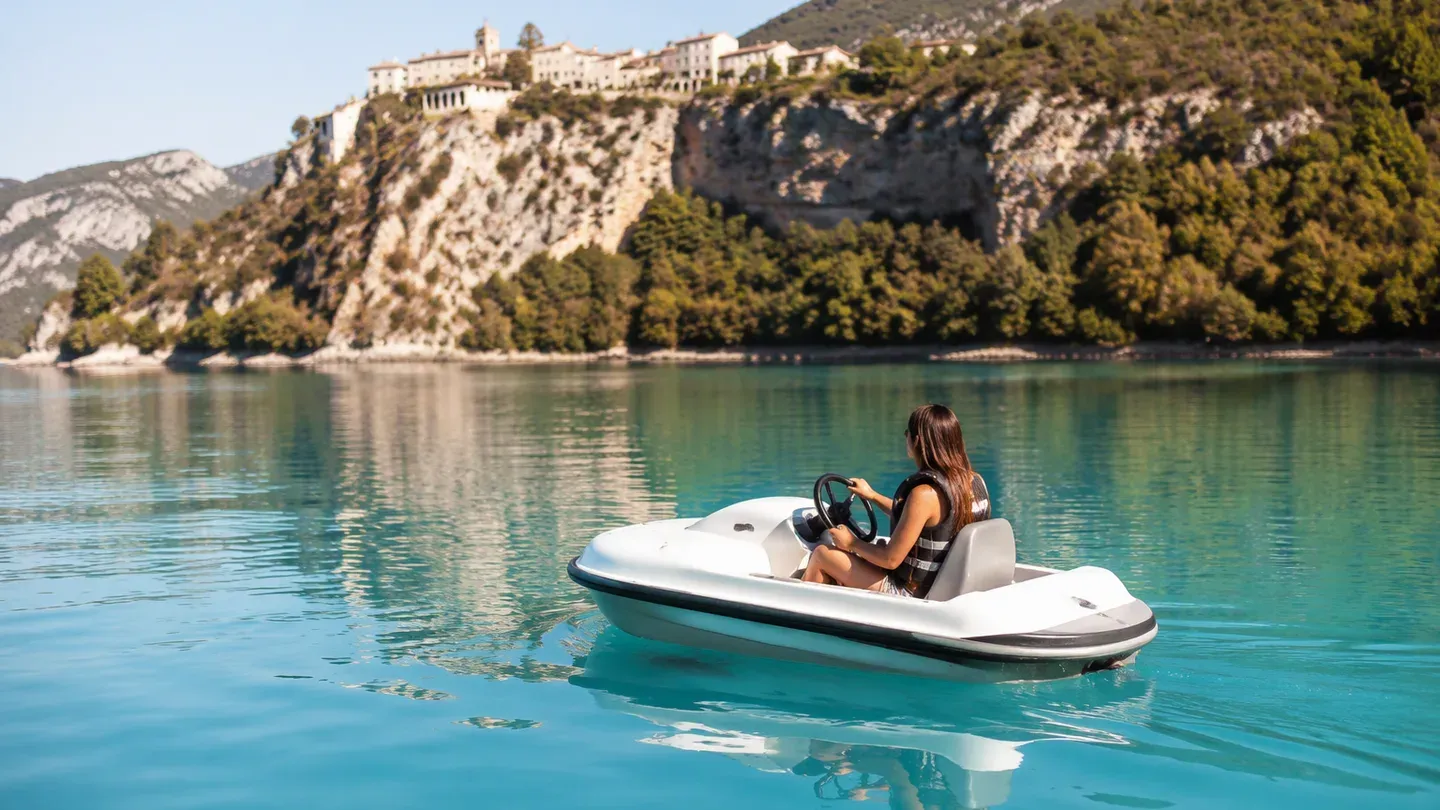
On 30 April 2025, the prefect of Alpes-de-Haute-Provence signed Arrêté préfectoral n° 2025-120-003, article 3.1, for the Retenue de Chaudanne reservoir: only electrically propelled craft are authorized, combustion propulsion prohibited (Volta Yachts regulations database, read 2026-08-23). It is the newest entry in a regulatory family that now covers the Verdon lake system in the French Mediterranean — and unlike most "electric-only" headlines, this one has direct commercial teeth.
Here is what most guides get wrong about European lake rules: "combustion banned" tells you almost nothing by itself. Some lakes that ban petrol also cap electric drives at 500 W — which is a trolling motor, not a rental fleet. Some lakes assumed to be electric-only (Annecy, most famously) have no engine-type rule at all. And on one French reservoir the law goes further than anywhere else in Europe: rental businesses may not operate thermal craft, so the commercial fleet is electric by statute, not by choice.
This guide is for operators and investors evaluating a watercraft rental or attraction business on southern European waters — the French Mediterranean lakes, the Italian lakes, and the broader electric-only pattern across the continent. We supply electric kart boats and configure fleets, so yes, we benefit from electric-only rules spreading. Everything below is written so you can verify each claim against the cited instrument yourself — and so you can use the framework against any supplier, including us.
Key Takeaways- France's Verdon system (Sainte-Croix, Esparron/Quinson, Chaudanne) is electric-only by statute with no power cap on electric drives — and at Esparron, rental fleets are electric by law (Arrêté 2018-327-003, art. 3.1 & 3.4).- "Combustion banned" ≠ "electric rental welcome": check for electric power caps separately — a 500 W cap makes a lake legally electric-only and commercially empty.- Lake Sainte-Croix already hosts a working electric rental market (multiple operators, ~€38–80/hr, no license needed) — the model is proven, not theoretical.- Lake Garda's northern Trentino section bans all motors including electric (LP 9/2001 art. 14(3)); the main Lombardy/Veneto waters have no engine-type rule. Same lake, three regimes — always check the specific instrument.- The charging-infrastructure gap is the opening: the largest electric-only lake in the Alps reportedly has no charging point on its entire shoreline.
Which Waters Are Actually Electric-Only — and Which Only Look Like It?
The starting point is a distinction most secondary coverage flattens: a water body's combustion rule and its electric allowance are two separate questions, and the answer to the first does not imply the answer to the second (Volta Yachts regulations database, 2026).
Three categories matter for fleet planning. Genuinely electric-welcoming waters ban or ration combustion while leaving electric drives uncapped — these are the commercially viable ones. Legally-electric-but-empty waters ban combustion but cap electric power at levels suited to trolling motors (500 W class), where no rental product lives. And assumed-electric waters — famous lakes that travel articles describe as electric-only — turn out on inspection of the actual instrument to have no engine-type rule at all.
The French Verdon system is the strongest example of the first category anywhere in Mediterranean Europe. At the Retenue de Sainte-Croix, the Arrêté inter-préfectoral of 15 June 2017 (art. 3.1) authorizes only electrically propelled craft, with no cap on what an electric drive may do, across a reservoir of roughly 114 km² (Volta Yachts, 2026). At the Retenue d'Esparron de Verdon (covering Quinson as well), the Arrêté inter-préfectoral n° 2018-327-003 of 23 November 2018 carries the same electric-only article 3.1 — and then article 3.4 settles the commercial question outright: hire businesses may not operate thermal craft. The rental fleet is electric by law. A July 2024 amendment to that order reopened unrelated paragraphs and left the propulsion rule untouched, adding only a safety ban on foiling devices. And the family is still growing: the Chaudanne order dates from April 2025.
For contrast, look at what the same region gets wrong in retelling. Lac d'Annecy — the French lake most often described as electric-only — has no engine-type rule in its governing instrument (Arrêté préfectoral DDT/DIR/UL/2015-0142, consolidated June 2023); the prefectural orders cited around it govern fishing and reed-bed protection (Volta Yachts, 2026). The lesson generalizes: verify the instrument, not the reputation.
Key takeaway: The power-cap trap is the single most expensive mistake in this market — an operator who reads "combustion banned" as "electric rental welcome" can buy a fleet for a lake where the electric allowance is capped below the power their product needs.
What Lake Sainte-Croix Proves: The Electric Rental Market Already Exists
This is not a speculative market waiting for regulation to catch up. Lake Sainte-Croix already runs a working electric rental economy across its main tourism villages.
Multiple operators rent electric boats from Bauduen, Sainte-Croix-du-Verdon, and Moustiers-Sainte-Marie (Verdon Secret, 2026). The Moustiers tourist office lists electric 4–5 seat boats at €40 per hour or €70 for two hours (Kako Beach via moustiers.fr, 2026); other operators advertise from €38 per hour for up to seven passengers, no boating license required (Location Bateau Verdon, 2026). The visitor mix runs from kayaks (~€20/hr) through pedal boats to the electric fleet at €40–80 per session — a functioning price ladder on a legal-electric-only lake inside a national tourist destination (the Verdon Gorge).
What does not exist yet, at scale, is the attraction tier. The current electric fleet is cruising-oriented: sedate exploration craft for entering the gorge. A kart boat product — timed laps, rankings, a competitive session — occupies a different slot on the same price ladder, aimed at the family and active segment rather than the scenery cruiser. The statutory framework does not distinguish; the market positioning does. For how that attraction tier runs operationally, see our resort fleet technology guide.
One more proof point from the north: Amsterdam's city-centre emission-free zone (Besluit uitstootvrije zone pleziervaart centrumgebied Amsterdam 2025, in force since 1 April 2025) is the only rule in this space that requires emission-free propulsion rather than prohibiting the alternative — electric, hydrogen, or muscle power only, hybrids conditionally (Volta Yachts, 2026). Mandates are spreading from lakes to urban waters; the direction of travel is one-way.
How to Read a Lake's Rules Before You Plan a Fleet
Key takeaway: This five-question instrument check is the framework we run before quoting any European lake deployment — it catches the mistakes that cost operators a season.
Work through these in order, against the actual instrument (the arrêté, ordinanza, or decree — not a tourism article):
Check | Question | Why it decides your plan |
|---|---|---|
Engine-type rule | Does the instrument ban combustion, ban all motors, or set no engine rule? | "All motors banned" (Garda Trentino, LP 9/2001 art. 14(3)) excludes electric too — no fleet, full stop. |
Electric power cap | Is there a ceiling on electric drives? | A 500 W-class cap means trolling motors only; a 15 kW kart boat is not a legal product there. |
Commercial clause | Does the order address hire/rental businesses specifically? | Esparron's art. 3.4 reserves the rental market for electric — the strongest possible position for an electric operator. |
Zone geometry | Where is propulsion allowed — whole lake, distance-from-shore buffers, seasonal closures? | Garda's main basin has a 300 m coastal buffer for motor craft; your circuit must fit the legal geometry. |
Charging reality | What charging exists on the shoreline? | Sainte-Croix: reportedly none across the entire lake. This is either your barrier or your moat. |
On the Italian lakes specifically, the regime splits three ways within single water bodies. The Trentino (northern) section of Garda prohibits private motor craft of any kind — electric included — under Legge provinciale 9/2001, art. 14 comma 3, with exceptions for public service, rescue, scheduled transport, and authorized racing. The main Lombardy/Veneto waters (Garda proper, Como, Maggiore, Iseo) operate under Ordinanza n. 58600/1997 as amended in 2009 with no engine-type rule — only national power thresholds and the 300 m shore buffer (Volta Yachts, 2026). Same lake, incompatible regimes: a deployment plan for "Lake Garda" is meaningless until you name which waters.
For buyers taking European delivery, the compliance layer beyond lake rules — CE marking under the Recreational Craft Directive, battery transport documentation, radio-equipment certification for GPS or app-connected options — is covered in our buyer trust center; the short version for lake fleets: lithium consignments need UN38.3 regardless of destination, and wireless-equipped options add radio certification work that non-wireless ones don't.
Why the Charging Gap Is the Opening
The strangest fact in this market: the largest electric-welcoming lake fleet in the Alps operates on a reservoir with no charging point anywhere on its shoreline (Volta Yachts, 2026). Operators run electric rental fleets by trailering batteries, swapping at base, and managing charge windows around bookings.
For a fleet planner, that gap is the strategy. Where shore power doesn't exist, battery swapping isn't a nice-to-have feature — it's the operating model. A modular-pack fleet with a charging rack at the rental base sidesteps the shoreline-infrastructure question entirely: boats never wait on a dock outlet, packs charge on your schedule overnight, and daily earning hours decouple from any charging-infrastructure rollout the lake may (or may not) ever build.
This inverts the usual pitch. In mature markets, swap is a throughput optimization. On European electric-only lakes in 2026, it is the enabling technology — the difference between an operable fleet and a shoreline fantasy. When you evaluate configurations for a lake deployment, weigh the swap architecture (pack count per boat, rack layout, charge management) ahead of every feature with a screen on it.
Key takeaway: In the lake deployments we configure, the operators who thrive on electric-only waters are the ones who planned their battery logistics like a warehouse — rack positions, charge states, pack rotation — rather than as an afterthought of boat selection.
What Can Go Wrong: Four Failure Modes
- Instrument illiteracy. Planning against a tourism article instead of the arrêté. The Annecy misread (no engine-type rule, widely described as electric-only) and the Garda Trentino trap (all motors banned, including electric) both come from reading reputation instead of law.
- Power-cap blindness. Deploying to a lake whose electric allowance is capped at trolling-motor power. The fleet arrives legal on paper and unusable in fact.
- Season concentration. Mediterranean lake tourism compresses into a summer window; a fleet sized to August peaks carries fixed cost through the shoulder. Size conservatively, expand on real utilization — the same discipline we detail in our rental business guide.
- Single-operator beachhead. Lake markets run on a handful of beach concessions. Losing your base location to a competitor's renewal bid strands a fleet. Secure tenure terms before capital commitment, not after.
FAQ: Electric-Only Lakes and Fleet Planning
Are Mediterranean lakes generally banning combustion engines?
No — and this is the most common misreading. Individual water bodies differ sharply: France's Verdon system is electric-only by statute (2017, 2018, 2025 orders), while Lake Annecy has no engine-type rule and Garda's main basin only applies shore-buffer and power-threshold rules. "Europe is banning petrol boats" is a trend headline; fleet plans are decided lake by lake, instrument by instrument (Volta Yachts, 2026).
Can I run a kart boat rental on Lake Sainte-Croix?
The statutory position is favorable — electric-only with no power cap, and the Esparron/Quinson order explicitly reserves commercial rental for electric craft. The commercial position is proven (existing operators, €38–80/hr price ladder). The practical unknowns are concession availability at the beach bases and how a higher-speed product fits the lake's navigation rules — both are questions to resolve with the operator community and the prefecture before capital commitment, and we state them as open questions, not answers.
What's the difference between a 500 W cap and no cap?
Everything. A 500 W ceiling is trolling-motor power — legally electric, commercially empty for rental products. An uncapped electric allowance (Sainte-Croix, Esparron, Chaudanne) permits full-size electric watercraft including 15 kW-class kart boats. Secondary sources routinely conflate raft rules, float rules, and boat rules; check what class of craft the cap applies to in the instrument itself (Volta Yachts, 2026).
Do electric boats need certification for European lakes?
Yes, layered. CE marking under the Recreational Craft Directive framework applies to watercraft placed on the EU market (with category and size nuances worth checking against your specific hull), lithium battery consignments need UN38.3 documentation for freight, and radio-equipped options (GPS, app connectivity) carry radio-equipment certification obligations that non-wireless features don't. Confirm which certifications your delivered configuration carries — in writing, per destination country.
Is the electric-only trend expanding or static?
Expanding, on the evidence: the Verdon family gained a new order in April 2025 (Chaudanne), Amsterdam's emission-free zone took effect in April 2025, and Bavarian lakes ration combustion through quota permits (electric permits issued indefinitely, combustion waits of ~12 years reported). Direction of travel is one-way, but the pace varies by country — plan on the instruments that exist today, not on the ones you expect (Volta Yachts, 2026). Country-level licensing and cost structures vary just as widely: Greece pairs a 30 hp license-free threshold with 2026 island VAT cuts — see our Greece operator guide for the worked example.
Conclusion
The compressed version: France's Verdon lakes are the real thing — statutory electric-only, no power caps, commercial rental legally reserved for electric at Esparron, and a proven rental market already operating. The traps are equally concrete: lakes that ban all motors including electric, lakes whose electric allowance is capped into uselessness, and famous lakes with no engine rule at all. Read the instrument, verify the cap, secure the concession, and plan your battery logistics as the core operating decision — because on lakes with no shore charging, the swap architecture is the business model.
If you're evaluating a specific water body and want a fleet configuration read against its actual rules — power caps, commercial clauses, charging reality, and the compliance scope written into the quote — talk to our team. Name the lake; we'll read the instrument.
Data Caveats (read this before quoting this guide)
- ✅ Verified from the cited instrument-level source: all Verdon-system orders (Sainte-Croix 2017 art. 3.1; Esparron/Quinson 2018-327-003 art. 3.1 & 3.4, as amended July 2024; Chaudanne 2025-120-003 art. 3.1); Garda Trentino LP 9/2001 art. 14(3); Garda Lombardy/Veneto Ordinanza 58600/1997; Annecy Arrêté 2015-0142; Amsterdam Besluit 2025 — all as compiled with direct statute reading by Volta Yachts (retrieved 2026-08-23; page HTTP header confirms live 2026-08-23). Lake Sainte-Croix operator/pricing data from operator and tourist-office pages (Verdon Secret; Kako Beach via moustiers.fr; Location Bateau Verdon — retrieved 2026-08-23).
- ⚠️ Directional: the "no charging point on Sainte-Croix" claim rests on a single careful secondary source's survey — plausible but not independently re-verified by us; Bavarian 12-year permit waits as reported, not confirmed with the authorities; concession availability and kart-boat product fit on Sainte-Croix posed as open questions, not findings.
- ❌ Deliberately omitted: fleet-size ROI projections for specific lakes (concession terms unknown); "X lakes will go electric-only by 20XX" forecasts (no basis); RCD exemption determinations for specific hull lengths (category nuances need per-hull checking); any invented operator case study.
One process note for transparency: the regulation compilation we lean on is published by Volta Yachts, a company in the electric-boating charging business. We cross-checked its headline readings against independent search results where available (Garda's Trentino motor ban is corroborated by regional navigation guides), and we cite it precisely because it names instruments and reads statutes directly — but a fleet commitment should end with your counsel reading the current text of the governing order, not with either of us.
Sources & Verification
- European lake regulation compilation (statutes cited per water body): Volta Yachts, "Combustion engine bans on European lakes", retrieved 2026-08-23
- Sainte-Croix rental operators and pricing: Verdon Secret, Kako Beach via Moustiers tourist office, Location Bateau Verdon, retrieved 2026-08-23
- Garda navigation rules corroboration: BoatGarda, retrieved 2026-08-23
- SinoKartboat internal: European lake deployment configuration framework; fleet technology capability documentation on file
Last updated: August 2026. Regulations change — the Chaudanne order itself is four months old at writing. Verify the current text of any instrument before committing capital. Contact our team for a configuration read against your target water.
Get a Quote for Your Kart Boat Business
Tell us what you need — OEM/ODM specs, quantity, target market. Our team replies within 24 hours.
Prefer a quick chat?
Chat on WhatsAppFree B2B resources
Buyer guides, ROI calculators, customs checklists, and case studies — built on direct factory manufacturing experience.