Kart Boats in Greece: Operator Guide to Licensing & Costs
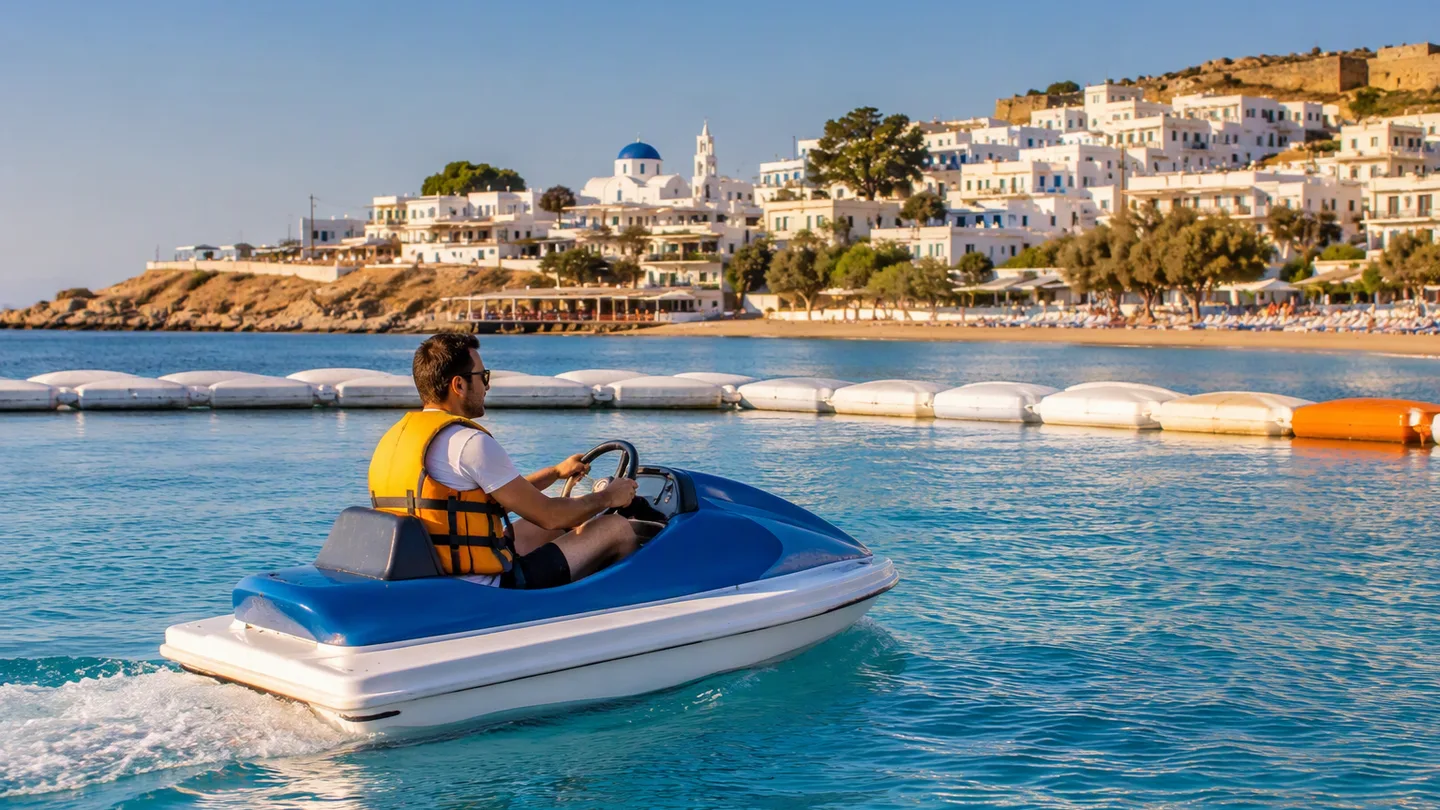
TL;DR: Greece combines a record €23.6B tourism year (2025, +9.4%) with overtourism controls — Santorini caps cruise disembarkation at 8,000/day. Kart boats at 15 kW (~20 hp) sit under Greece's 30 hp license-free threshold, import at low EU duty plus recoverable 24% VAT (17% on listed islands from 2026), and need no license from your customers. Family islands one ring out from the capped hotspots are the venue to watch.
Every market in our operator series so far has been a frontier story: NEOM building a waterfront from nothing, Kuwait writing a new law in 2026, Qatar converting a World Cup into a leisure economy. Greece is the opposite kind of opportunity — the most mature summer water-sports market in our series, and precisely because of that maturity, the first one where government policy is actively reshaping what kind of equipment operators can profit from. The country posted a record €23.6 billion in travel receipts for 2025, up 9.4% on 2024, its ports handled 8.4 million cruise passengers in 2025 (+6.2%), and the headline response to that growth has been caps, taxes and slotting systems on the busiest islands — Santorini now enforces a hard limit of 8,000 disembarking cruise passengers per day, down from peak days that exceeded 11,000. When a market starts rationing headcount, it starts paying for yield per visitor instead. That is the window a family-scale electric kart boat fleet is built for.
This guide covers the demand picture, the licensing chain under Law 4256/2014 and its 2019 modernization, the landed-cost math — EU customs territory, 24% standard VAT with a 2026 island-rate reversal in the operator's favor — and where in the archipelago a kart boat circuit actually fits, as opposed to where the crowds and the restrictions already are.
Why does Greece suit electric kart boats?
Start with the scale, because Greece is the biggest tourism economy we have covered in this series by a wide margin. Travel receipts reached €23.6 billion in 2025, up 9.4% year on year, per Bank of Greece data reported through ELSTAT channels — against roughly €21.6 billion in 2024. International arrivals run around 40 million a year on the broad travelers basis (ELSTAT's stricter non-resident arrivals count is lower, around 26 million; the two definitions measure different things, and we flag the gap again in the caveats below). The cruise line matters as much as the beach line: 8,415,713 cruise passengers transited Greek ports in 2025, up 6.2% from 7,927,709 in 2024, per trade-press port aggregates (Travel and Tour World), with Santorini and Mykonos the busiest calls.
Now the structural point that a fleet buyer should internalize: Greece's waterfront demand is not one market but an archipelago of micro-markets with very different regulatory pressure. Santorini's cap and the €5–20 per-passenger cruise tax (topped at €20 in high season on Santorini and Mykonos, from July 2025) are demand-rationing tools aimed at volume businesses. Mykonos jet ski operators charge €70–80 for a 10-minute ride on Paradise Beach. A cap on arrivals does not cap what each arrival spends — it rewards operators who convert fewer guests into longer, higher-value sessions. That is the commercial logic of a kart boat circuit: multi-rider family sessions priced per boat rather than per adrenaline-minute.
The environmental direction points the same way. Greece maintains 174 marine Natura 2000 sites, yet only 12 of them currently operate under an actual protective regime — a gap the country has committed to close by expanding marine protected areas to over 30% of its territorial waters under the EU Biodiversity Strategy. Proposed measures in the pipeline — no-mooring zones, designated mooring areas, ecological mooring systems — all squeeze combustion craft and anchoring behavior. Electric propulsion, with no exhaust, less wake and no fuel-handling on fragile beaches, walks through that door rather than into it. We made the same alignment argument for Oman's Daymaniyat reserve; in Greece it is backed by a binding EU-level expansion commitment, which makes it policy rather than marketing.
What is the market signal actually saying?
Three signals, and the third one is the one most buyers miss.
First, the volume signal is unambiguous: record receipts, record cruise traffic, and a hospitality sector that has absorbed year after year of growth. Second, the management signal is equally clear — Santorini's 8,000-passenger daily cap, enforced with tighter ship counting and slotting in 2026, arrived with the unusual public support of CLIA itself. Islands are no longer buying raw arrivals; they are curating them. Third — and this is the one we under-weighted until we ran the numbers — the fiscal signal reversed direction in 2026. After years of phasing out the reduced VAT rates that Greek islands enjoyed, Greece cut VAT by 30% on a list of smaller islands from 1 January 2026: the standard 24% rate drops to 17%, the 13% reduced rate to 9%, on islands selected for population and demographic criteria, with Chios, Kos, Lesvos and Samos keeping the treatment beyond 2026. A market that raises taxes on mass tourism while cutting them on designated islands is telling you exactly which kind of operation it wants more of.
One honest note on demand evidence: no Greek inquiry has reached our inbox yet — the Kuwait journey we documented in our Kuwait guide remains our only first-hand buyer story, and it came from a smaller market than Greece. Everything in this guide is built from public data. We think the inference is strong, but you should know it is inference, not inbox.
How does licensing work?
Greece regulates recreational water sports through Law 4256/2014, the tourist-vessels framework, as modernized by Law 4629/2019. The 2019 law moved sea-sports businesses from full operating licenses to a notification-of-operation regime filed with the competent authorities, backed by an electronic registry — a meaningful de-formalization compared with the license regimes in our Gulf guides, and consistent with how EU services directives push member states. The Hellenic Coast Guard (under the Ministry of Maritime Affairs and Insular Policy) remains the enforcement and approval authority for sea-sports operations, equipment and crew matters, and tourism-sector businesses carry additional Greek National Tourism Organisation (EOT) registration. The practical chain for a kart boat venue is therefore: company formation, EOT registration for the tourism activity, notification to the coast-guard authority for the sea-sports operation, and compliance with the safety equipment and supervision rules the Coast Guard applies to the specific beach and operating zone.
The single most commercially interesting threshold is horsepower. Greek practice — consistent across the major charter and rental platforms — treats motorboats at 30 hp or below as operable without a skipper license, with EU-state licenses and the ICC recognized above that line. Our kart boats ship at 15 kW, roughly 20 hp, comfortably inside that license-free band. For a rental operator, that is the difference between a customer base of license holders and a customer base of everyone. We state this as an industry-standard threshold rather than a statute citation: the 30 hp line appears consistently across charter platforms and operator guidance, but we have not read it in the underlying statute text, so treat "confirm with your local port authority" as a real step, not boilerplate.
What does landed cost look like?
Greece is EU customs territory, which changes the import math fundamentally from every Gulf market in this series. There is no national import-permit layer for recreational craft: goods clear under the EU Common Customs Tariff, and the classification question — the 8903.99 versus 9508.29 debate we cover in our duty and HS-code guide — determines the duty line, a low single-digit percentage either way. The bigger number is VAT: the standard rate is 24%, applied at import, with the reduced 13% band covering accommodation and some services. Two planning points matter. First, a VAT-registered Greek business generally recovers input VAT on equipment used for taxable operations, so the 24% is closer to cash-flow than permanent cost — the same logic we described for Oman's recoverable 5%. Second, the 2026 island measure cuts the rates themselves by 30% on listed islands — 24% becomes 17% — so a venue on a qualifying island books a structurally lower tax line than its mainland competitor, a rare case of the tax code moving in the operator's favor.
The compliance cost is front-loaded and mostly ours, not yours: CE marking under the Recreational Craft Directive 2013/53/EU is the legal entry ticket for putting a boat on the EU market, and our production line ships with the CE documentation chain — declaration of conformity, builder's plate, owner's manual — as standard. Unlike the Gulf guides, where compliance was the buyer's project, in Greece it is a box we tick before the container closes.
One cost line buyers routinely underestimate in Greece is not tax at all: island logistics. A container to Piraeus is routine. From Piraeus to a Cyclades berth means island transshipment, port-agent fees and summer schedule congestion — we budget it explicitly per destination island rather than assuming the port-to-venue hop is free, because in August it very much is not.
Where should you operate?
Not, our view, on the headline islands. Santorini and Mykonos have the traffic but also the caps, the €20 head tax, the most expensive waterfront in the country and jet ski pricing already at €70–80 per 10 minutes — the adrenaline niche there is crowded, licensed, and priced like it. The fit we see is in the family-holiday islands one ring out: the Naxos–Paros belt, where a 30-minute jet ski session already runs €140–170 and the beach crowd is multi-generational rather than thrill-seeking; Crete's north-coast resort strips, which combine island VAT treatment on parts of the island with the country's largest all-year resident base; and the Ionian corridor — Corfu, Lefkada — which trades Cyclades prestige for shorter, calmer water and a different weather window. The product-market logic is the one that has held in every mature market we have studied: the family that will not buy a 10-minute jet ski blast will happily book a 30-minute self-driven boat session with their kids, priced per boat, no license needed on either side of the counter.
Session economics | Jet ski rental (Mykonos/Naxos) | Kart boat circuit (proposed) |
|---|---|---|
Pricing unit | Per rider, per 10–15 minutes | Per boat (2–4 riders), per 20–30 minutes |
2025 observed pricing | €70–80 / 10 min Mykonos; €80 / 15 min Naxos | Set by operator against family budgets, not adrenaline minutes |
Customer license | None under ~30 hp; typical rentals comply | None — 15 kW ≈ 20 hp is inside the threshold |
Audience | Solo riders, thrill-seekers | Multi-generational families, resort guests |
Session length | 10–15 minutes | 20–30 minutes, repeatable within a day pass |
Kos deserves its own sentence: it appears on the VAT-reduction continuation list beyond 2026, it has a mass-market package-tour customer, and its water-sports supply is established but conventionally powered — a candidate for an operator who wants the fiscal tailwind and a differentiated fleet in the same venue.
How do season and delivery timing work?
The Aegean and Ionian season runs broadly May through October, peaking July–August; unlike the Gulf guides, there is no winter revenue to speak of on most islands, which is exactly why the fleet decision should be evaluated on a 120–140 operating-day payback — the framework in our 15-boat ROI case study — rather than year-round occupancy. Delivery timing then becomes the planning variable: production runs six to nine weeks and ocean transit to Piraeus roughly three to four, so a fleet ordered in late winter lands with margin before a May opening; order in spring and you are installing in the season, paying island peak-season freight rates for the privilege.
And if you operate across our series' geography, the Greek summer is the other half of a GCC winter: a fleet running Dubai or Doha from November to March and the Aegean from May to October is one asset base with two peak seasons — the two-venue model we first sketched for Oman's Muscat-plus-Salalah split, extended across seas instead of mountains.
What should you check before ordering?
Our standing sourcing checklist applies unchanged: verify the specification sheet against the quote, inspect before shipment (our pre-shipment inspection guide covers the third-party workflow), confirm spares and documentation in the contract (MOQ and lead-time guide). For Greece add three: confirm the 30 hp license-free treatment and the applicable supervision rules with the local port authority for your specific beach; confirm your island's status on the 2026 VAT-reduction list with your accountant before you price the business plan; and make sure the CE technical file matches the configuration you actually ordered, because the Greek market authority can and does ask for it.
FAQ
Do I need a license to rent kart boats to tourists in Greece?
Your customers do not need a boat license for craft at or below the ~30 hp industry threshold, and kart boats at 15 kW (about 20 hp) sit inside it — that is a core part of the rental proposition. The business itself still needs the Law 4256/2014 / 4629/2019 compliance chain: company and EOT registration, operation notification to the coast-guard authority, and the safety-equipment and supervision rules that apply to your beach.
How does the Santorini cap affect a kart boat business?
Directly, and in your favor if you position correctly. An 8,000-passenger daily ceiling with €20 high-season head taxes is designed to thin out volume tourism; operators who convert fewer arrivals into longer, higher-value family sessions gain revenue per visitor. Crowded-water adrenaline rentals lose pricing power under caps; family-scale, low-noise electric fleets do not.
What is the total tax load on an imported kart boat?
EU common customs duty at the rate your HS classification carries (low single digits — see our HS-code guide), plus 24% import VAT, which a VAT-registered operating business typically recovers as input tax. On the islands on the 2026 reduction list, the VAT rates themselves are cut 30% — 24% becomes 17% — so the permanent tax line is lower than on the mainland.
Is electric propulsion required or subsidized in Greece?
Neither, currently. We found no Greek subsidy program for electric recreational craft. The alignment is regulatory-directional: the Natura 2000 marine expansion commitment toward 30% of territorial waters and proposed mooring-and-emissions restrictions favor low-impact craft over time. Buy electric because the operating economics and the regulatory trajectory make sense, not because a check is coming.
How long does delivery to Greece take?
Six to nine weeks of production plus roughly three to four weeks of ocean transit to Piraeus, then customs clearance and, for island venues, transshipment with August congestion risk. Working backwards from a May season opening, the order deadline is late winter.
Can one fleet serve both Greece and a Gulf venue?
Physically yes, commercially that is the interesting play: Gulf waterfronts peak November–March, the Aegean May–October. Operators in our series' geography increasingly treat fleets as transferable seasonal assets rather than single-venue fixtures — the same two-climate logic as Oman's Muscat-plus-Salalah model, one sea further apart.
Data caveats
Tourism receipts (€23.6 billion, +9.4%) come from Bank of Greece data as reported via ELSTAT channels; arrivals figures vary by definition (about 40 million international travelers versus about 26 million ELSTAT non-resident arrivals) and we have kept the two labeled. Cruise volumes (8,415,713 in 2025) come from port-authority aggregates quoted in trade press. The 30 hp license-free threshold is an industry-standard figure consistent across major charter platforms, not a statute citation we have read in the original Greek legal text. The Law 4256/2014 and Law 4629/2019 descriptions reflect the framework's notification-based regime as summarized by Greek legal and sector sources; we have not quoted article numbers because we have not read the consolidated text. Jet ski prices are operator-listing and review-platform data from the 2025 season and move with demand; the €140–170 thirty-minute band for Naxos–Paros is our extrapolation of the published 15-minute rates, not a quoted tariff. Island VAT reductions apply to a specific official island list effective 1 January 2026 — venue-level eligibility must be confirmed against that list. Nothing in this guide should be read as legal or tax advice; confirm the licensing chain and tax treatment for your specific venue with Greek counsel.
Sources
- Euronews — Record arrivals and tourism revenues for Greece in 2025 — €23.6B receipts (+9.4%), arrivals context (retrieved 2026-10-03)
- ELSTAT — Tourism statistics — arrivals definitions (retrieved 2026-10-03)
- Travel and Tour World — Greek ports 8,415,713 cruise passengers 2025, +6.2% vs 7,927,709 in 2024 (retrieved 2026-10-03)
- WeOnCruise — Santorini cruise cap: 8,000/day, 2025–26 enforcement — cap mechanics, slotting, CLIA position (retrieved 2026-10-03)
- The National Herald / Keep Talking Greece — cruise passenger tax €5–20 from July 2025, €20 high season Santorini/Mykonos (retrieved 2026-10-03)
- Deloitte Taxathand — Circular clarifies 30% VAT reduction on specific islands from 1 January 2026 — 24%→17%, 13%→9%, continuation list (retrieved 2026-10-03)
- PwC Worldwide Tax Summaries — Greece — 24% standard, 13%/6% reduced (retrieved 2026-10-03)
- forin.gr — Law 4256/2014 (ΦΕΚ Α' 92), tourist vessels framework, full text (retrieved 2026-10-03)
- Safe Water Sports — legislative framework — Law 4629/2019 (ΦΕΚ Α' 154) notification regime for sea-sports businesses (retrieved 2026-10-03)
- ARCHELON — Greece's Marine Protected Areas remain unprotected — 12 of 174 marine Natura 2000 sites with protective regime (retrieved 2026-10-03)
- UN SDG Partnership — Greece MPA enlargement toward 30% of territorial waters (retrieved 2026-10-03)
- TripAdvisor operator reviews — Paradise Water Sports, Mykonos: jet ski €70–80 per 10 minutes, 2025 season (retrieved 2026-10-03)
- Xtreme Greece, Naxos — jet ski €80 per 15 minutes (retrieved 2026-10-03)
- Borrow A Boat / SamBoat / HappyCharter / Filovent / Tubber — 30 hp license-free threshold, EU license and ICC recognition (retrieved 2026-10-03)
Get a Quote for Your Kart Boat Business
Tell us what you need — OEM/ODM specs, quantity, target market. Our team replies within 24 hours.
Prefer a quick chat?
Chat on WhatsAppFree B2B resources
Buyer guides, ROI calculators, customs checklists, and case studies — built on direct factory manufacturing experience.