Electric vs Gas Bumper Boats: Real Costs and Fleet Math
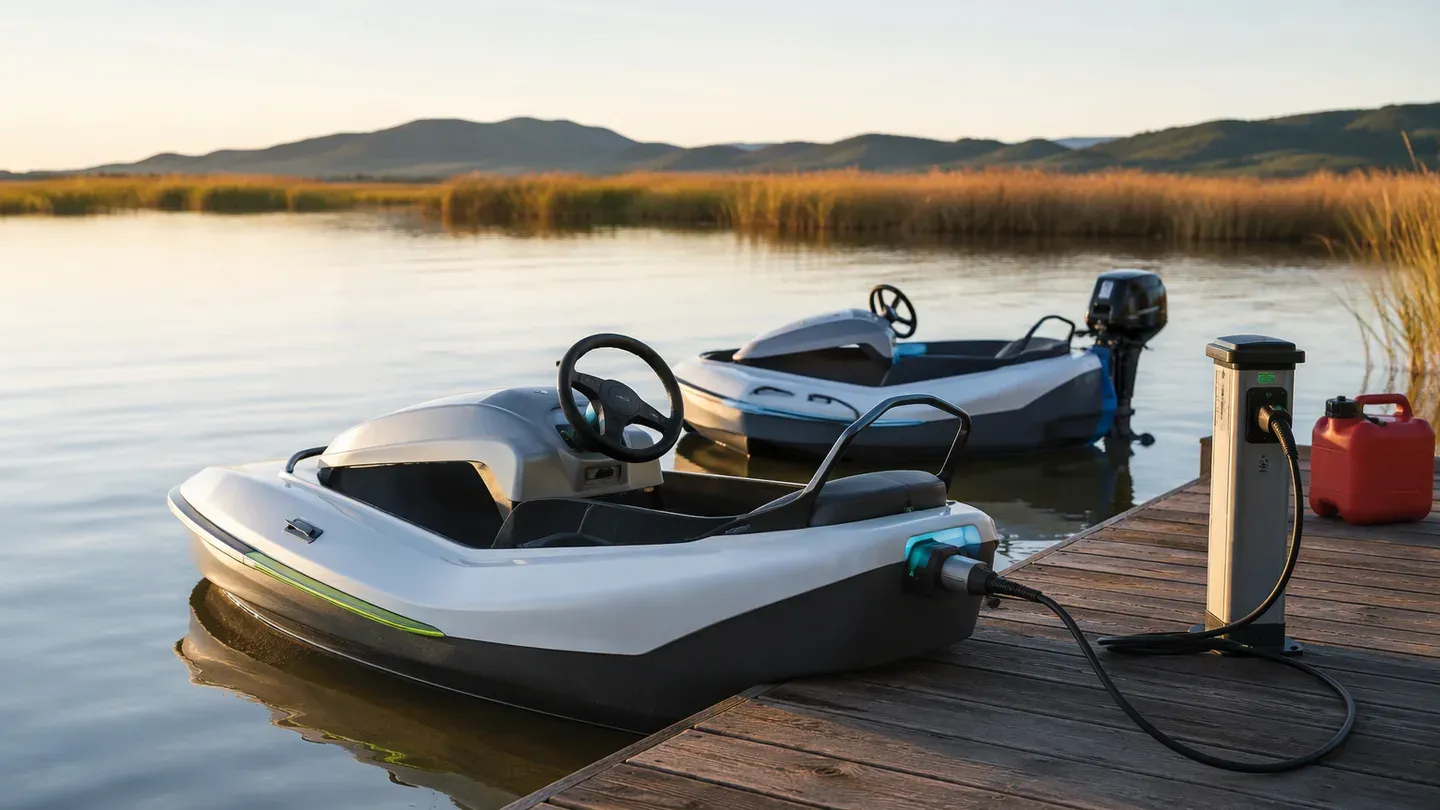
Electric or gas bumper boats in 2026: which way is the market moving?
TL;DR. Gas bumper boats are still sold — J&J Amusements builds the Honda-powered Waterbug — but a US retailer has discontinued its gas Frogger and a US park listed its converted gas fleet for sale. At bumper-boat scale, energy runs about $0.20 per hour on electric against about $1.50 on gas, and five-season cost, not sticker price, should decide the fleet.
Early signals point electric at the distribution level, while gas remains available direct from manufacturers. Gas bumper boats are not extinct. J&J Amusements still builds its Waterbug line in the United States — fiberglass hull, heavy-duty vinyl tube, Honda power — and positions it for commercial high-volume use. What has moved is the supply side: a US boat retailer now lists its gas Frogger model as Discontinued, and a US park that switched to electric has listed its gas boats for sale. At bumper-boat scale, energy runs roughly $0.20 per boat-hour on electric against roughly $1.50 on gas. Operators who model five seasons rather than one sticker price tend to land in the same place. The decision sequence that follows:
- Count your sessions and season hours at your own dock.
- Price both fuels for your site — grid power at the water, or fuel storage and handling.
- Add the maintenance calendars: oil changes, impeller replacement and seasonal service on gas; battery care on electric.
- Compare delivered, duty-paid quotes on the same basis — engine spec included for gas, battery platform for electric.
- Model five seasons including the battery replacement line, not one sticker price.
SinoKartBoat manufactures electric kart boats and bumper boats at its own facility in Guangzhou, China, and quotes factory-direct to water parks, resorts, campgrounds and rental fleets.
What does a gas bumper boat cost, and what does electric cost?
There is no published gas price: gas is quote-only where we checked — J&J Amusements publishes no list price for the Waterbug, and we have not verified published pricing from other gas manufacturers — while electric factory pricing is visible. Any gas number you see quoted in a comparison table is somebody's estimate, not a published figure. Treat it accordingly.
Electric has a visible floor. For 2027 our approved factory pricing sits at $3,600–6,900 per unit across the B2B range, with the SKB-010 single-model configuration at $5,000–6,900; the Incoterm is confirmed at quotation. The bumper boat price guide breaks down the full quote-to-delivered-cost math.
Wider market context, with attribution intact:
Tier | Figure | What it represents |
|---|---|---|
SinoKartBoat B2B factory range (2027) | $3,600–6,900 | Direct factory pricing, Incoterm confirmed at quotation |
SKB-010 single-model configuration | $5,000–6,900 | One configuration, factory direct |
French park equipment-maker quote (Water Play Center) | 23,000 EUR HT | Captured 2026-11-18 |
French park equipment-maker quote (Splash & Play, PRO-35) | 24,000 EUR HT | Captured 2026-11-18 |
French retail quality listing (e-surfer.com/fr) | from 15,000 EUR | Captured 2026-11-18 |
China export platforms | ~2,440–2,803 (platform-display currency, MOQ 1) | Display price, captured 2026-11-18 |
J&J Amusements Waterbug (gas) | Quote only | No public price published |
Those tiers are not the same product with different margins. They differ in hull construction, battery architecture, documentation, spares support and who answers the phone in July. A platform display price is a listing, not a delivered cost.
How big is the electric vs gas operating cost gap?
Roughly seven and a half times on energy alone: about $0.20 per boat-hour electric against about $1.50 gas. This is where the five-season math lives. The buyer-guide ledger for bumper-boat operating economics puts electric energy at about $0.20 per hour and gas at about $1.50 per hour. That is the single most useful number in the decision, because it recurs every session, every weekend, every season, and it does not depreciate.
A named venue puts the gap in revenue terms: Discovery Green in Houston charges $12 per 10-minute session (re-verified 2026-09-16). At that session length, the gas fuel line runs about seven and a half times the electric one every operating hour — a recurring saving on the electric side, not a one-time price move.
Now the honest caveat, labeled as it must be: the widely cited fuel-versus-charge comparison from eBoatDirectory (published 2026-02-14) is a full-size leisure boat reference, not bumper-boat data. It puts a conventional 150–250 hp gasoline outboard at 10–20 gallons per hour at cruise — about $65–130 per hour at $1.70/L Ontario fuel prices — and a 75-hour season at $5,000–10,000 in fuel alone. The same piece puts a comparable electric at 40 kWh, roughly $6 per charge, or 100 kWh at about $15, at $0.15/kWh. Quoting those figures as bumper-boat costs would be dishonest. The ratio is what transfers down the scale, and it points the same direction as the $0.20 versus $1.50 figure at bumper-boat scale.
Cost line | Electric (bumper-boat scale) | Gas (bumper-boat scale) |
|---|---|---|
Energy per boat-hour | ~$0.20 | ~$1.50 |
Fuel logistics | Charging circuit, or battery swap at the dock | Fuel storage, transport, dispensing, spill control |
Routine service items | Battery care, BMS checks, hull and console | Oil changes, impeller replacement, fuel system, seasonal service |
Peak-session downtime | 10-second battery swap | Refuel or return to dock |
Upfront price visibility | Published B2B range | Quote only |
Five-season view | Dominated by battery replacement cycle | Dominated by fuel plus service labor |
If you want the utilization-and-margin side of the model rather than the fuel line, the commercial water kart ROI framework applies the same logic to session pricing and payback.
What maintenance does each type actually need?
Gas needs a service calendar; electric needs a battery routine. The gas routine is well documented for engine-fitted boats: fuel stops, oil changes, impeller replacements, seasonal service. Each item is a scheduled interruption, and interruptions cost more than parts. At Discovery Green's $12 ticket, a boat sitting on the trailer on a Saturday afternoon is revenue you cannot recover on Tuesday.
Electric removes the fuel system, the oil, the impeller and the exhaust from the maintenance calendar. What remains is battery care — charge discipline, terminal inspection, BMS health checks — plus hull and console upkeep. The operational feature that changes the rhythm most is the 10-second battery swap: a depleted pack comes out, a charged one goes in, and the boat returns to the water inside the same session window instead of sitting out until a pack recharges. That is covered in more detail in our note on fleet technology, GPS, timing and battery swap.
On inspection discipline, if you are buying from China and want a third party on the floor: the minimum inspection notice is 48 hours, and in practice you should book about a week ahead so the inspector is present while your units are actually being built rather than before the line starts.
Why are distributors phasing out gas bumper boats?
Four forces are doing the work, and none of them is sentiment.
The catalog signal. DirectBoats.com lists the gas Frogger — 72 in diameter, 40 in high — as Discontinued, stated directly in the page title (retrieved 2026-11-26). When a flagship retailer stops carrying a category, the parts and service tail follows it down, and an operator who buys into a discontinued platform inherits that tail.
Fleet conversion. A US park publicly listed its used gas bumper-boat fleet for sale after switching to electric (Facebook listing surfaced 2026-11-26). That single listing is weak evidence on its own — trend context only, no figures drawn from it.
Venue rules. European lake electrification is spreading, with electric-only rules on inland waters and Verdon in France frequently cited; noise and emission constraints are tightening at urban venues and resorts with lodging close to the water. A gas fleet is a depreciating asset in a jurisdiction that may restrict it inside the asset's service life.
Labor and refueling logistics. Fuel is a task with a trained person attached to it, a storage requirement, and a spill plan. At a campground running two staff across a weekend, that task competes with everything else.
When does gas still make sense?
A comparison that only points one way is a sales document, not an analysis. Gas still wins in specific situations:
- Off-grid venues with no realistic path to a charging circuit at the water, where the cost of running power exceeds the fuel savings over the fleet's life.
- Very high continuous-power duty, where a boat must hold sustained load for long stretches. Electric runtime is regime-dependent and we quote it that way: full speed is about 20 minutes on the 5.5 kWh pack and about 30 minutes on the 8.5 kWh pack, roughly 40 minutes at half throttle, and 90–120 minutes in a slow regime. That is a design characteristic, not a defect — the swap system exists precisely because sessions are short — but an operator who genuinely needs an hour at full throttle is not our customer yet.
- Operators already running a gas service chain — mechanic, parts, fuel supply — for whom the marginal cost of two more gas boats is genuinely low and the switching cost is genuinely high.
The pattern that matters: at a family entertainment center or campground running 10-minute sessions with a dock, gas is usually the more expensive choice over five seasons. On a remote lake with no power and long open runs, it often is not.
How do you specify and order a first electric fleet?
What to put in the specification:
Parameter | SKB series (manufacturer-rated) |
|---|---|
Peak power | 15 kW |
Battery options | 5.5 kWh (72V80Ah) or 8.5 kWh (72V120Ah) |
Runtime, full speed | ~20 min (5.5 kWh) / ~30 min (8.5 kWh) |
Runtime, half throttle | ~40 min |
Runtime, slow regime | 90–120 min |
Battery swap | 10-second battery swap |
Speed modes | H/L dual speed |
Safety | Magnetic kill switch, tilt auto-stop |
Battery protection | BMS 8-level, designed to meet UL2054/UN38.3 |
Hull design life | 10–15 years |
What the warranty does — and does not — cover
Two clarifications operators should hear plainly. First, "designed to meet" is not "certified" — certification status is confirmed at quotation, and you should ask for it in writing rather than assume it. Second, the warranty is motor and controller for 1 year plus battery for 6 months; the hull is discussed as a 10–15 year design life, and that is a design statement, not a warranty term.
The order-to-dock timeline
On order mechanics: roughly 74% of B2B listings on the platform take a single unit and about 26% take two, so single-unit orders are normal in this category; our own MOQ is confirmed at quotation. Production runs 3–60 days, typically 10–35. Sea freight is 30–40 days port to port plus 1–2 weeks door to door. Chinese New Year freezes production for 5–8 weeks, so order 4–6 months ahead of your season and carry 30–40% safety stock on consumables and spares. Lithium packs ship as class 9 dangerous goods, so the UN38.3 report and certified packaging belong on your buyer checklist — that is a shipping requirement you verify, not a claim we make for you. More detail sits in the MOQ and lead time breakdown.
We have been building since 2007, run a staff of about 50 in Guangzhou, and ship to 50+ countries. OEM and ODM work, custom colors and branding, and sample orders are all part of the normal flow.
FAQ
Is an electric bumper boat cheaper to run than a gas one?
Yes, on energy. At bumper-boat scale the comparison is roughly $0.20 per hour for electric against roughly $1.50 per hour for gas, which is the figure that compounds over a season. The fuller answer includes maintenance: electric removes oil changes, impeller replacement and fuel handling from the calendar, so the operating advantage is larger than the energy line alone. Whether that outweighs a higher upfront price depends on your session count and your season length.
What does a gas bumper boat cost to buy?
There is no published answer. J&J Amusements sells its Waterbug line quote-only, so any single gas price quoted in a comparison article is an estimate rather than a list price. Ask for a written quote with the engine specification and delivery terms, then compare it against an electric quote on the same basis — delivered, duty-paid, ready to run.
How long can an electric bumper boat run on one charge?
It depends entirely on the regime, and any vendor who quotes a single runtime number without stating the regime is telling you half the story. On the SKB series, full speed gives about 20 minutes on the 5.5 kWh pack and about 30 minutes on 8.5 kWh; half throttle gives about 40 minutes; a slow regime gives 90–120 minutes. Because a 10-second battery swap returns a boat to the water, runtime matters less than the number of charged packs you keep on the dock.
What maintenance does an electric bumper boat need?
Less than gas, but not none. Expect battery care — charge discipline, terminal and connector inspection, BMS health checks — plus hull, console and safety-switch checks. There is no oil, no impeller, no fuel system and no exhaust to service. The battery is the wear item, which is why the 6-month battery warranty and the pack's replacement cycle belong in your five-season model rather than your first-year budget.
How long does it take to get electric bumper boats delivered?
Production runs 3–60 days depending on configuration and queue, typically 10–35. Sea freight adds 30–40 days port to port, or 1–2 weeks more door to door. Build in the Chinese New Year freeze of 5–8 weeks by ordering 4–6 months ahead of your opening date, and schedule any third-party inspection about a week in advance, since the minimum notice in China is 48 hours.
Can I order a single boat as a sample?
Single-unit orders are the norm in this category — about 74% of B2B listings take one unit. Whether a single-unit sample works for your configuration is confirmed at quotation, as is any custom branding. A sample order is the sensible way to validate build quality, runtime under your own session pattern and the swap workflow before committing a season's capital.
Next step
If you are modelling a conversion or a first fleet, send your session length, boat count and season length to sales@sinokartboat.com or WhatsApp +86 136 3656 3965, and we will quote against your actual duty cycle rather than a headline runtime. If you are still at the feasibility stage, the startup economics walkthrough is a reasonable place to start before anyone sends you a price.
Sources
- J&J Amusements — gasoline bumper boats (Waterbug line, Honda power, quote-only; retrieved 2026-11-26)
- DirectBoats.com — the Frogger bumper boat (gas model, page lists Discontinued; retrieved 2026-11-26)
- eBoatDirectory — gas vs electric boats operating costs (full-size leisure boat reference; published 2026-02-14, retrieved 2026-11-26)
- Discovery Green, Houston — session ticket pricing — re-verified 2026-09-16
- French park-equipment maker quotes, 23,000–24,000 EUR HT per unit — captured 2026-11-18
- e-surfer.com/fr, French retail quality tier from 15,000 EUR — captured 2026-11-18
- China export platform listings, ~2,440–2,803 platform-display, MOQ 1 — captured 2026-11-18
Methodological note
All SinoKartBoat figures are manufacturer-approved and factory-verified; third-party market figures retain their original currency, attribution label and capture date, and the eBoatDirectory cost data describes full-size leisure boats rather than bumper boats and is presented as a reference ratio only.
Lecturas relacionadas
Get a Quote for Your Kart Boat Business
Tell us what you need — OEM/ODM specs, quantity, target market. Our team replies within 24 hours.
Prefer a quick chat?
Chat on WhatsAppFree B2B resources
Buyer guides, ROI calculators, customs checklists, and case studies — built on direct factory manufacturing experience.