E-Foil vs Surfboard vs Kart Boat: Which Sport Wins?
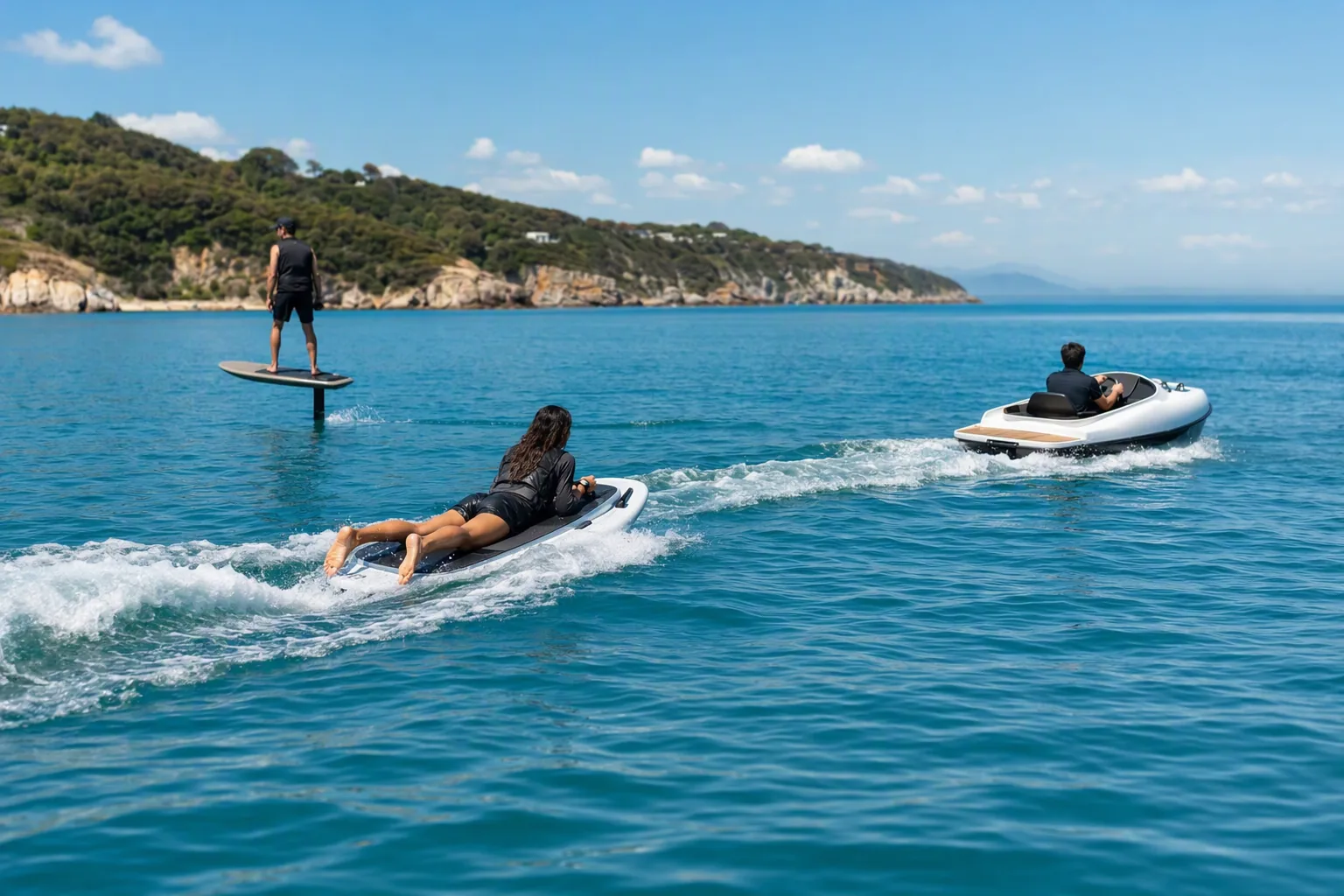
Quick answer: For a venue, "which wins" depends on what you are optimizing. E-foils deliver the most dramatic experience but demand the most skill and the lowest guest throughput. Electric surfboards are accessible and highly photogenic on flat water. Kart boats carry the most guests per hour with the shortest learning curve — which is why family-heavy venues usually start there and add the others as premium tiers.
How Do the Rider Experiences Differ?
The three categories feel so different that comparing them is really about matching sensation to guest profile:
- E-foils lift the rider above the water on a hydrofoil. It is the most magical sensation of the three — and the most skill-intensive. First-timers spend real time on posture and throttle control before the flight feels controlled, which is why e-foil sessions sell as lessons, not walk-up rides.
- Electric surfboards carve across the surface with no wave needed. The learning curve sits between the other two: most guests are riding within a session, but balance still filters out a share of casual guests, and falls are part of the experience.
- Kart boats are seated, stable, and social. A guest controls speed and steering from a secure seat, a safety kill switch cuts power instantly, and first-timers are productive within minutes. The stable hull and seated position are also what make supervised family use realistic — the dimension that matters most to resort and park operators.
Side-by-Side: The Dimensions That Matter to a Venue
Dimension | E-Foil | Electric Surfboard | Kart Boat |
|---|---|---|---|
Rider position | Standing, elevated on foil | Standing, on surface | Seated, in hull |
Learning curve | Steepest — lesson-first product | Moderate — falls expected | Gentlest — minutes to competence |
Guest throughput per hour | Lowest | Medium | Highest |
Staffing & training load | Highest | Medium | Lowest |
Family / child suitability | Limited (skill floor) | Age- and balance-dependent | Strongest (supervised, seated, kill-switch) |
Best water | Deep, open, calm | Flat or small chop | Marked course or sheltered area |
Photogenic story | "Flying" — dramatic | Carving turns, spray | Groups riding together, leaderboards |
Revenue model fit | Premium lesson tiers | Session rental | High-volume sessions, timed races |
The throughput row is the one venue operators underestimate. Two sports can each be profitable at low volume; a family resort deck is never low volume. That single row explains most of the category choices we see in practice.
Which Category Fits Your Venue?
- Resort family deck or water park: kart boats. Highest throughput, lowest training load, and the safety story (seated riders, magnetic kill switch, stable hulls) that lets a family entertainment manager say yes. Session timing and lap racing add a competitive layer that guests pay for twice.
- Boutique resort or premium island experience: e-foils as the upsell. Guests who buy e-foil time are buying exclusivity and a story — pricing per lesson supports the high-touch staffing model. As a standalone attraction, though, the skill floor limits walk-up volume.
- Beach club: electric surfboards as the middle path. Photogenic, accessible enough for most guests, and session-based rental matches the beach-club rhythm of shorter stays and social sharing.
The Answer Is Usually a Mix — With Kart Boats as the Base
In practice, the venues happiest with their lineup rarely bet on a single category. Kart boats carry the volume and the families; e-foils and surfboards layer on as premium or novelty tiers for the guests who want more. The mixed fleet is where most of our venue conversations land: a high-throughput base product funds the staffing and safety infrastructure that the premium tiers also use.
If you are weighing kart boats against gas-powered alternatives rather than other electric categories, our kart boat vs bumper boat vs PWC comparison covers that boundary in detail — including where jet-ski economics start and stop. And once the fleet is in the water, the maintenance guide for rental fleets is the operating manual that keeps all three categories' battery assumptions honest.
FAQ
Which category is easiest for beginners?
Kart boats. Seated position, stable hull, instant kill switch, and steering that behaves like steering. E-foils need the most practice; surfboards sit in between, with balance as the filter.
Which has the highest margin per guest?
E-foils command premium per-lesson pricing, but their throughput is the lowest of the three, so per-guest margin and per-hour revenue tell different stories. Kart boats usually win on revenue per hour of operation; e-foils win on ticket price. Model both against your season before choosing.
Can I run all three categories at one venue?
Yes, and it is a common pattern — but sequence it. Start with the category that matches your core guest flow (for most venues, kart boats), get the safety and staffing systems running, then add premium tiers. Running three categories from day one multiplies training and battery logistics before your operations have proven themselves.
How much water area does each need?
E-foils want deep, open, calm water for the foil to work safely. Surfboards need flat water or small chop with room to carve. Kart boats are the most flexible — a marked course or sheltered area with defined boundaries works, which is why they fit resort lagoons and pools-with-liners that the other two cannot use.
What should I check before mixing categories in one fleet?
Battery and charging logistics first: swapping, charging cycles, and storage differ per category, and mixed fleets multiply the rotation math. Our maintenance guide covers the fleet-side routines that keep any of the three running.
Data Caveats & Sources
- ✅ Category characteristics (rider position, learning curve, throughput ranking, water requirements) are stable, qualitative descriptions of the three product classes, consistent across manufacturer materials and operator discussions.
- ⚠️ Revenue statements (premium lesson pricing for e-foils, throughput economics for kart boats) are directional and venue-specific — model them against your own season length, staffing, and pricing before committing.
- ❌ Deliberately omitted: specific speed, runtime, and pricing numbers (configuration-specific and covered in our motor power and payload selection guide); any claim that one category is universally "best."
Last updated: September 2026. Category fit depends on your venue's guest mix, water, and staffing — talk it through against your actual floor plan.
Get a Quote for Your Kart Boat Business
Tell us what you need — OEM/ODM specs, quantity, target market. Our team replies within 24 hours.
Prefer a quick chat?
Chat on WhatsAppFree B2B resources
Buyer guides, ROI calculators, customs checklists, and case studies — built on direct factory manufacturing experience.